Thoughts, Ideas, Actions for 2026… and Beyond. Part 2.

Last week we looked at ’16 Emerging CRE Tech Trends’; This week we’re going to look at ’10 Foundational Themes’ - capturing the fundamental shifts required for the next decade, and defining the high-level competitive landscape.
1. The ‘Bicycle for the Mind’ Gets an Update
In 1981 Steve Jobs talked about how a computer was like a ‘Bicycle for the Mind’, a tool to amplify our mental capabilities through elegant digital engineering. The computer, like the bicycle, isn’t just a passive tool - it’s an efficiency multiplier that dramatically extends human potential.
Bicycle though no longer feels adequate. In the last 8 years Nvidia’s GPUs (the chips that power most of ‘Planet AI’) have increased in power 1000X. According to the AI Research Company, Epoch AI, by 2030 we are likely to have 1000X the compute capacity that we have today. And R&D benchmarks in many domains are on track to be solved by 2030.
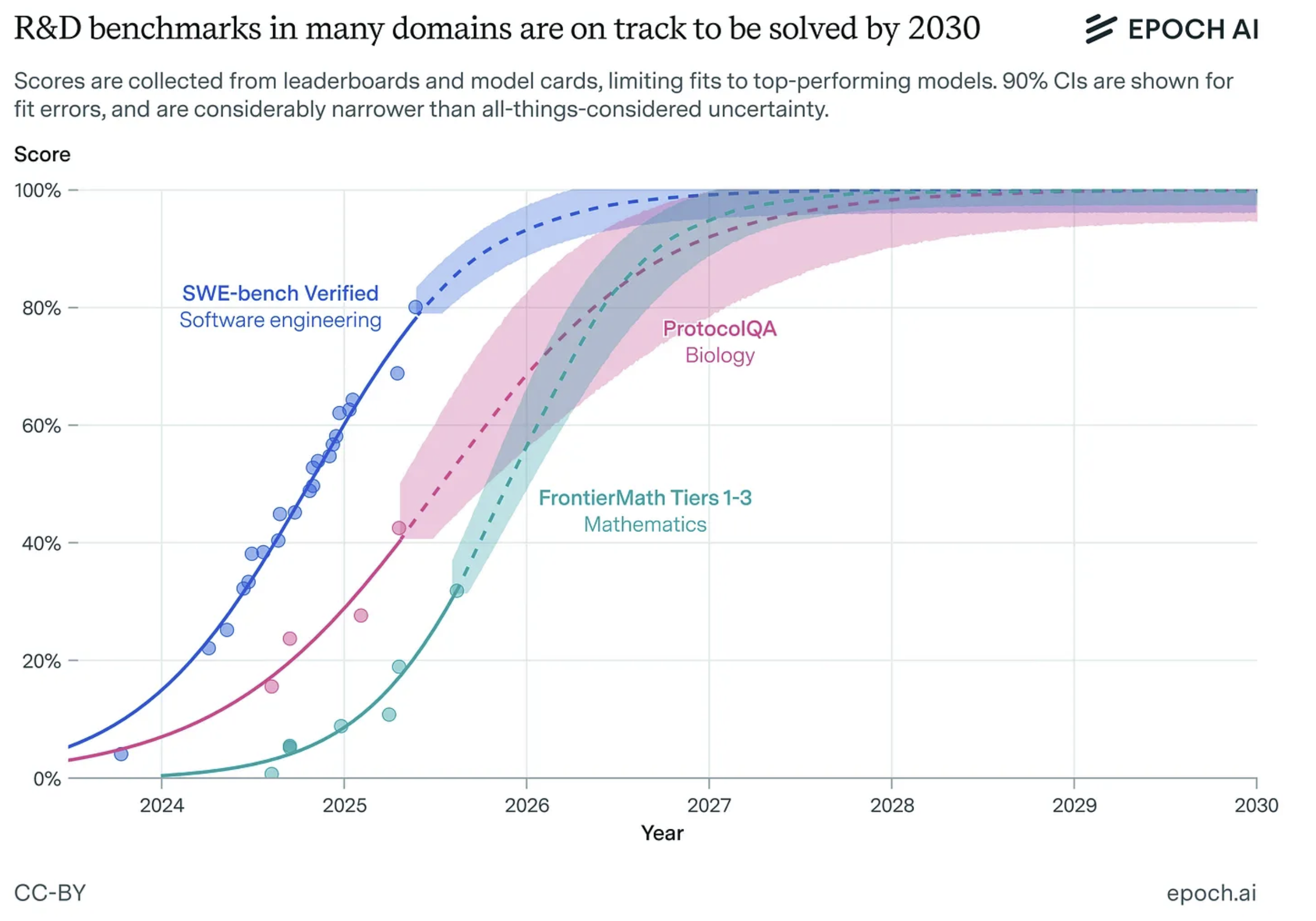
It needs to be foundational in your thinking that this scenario has a high probability of coming to pass, and therefore one must be anticipating what is likely to be possible, rather than over-indexing on current day capabilities. If one takes 9 months to develop a product/service it’s no using basing the specification on what can be done today.
What is arriving sooner than expected is the ‘LLMs as the kernel of a new operating system’ idea put forward by famed AI Research Andrej Karpathy in 2023. This is the concept that instead of needing to program a computer, increasingly one will be able to use natural language to simply ask for what we want. An LLM will be able to interpret this and pull in the necessary specialist tools as required. ‘The hottest new programming language is English’, as he says.
This is going to leave us less as individual cyclists and more as orchestrators of armies of ‘e- bikes’, which we don’t need to pedal, just steer.
Unbundling & Rebundling
There is no question that there are going to be winners and losers in an AI mediated world. Where you end up is largely going to be a function of how well you understand the way AI is going to unbundle and rebundle almost all knowledge work.
Currently each of us has a job, a role. This typically involves a series of goals that we have to achieve in order to fulfil our responsibilities. In turn each of these goals consist of a series of tasks we need to perform, or execute, to fulfil each goal. In effect, this is what every job description is specifying.
As technology develops it can perform ‘some’ of our Tasks. But Goals and Roles are still overseen by Humans.
Over time technology will enable a series of Tasks, that make up specific Goals, to be performed entirely by an ‘AI Agent’. These will be discreet mini applications that are tasked with performing X, and provided with the necessary capabilities to do so.
This means that some tasks will remain as a collection of tasks performed in part by humans, and in part by technology, whereas other goals will be possible to achieve solely through the application of technology. That goal can then be removed from the ‘job description’ and handled separately.
What might also occur is that multiple goals can be fulfilled by pulling from a repository of ‘AI Agents’ that can be combined in ways that enable them to have utility across multiple domains. Maybe with 30 ‘AI Agents’ we can deal with 50, or 100 goals.
Think of it like Lego; with the same pieces we can combine them in different ways and create a multitude of different things.
And this ‘unbundling & rebundling’ process is guaranteed. Either wilfully, or by having it imposed on us by changing circumstances.
The process is also how we will be able to fully leverage AI. One cannot simply bolt on AI to existing processes and expect transformational outcomes. Many are doing this, but already we have plenty of research showing it does not work.
We don’t need to add cream on the top of our cake - we need to bake a new one!Fast, Agile, Ultra-Productive Superteams
We are seeing the emergence of small, highly skilled teams leveraging AI augmentation to achieve exceptional productivity, challenging the size and speed of traditional large firms. Whilst the meme about ‘Single Person Unicorns’ is probably over-egging it we are already seeing various software companies, such as Midjourney, Cursor, Lovable, with dozens of employees by hundreds of millions in ARR.
Software is of course perfect for leveraging AI, more so than other industries, but there is enough evidence of quite dramatic bumps in productivity at the team level, to take this seriously.
At a corporate level achieving high productivity gains is harder and slower, due to the usual ‘Normal Technology’ …frictions: slow organisational and institutional change, the need to redesign workflows and incentives, regulatory and safety constraints, and the simple fact that deep adoption demands far more than merely making powerful tools available.
But for startups, or scale-ups, these don’t apply, and the ability of new companies to outperform incumbents is dramatically increased by AI.
Over the next two years I envisage many incumbents suddenly coming up against these new entities… and losing out.
Here’s a possible CRE example:
The “Capital Sniper” Team (Investment & Acquisitions)
The Old Way: A Head of Acquisitions manages an army of Junior Analysts. They manually read IMs, input data into Excel, and take 2 weeks to screen a deal.
The Superteam (2-3 People): One Senior Deal Maker + One Data Architect + A fleet of AI Agents.
The Workflow: AI Agents ingest every listing instantly, extracting data and running it against the firm’s investment thesis.
The Advantage: They don’t look for deals; the deals are surfaced automatically. They underwrite 500 deals a week, not 5.
Expect a few ‘Code Reds’ to be issued.Removing Friction and Enabling Discovery
Jeff Bezos said in 2021 that he thinks less about what’s going to change and more about “What’s not going to change in the next 10 years?”—because you can build a business strategy around things that are stable in time.
In commercial real estate, I’d posit that “Removing Friction and Enabling Discovery” will be forever constant. Our customers want to do what they need to do painlessly, and based on the best possible information.
But to understand why this matters now, we need to recognise a deeper shift: real estate has moved from being a Bond to being a Business.
The 25-year lease with upwards-only rent reviews is largely dead. The “lock up and leave” operating model is over. Our customers are now our users, not just our investors - and for investors to achieve the returns they want, we must put user interests first. The smart money has recognised this as opportunity, not threat: today, you can differentiate yourself like never before.
Friction has been endemic to our industry. Jargon-filled leases. Inflexible terms. Manual processes for payments, access, and visitor management. Opaque pricing. Poorly designed spaces that don’t support actual work.
Meanwhile, “enabling discovery” means making it easy for people to find what they need: seamless access to information, personalised experiences, data-driven insights, and spaces designed for serendipitous connection.
Technology, especially AI, is the key. But the level of service now required cannot be delivered economically through humans alone. Automating the “human touch” authentically, rather than robotically, is becoming a superpower for real estate operators.
The industry is at a liminal point. Removing friction and enabling discovery are the foundations upon which the winners will build.
Redefining ‘what is the best affordable option?’
In business, the quality of service we receive is directly tied to what we can afford - and the same applies to the quality we provide. Every service operates within defined price points: pay more, get more. For decades, this has created a clear divide between those who can afford premium offerings and those limited to more basic options.
Generative AI is going to upend this apple cart. It is going to redefine what is meant by ‘affordable’. In terms of the services you receive, or the services you supply. In short, it is going to massively redefine ‘the best affordable option’.
Many services that were previously ‘White Glove’ - only available to the richest and most prestigious companies - are going to be commoditised and made available to all. When financial models take 2 hours not 2 weeks to develop, when research takes 1 hour instead of 1 month, and when software apps are deliverable in 6 days instead of 6 months, the economics and dynamics of markets totally change.
This could mean services are no longer profitable to deliver, if kept as ‘White Glove’ ones, but if repositioned to be sold to a much larger market that did not exist at the old price points, the game changes entirely.
At the core, AI is going to be, in many cases, ‘the best affordable option’.
Outcomes as a Service (OaaS)
The limitations of the pure SaaS model are becoming apparent. While SaaS democratised access to powerful software, it left the burden of achieving results squarely on the client. Companies purchased subscriptions, but the responsibility for implementation, adoption, and tangible improvement remained with them.
AI changes the equation. Software alone is not enough - the operational landscape now requires software, plus data wrangling, AI implementation, analysis, and definable outcomes. Most buyers don’t want to orchestrate all of this; they just want X to perform according to A, B, and C.
Consider the difference between subscribing to an energy management platform and partnering with a provider who guarantees a specific percentage reduction in energy consumption, with fees tied to achieving that target. That’s OaaS: selling outcomes, not access.
In CRE, this might mean committing to specific tenant satisfaction scores, delivering guaranteed sustainability metrics, or ensuring space utilisation hits agreed benchmarks - with payment contingent on results.
This shift will force transformation on the supply side. PropTech companies will need new roles, such as ”Outcome Managers,” “Value Engineers”, and new pricing models: performance-based fees, risk-sharing agreements, value-based pricing tied to realised benefits.
Who’s positioned to win? Existing PropTech players have the technology but must build service capabilities. Specialised startups can focus on niche outcomes. And the large CRE services firms, JLL, CBRE, Cushman & Wakefield, have the client relationships and industry knowledge, but face the classic Innovator’s Dilemma: can they cannibalise existing revenue streams fast enough?
Increasingly, selling outcomes, not software, will be the norm.
#HumanIsTheNewLuxury
This has been my theme of the year. As the world gets ever more AI-mediated, it will actually be human skills that command premium value.
We humans tire of technology remarkably quickly. We strive to acquire the next big thing, are in thrall to it briefly, then become bored. It wasn’t long ago that maintaining a phone signal in a car was hit and miss; now we rage when 4K streaming drops at 80 mph. As Shania Twain put it: “Okay, so you’re a rocket scientist / That don’t impress me much.”
Technology will move into the background, powering much of what happens around us, but given no more thought than a light switch. What we’ll pay for is what sits on top: experiences that delight, connections that feel authentic, craftsmanship that carries the mark of human hands.
In a world of mechanical perfection, we will actively seek out imperfection. The imperfect will be unique; the perfect, a commodity. Think vinyl versus CD - the CD is technically superior, but vinyl speaks to your soul.
For real estate, this points in specific directions: high-touch concierge services where AI provides the insight but humans deliver the experience; curated spaces that reflect human judgment, not algorithmic optimisation; community-centric developments that foster genuine connection; relationship-based transactions for deals that matter.
To be clear, being a great human with great human skills won’t be enough. Each of us will need to be AI Fluent, orchestrating technology while creating and curating the intensely human experiences that constitute “work.” This is not a call for Luddism; it’s a demand for the kind of skill that makes everything look effortless.
The challenge will be making this the norm, not just a luxury.
Evolving Real Estate: Form, Purpose, Location
“We shape our buildings, and afterwards our buildings shape us.”
If we want to benefit from the themes discussed here, we need the right real estate. Churchill was explaining how our internal environment shapes us: form, purpose, and location matter. Real estate is an input to whatever output is created within it.
Technology now enables us to do “Everything Everywhere All at Once.” RTO mandates fail because they fight against the tide of technology. The world of everyone in the office, five days a week, is fundamentally a pre-internet construct - it’s just become clearer as capabilities have developed.
So what matters when pervasive AI means “the machines” are doing much of our work? I’d argue for six pillars of human-centric real estate:
- Health & Wellbeing: Environmental quality - lighting, acoustics, temperature, air quality - directly affects cognitive function. Get this right and you enable people to perform at their best.
- Ergonomics & Comfort: Physical quality designed for actual use, by actual users.
- Technology Integration: Seamless, friction-free - not ten minutes getting the AV to work before every meeting.
- Community & Connectivity: Over the next decade, this becomes THE purpose of commercial real estate. Everything else gets offloaded to machines. Why else would we commute except to do what we cannot do elsewhere?
- Flexibility & Adaptability: Sam Altman has a sign above his desk: “No one knows what happens next.” If he doesn’t know, nobody does. Billions of square feet have already outlived their product/market fit. We must create spaces people can reconfigure.
- Sustainability: Non-negotiable and foundational.
But form is only part of the story. Purpose is shifting: we don’t NEED an office to work, or a shop to shop - we have to be made to WANT them. And location is morphing: Central Business Districts are becoming Central Social Districts.
Beyond individual buildings, four broader shifts are coming:
- Decentralised hubs: The biggest agglomeration of talent is now on the internet. Distributed working is the future; real estate must supply to this demand.
- Micro-locations: Hyper-local, mixed-use developments with deep understanding of customer wants and needs.
- Transportation-responsive design: Autonomous vehicles are here - “just not evenly distributed.” When we don’t need parking, what happens to all that space?
- Fluid space allocation: A curb as delivery zone in the morning, rideshare pickup in the afternoon, restaurant seating in the evening. 24 hours in a day - use them.
- Whoever truly understands the drivers of successful spaces and places will make fortunes. And vice versa.
#SpaceasaService loves Generative AI
This grew out of a feeling that the same characteristics that make a company embrace #SpaceasaService are the ones that make them active adopters of Generative AI. Both are fundamentally creative movements, looking to enable humans and machines to work together to produce things neither could achieve alone.
And as it happens, a new study (’Employee Centricity in an AI World’) by BCG and Columbia University confirms this:
“Employee-centric organisations are 7X more likely to be AI mature compared to orgs who are beginning/emerging in employee centricity.“
And: “The same capabilities needed for successful flexible (hybrid) work arrangements—transparent communication, focusing on outcomes over activities, cross-functional coordination—are also crucial for effective AI transformation.“
The implication for real estate strategy is significant. We’re likely heading toward a market that looks like this:
- Top 15-20%: Large multinationals with in-house scale to create exceptional workplaces in exceptional buildings.
- Next 40-45%: #SpaceasaService - either through high-quality flex operators or by having operators run their buildings for them. CBRE’s acquisition of Industrious suggests this is now a core strategic bet.
- The remainder: Shrinks, goes fully distributed, or disappears. There is no future for low-to-medium quality commodity office space.
If 30-40% of existing office stock is already obsolete or heading there fast, the question becomes: which side of this divide are you positioning for?
As I’ve been saying all year—mindset matters.
We Need a Bigger Pie
You’ve heard the saying: “AI won’t take your job - someone using AI will take your job.” This is dangerously misleading. It implies 1:1 displacement - your job goes to another person who’s better with tools. This ignores the maths of leverage.
AI doesn’t just make workers better; it makes them exponentially faster. If one asset manager equipped with AI agents can perform the underwriting, market analysis, and reporting work of five junior analysts, the remaining four jobs aren’t “taken by someone using AI.” They simply evaporate.
The fundamental flaw focuses on the survivor and ignores the displaced.
In a stagnant macroeconomic environment, efficiency gains result in headcount reduction, not output expansion. The absolute certainty is this: AI means we will need fewer people to achieve our current level of output.
Which means we need a bigger pie.
But how? Not through efficiency alone - that just concentrates gains among fewer people. We need genuine expansion: new industries, new markets, new categories of value.
AI is already unlocking markets that were previously inaccessible. Language translation enables global reach; analytics reveal untapped customer segments; personalised services that once required armies of staff become viable at scale. Barriers to entrepreneurship are falling - smaller players can now compete with established enterprises through AI-powered automation.
And we need to rethink value itself. In an AI-augmented economy, intangible assets, data, knowledge, creativity, curation, take on heightened significance. Companies must move beyond efficiency gains and reimagine what constitutes value when intelligence is increasingly commoditised.
Without intentional effort, AI risks concentrating wealth among a small subset of individuals and companies. The bigger pie only matters if more people get a slice.
Surveys show that employees in the West are anxious about AI while the C-suite remains optimistic. There is a major disconnect, because employees understand the incentives. For a certain type of management, AI is a zero-sum efficiency tool. It takes a different mindset to see it as a growth catalyst.
So what’s required?
- Businesses must embrace AI for expansion, not just cost-cutting.
- Policymakers must create frameworks that encourage responsible innovation and workforce transition.
- Individuals must invest in skills that complement AI, creativity, judgment, relationship-building, and assess whether their organisation sees AI as growth engine or headcount reducer.
The next decade will determine whether AI-driven prosperity is broadly shared or narrowly concentrated. That’s a choice, not an inevitability.
Conclusion
These ten themes are not predictions to debate but a roadmap to a destination that’s largely certain. The precise route will vary, by sector, by firm, by individual circumstance, but the direction of travel is clear. AI will unbundle and rebundle knowledge work. Small teams will outcompete slow incumbents. Human skills will command premium value precisely because everything else becomes commoditised. Real estate will either serve human needs brilliantly or become obsolete.
The framework is deliberately flexible. You don’t need to act on all ten themes simultaneously. But you do need to understand how they interconnect, because they will shape the competitive landscape whether you engage with them or not.
What makes this moment different from previous technology transitions is the speed and the scope. We’re not adapting to one new tool; we’re adapting to a new substrate for all knowledge work. That’s daunting. But it’s also genuinely exciting. The organisations and individuals who approach this with curiosity rather than fear, who see growth rather than just efficiency, who invest in human capability alongside technological capability - they will thrive.
Work could be, in almost every way, better and more fulfilling in an AI-fluent world. We remain the apex species. These are super-tools, and it is for us to use them in ways that are positive and life-enhancing.
The destination is a bigger pie, more human-centric spaces, and work that plays to our distinctly human strengths. The road there is ours to choose.