Without a bigger pie, AI means fewer, better people.
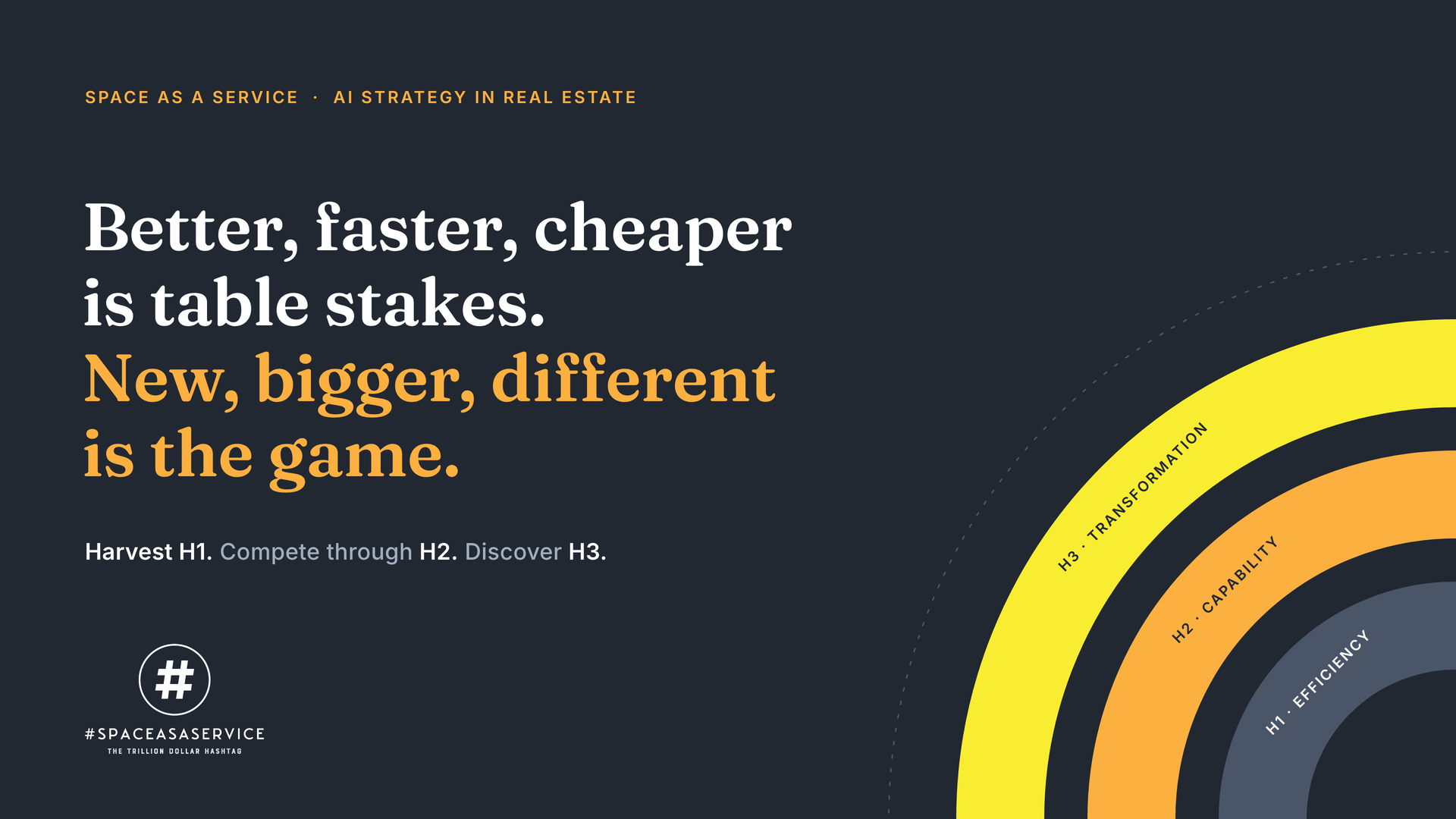
Almost every AI initiative in real estate is aimed at doing today’s work more efficiently. Widely shared efficiency is a condition of competing, but without a bigger pie it is also the road to a much smaller industry.
“New tech collapses old constraints. Once a constraint disappears, the logic of competitive advantage and business model design must be reimagined from first principles.” - Sangeet Choudary
I have spent much of this week reading about AI adoption. A major BCG survey. A thoughtful industry roundtable on change management. A widely shared letter on the future of property management. What struck me was the gap between what the evidence now says and what the conversation keeps doing with it.
Executive Summary: AI efficiency will not, by itself, produce durable advantage: as widely available tools make existing workflows cheaper, much of the gain passes to clients and technology providers, and, unless demand expands, fewer people will be required. Real advantage lies in H2: using collapsed costs to sell services and capabilities that were previously uneconomic. Harvest H1. Compete through H2. Discover H3.
THE ADOPTION REFLEX
BCG’s latest AI at Work survey, of nearly 12,000 employees, is close to my own position. Organisations using AI to reshape workflows end-to-end, or to invent new business models, have nearly doubled in a year, from 22% to 42%, and they report more value and happier people than those merely deploying tools. BCG’s advice to CEOs is to invest in redesigning work, and to stop buying more tools.
The revealing part is what happened when that finding reached the industry conversation. It was translated, almost instantly, back into the familiar language of adoption: sponsorship, guidance, governance, citizen developers, data trust, training. All necessary. All useful. And all of it answering the same question: how do we absorb AI into the business we already have? The workflow is treated as fixed. The deliverable is treated as fixed. The business model is treated as fixed. All that is up for discussion is speed.
Which is the tell.
ALMOST EVERYTHING IS H1
In my RIRA process I use three horizons. H1 is efficiency: the same work, done faster and cheaper. H2 is capability: things that were either impossible before, or possible but never economically viable. H3 is transformation: the workflow, the deliverable or the business model redesigned outright.
I should be precise about the claim, because it is easy to over-egg. Some workflows are genuinely H1-only, and I say so every time I teach. Not everything is an H3 in waiting. And nobody needs to bet the firm on full transformation this quarter.
The claim is narrower and, I think, harder to dodge: scan the industry’s actual deployments and almost everything is H1. Faster lease abstraction. Quicker IC papers. Cheaper reporting. The current workflow assumed to be absolute, with intelligence poured into it like a faster engine into the same chassis.
Timidity is the wrong diagnosis. Most people have simply not joined the dots on what comes next, and so are not managing for it. That is a failure of foresight, and foresight is a governance duty.
WHY H1 CANNOT BE THE WHOLE STRATEGY
Two dots, joined.
The first is economic. H1 done well is real work, and it can stick: proprietary data, deep integration, fast organisational learning and unusually good execution all turn generic tools into embedded capability. Toyota’s competitors could buy the same machinery. The Toyota Production System was another matter. But where the gain comes from applying a widely available tool to a standard workflow, competition redistributes it: clients take it as lower fees, model providers take it as margin, and the firm keeps it only briefly. Efficiency you share with all your competitors is a cost of staying in the game. H1 can make you competitive. It cannot tell you what to compete on.
The second dot is Choudary’s, in the quotation above. Every workflow in this industry was designed around a scarcity: documents were expensive to read, analysis was expensive to produce, expertise was expensive to access. Those constraints are the ones collapsing. And when a constraint collapses, the opportunity appears precisely in the space it used to fence off: everything that was never impossible, merely uneconomic. That space is H2, and it is enormous.
FEWER, BETTER PEOPLE
AI will make us more efficient. It will make economically viable much that never was. And it will enable things entirely new. But efficiency on its own carries a consequence the industry keeps stepping around: without a bigger pie, we will need fewer, better people.
Take that widely shared property management letter, guest-written by the CEO of a US national operating platform. It is one of the better things published on the subject this year, and it gets a great deal right: managers elevated into genuine asset managers, and a potential new market drawn from America’s 87 million owner-occupied homes, which professional management has never economically reached. That is real H2 thinking.
But its own numbers point somewhere its conclusion refuses to go. Traditional operators, it says, run roughly 100 units per person; AI-forward operators already run up to 200 per employee. If the top of that range becomes the norm, employment holds only if the number of managed units, or the depth of service provided to each one, grows at comparable speed. The letter leans on Jevons, the Victorian economist who observed that more efficient steam engines led Britain to burn more coal. But Jevons describes demand for the resource, and the resource here is management capacity, which AI now supplies. Lower costs may well unlock new demand. Somebody still has to design the service, find the customer and persuade them to buy.
Jevons is a prize, and it has to be earned.
GO ALL IN
Accept that arithmetic and the rational response writes itself: go all in. Use this technology to become a demonstrably better company than your peers. Better data, better judgement, faster learning, lower cost, and above all new things to sell.
All in on what, exactly? On the objective, and the objective is the pie. Harvest H1 to fund the work: those efficiencies are real money, just rarely durable advantage. Compete through H2, where capability is scarce and yours to shape. And let H2 experiments reveal where H3 lives, because transformation is discovered through redesign, never declared in advance.
Worst case, the pie stays flat. The market thins, and yours is one of the firms still standing, taking share from competitors who spent the decade giving the 2019 business a lick of paint. Best case, this new capability does what technology has done in wave after wave before it, and grows the pie, and you are positioned to take more than your share of a bigger market.
You do not need to forecast which future arrives.
The same strategy wins in both.
WHAT GOING ALL IN ACTUALLY MEANS
You cannot H3 by declaration, and you cannot H2 from the town hall stage either. This is a granular game: take one material workflow, unbundle it into tasks, ask which of its assumptions are scar tissue from constraints that no longer exist, then rebundle around what the customer is actually buying. Then the next workflow, and often several together, because value crosses their boundaries. This is the entire premise of RIRA: Release, Imagine, Redesign, Actualise.
And aim, at minimum, for H2. Does lease abstraction stay a cheaper abstract, or become portfolio intelligence: every obligation in every lease, continuously legible? Does underwriting stay a faster IC paper, or become underwriting everything: the whole investable universe screened as a matter of course? Does property management stay a ticket queue, or become a service valuable enough that affluent owner-occupiers, from a universe of 87 million homes, choose to buy it?
Right now, the industry is funding the first half of each of those sentences.
HOW YOU WILL KNOW
It is my belief that within five years the divergence will be visible in revenue mix. The firms that went all in will be earning meaningful income from services that did not exist in 2025. The H1 firms will be running the 2019 business at 2019 fee levels, minus the compression. If that divergence fails to appear, I will have been wrong about the size of the opportunity. I do not expect to be.
Better, faster, cheaper is table stakes. New, bigger, different is the game. And which game you are playing is entirely down to you.