Stop automating the company you have. Start designing the company you need.
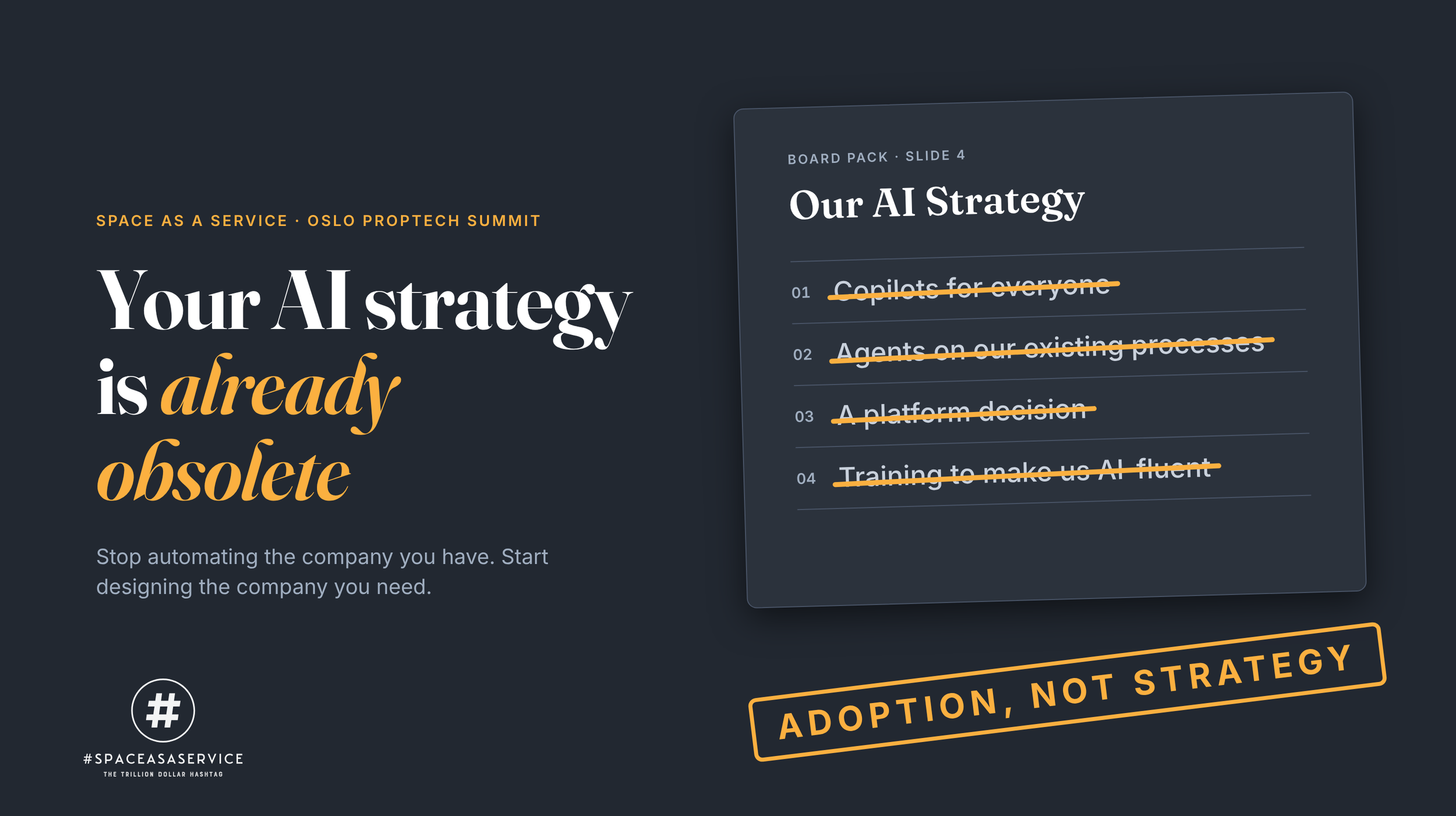
Last Wednesday I spoke at the Oslo PropTech Summit, a brilliant day in the Glasshallen. The talk took aim at the AI strategies most real estate companies have now written, and asked what should replace them. Below is the argument, developed in full.
Executive summary. Most CRE AI strategies are adoption programmes: copilots, agents on existing processes, a platform decision and training. They are useful, but they speed up the existing company without asking whether it is still the right shape. The alternative has three parts. Redesign like a founder: rebuild workflows, then the organisation, around what customers buy, so that every piece of work produces both a result and a more capable company. Score like an investor: ask separately whether a real buyer will pay and whether a better-placed player can take the position. Build to change: own a small, durable core and keep everything around it swappable, because nobody knows which future arrives.
YOUR AI STRATEGY, ON ONE SLIDE
I opened with a slide most of the room could have written. Four bullets:
Copilots for everyone
Agents on our existing processes
A decision on which platform to buy
Training to make us AI-fluent
Every item is defensible, several are necessary, and a company doing all four well is ahead of most of its peers. Put them together, though, and what you have is an adoption programme. It answers “how do we use AI?” and leaves alone the question a strategy has to answer: what will customers pay us for once the constraints that shaped our business have gone?
Efficiency programmes can be hard work to deliver, but they ask nothing of the business model. The org chart, the service promise and the fee basis all survive; the same work just takes fewer hours. And when every competitor can buy the same copilots and agents, using AI becomes the entry ticket. The edge has to come from somewhere else.
These strategies are obsolete, rather than merely incomplete, because they rest on a hidden premise: that the existing company is the right unit to optimise. That premise held while reading every document was expensive, analysis took weeks and expertise was scarce. Those were the constraints most CRE firms were built around, and they are going.
THE FIVE-YEAR QUESTION IS RIGHT
The better boards have started asking a different question: what does this company look like in five years? It is the right question, with three powerful sub-questions.
What will customers still pay for, once the commodity parts of the service cost almost nothing to produce?
Where does judgement matter, and until when? The second half matters as much as the first. As I argued in “Human Judgement Has a Timestamp“, the line between what needs a person and what doesn’t moves every few months.
What do you know that others don’t? Your data, your decision history, your relationships, your understanding of particular buildings and particular customers.
The danger lies in working backwards from a single answer. Nobody knows which five-year future will arrive. Pick one forecast, plan back from it, and you end up with a plan that only works if that forecast is right. Customer needs change far more slowly than technology does, so design around one of those, then test the design against several quite different futures and see where it breaks.
The core argument of the talk fits on three lines:
Redesign like a founder. Score like an investor. Build to change.
THE GROUND HAS MOVED
Before redesigning anything, be clear about who you are competing with, because the cast has changed. Five types of player now compete on the same ground:
Frontier labs: generic reasoning that improves every time the models do
Deployment companies: the repeatable, configurable middle, packaging that reasoning for common jobs
Incumbent systems: the systems of record beneath the work, now extending upwards into it
CRE operators: distinctive workflows built on their own context
Startups: the painful systems of work that customers can’t sensibly build alone
The fourth line changes most for a real estate audience. Your customer used to be the user of your product and its purchaser. Now they may also build their own alternative and compete for the value you hoped to capture. As the cost of building software collapses, the build-or-buy calculation that governed PropTech for fifteen years flips for a whole class of work. As CRE practitioners you have a new rule: build what is uniquely yours, buy what is not.
Every real estate firm is now both a PropTech customer and a PropTech.
Plenty of landlords will never write a line of code. All of them are now making a build-or-buy decision about their own workflows, and choosing to buy everything is a decision too. But the smart landlords are building. Vendors are being built around.
REDESIGN THE WORK
You can’t redesign a company by declaration. You redesign it one workflow at a time, taking specific workflows apart and putting them back together around what the customer actually buys. The method I use is RIRA.
Release. Which constraints has AI removed, and which has it added? Most firms only look at the first list.
Imagine. What was impossible? What was uneconomic? This is where you deliberately aim past efficiency. “How do we do this for less?” is rarely the useful question. “What could we now offer that we couldn’t before?” usually is.
Redesign. Rebundle tasks, roles and handoffs around what the customer buys, rather than around the order in which work used to have to happen.
Actualise. Put the redesigned workflow into operation: bounded, tested and recorded. Bounded means permissions, limits on what runs automatically, and clear rules for escalation. Tested means checking the workflow against real cases before trusting it, then measuring whether it works once live. Recorded means every judgement gets a source, a date and an owner.
Then you go round again. Actualise feeds back into Release, because the frontier moves and because outcomes tell you which of your assumptions were wrong. RIRA is a loop.
Release deserves more time than it usually gets. On the loosened side, AI has collapsed four costs that shaped CRE business models: the cost of reading every document, of producing analysis, of reaching expertise and of building software. Each of those once justified a layer of the org chart or a line in the fee.
The added constraints get less attention, and they are where firms get hurt:
Checking work you didn’t produce. Verification becomes a core skill, and a cost.
What your suppliers learn from you. Every tool you use is also observing how you work.
Accountability for decisions AI shaped. The committee still signs, and it now needs to know what it is signing.
A frontier that moves every few months. Any division of labour you settle on is provisional.
TWO MAPS, TWO JOBS
Once a workflow is taken apart, two maps help put it back together. They answer different questions. The first decides how each task should be performed and supervised. Place every task, rather than the whole workflow. I sort tasks on two axes: whether the work is cognition or plumbing, and whether its output is verifiable or hard to verify. That gives four zones.
Human-led strategic (cognition, hard to verify): asset strategy, the house view, negotiation. AI acts as challenger; a human decides.
The Karpathy Frontier (cognition, verifiable): benchmarking, scenario analysis, cost modelling. Named for Andrej Karpathy’s observation that AI most readily automates what can be verified. Evidence-based agents do the work; humans review it.
The Messy Middle (plumbing, hard to verify): supplier exceptions, occupier requests. Automate the core; people handle the exceptions.
High-ROI automation (plumbing, verifiable): lease data, critical dates, reconciliation. Straight-through processing, with checks.
The boundaries run through individual documents. Generating reminders from validated critical dates is verifiable plumbing. Deciding what a break clause actually requires of the tenant is interpretation: it carries legal risk and belongs with a person. The same lease sits in two zones depending on the task.
Every placement needs a date on it.
Better AI doesn’t automatically turn cognition into plumbing. What changes is how reliably the machine performs a task and how much human review it needs, and better evidence or a redesigned workflow can make an output easier to verify. A scenario model that needs a careful human check this autumn may need only a spot check by next summer. An undated placement never gets checked, and declines in value rapidly.
The second map decides what to buy, share or keep. Every workflow resolves into three bands. Plumbing is the mechanical work that is largely the same at every firm. Judgement is your method, your house view, your decisions and what happened next. Between them sits the overlap: systems of work every firm needs and none should build alone, such as market data, valuation conventions and shared definitions.
A WORKED EXAMPLE: SELL, HOLD OR REFURBISH?
To make this concrete, take a decision every owner faces: should we sell, hold or refurbish this asset?
Run the three bands over it:
Plumbing: lease events, cash flows, the arithmetic. A tool that does this, with its assumptions and workings open to inspection, is now cheap to build, for you and for every competitor.
The overlap: market data and valuation conventions. Mostly bought or shared, and rightly so.
Judgement: the owner’s objectives, the house assumptions, the questions that break the ranking, and what actually happened afterwards. Yours, if you learn from it.
The tool is copyable. What you learn with it can be yours alone.
That qualifier, if you learn from it, carries the whole argument. Owning your judgement and having good judgement are different things. A house view can preserve a firm’s biases as faithfully as its expertise, and a decade of confident hold recommendations proves nothing until someone checks how those assets actually performed. The advantage comes from the mechanism: write the assumptions down, compare them with outcomes, improve the method. A firm that does this learns faster than one that doesn’t, and it keeps what it learns. Either half on its own is worth far less.
The bigger prize lies in what the redesign lets you sell. Today an asset manager delivers asset strategy periodically: an annual business plan, a quarterly report, a paper when a lease event or an offer forces the question. The analysis is expensive to assemble, so it happens when it has to.
Once the evidence is kept current, the service can change shape. Decision support becomes continuous, with review triggered by the events that matter: a break notice, an unsolicited offer, a capex quote, a move in the debt markets. The same team can cover more assets without thinning the attention each one gets.
And it may open a market. It is my belief, argued in “From Boardroom Privilege To Baseline Utility“, that the larger opportunity lies with owners for whom serious asset strategy has always been uneconomic: the private owner with a handful of £5m buildings, the family office, the local authority. Cheaper production makes the service affordable. Whether it is good enough, and whether those owners will pay and can be reached at sensible cost, are viability questions to test.
That is a different company, with a different service promise, different coverage and potentially a different charging basis. Which is the point.
REDESIGN THE COMPANY
Follow the same asset-strategy workflow into the organisation and the existing structure starts to look odd.
Work. Today, information is assembled periodically for an investment paper. Redesigned, evidence is kept current and review is triggered when something material changes.
Roles. Today, analysts assemble, specialists contribute and seniors review. Redesigned, agents keep the numbers current while a small team challenges the assumptions and owns the decision.
Handoffs. Today, requests pass sequentially between teams. Redesigned, everyone works from shared evidence, with a named owner for each assumption.
Decision rights. Today, routine decisions wait for committee. Redesigned, set limits govern routine action, with escalation for consequential calls.
Learning. Today, papers are filed and lessons live in people’s heads. Redesigned, assumptions are compared with outcomes and the method is updated for the next team.
Junior analysts existed in such numbers because gathering and checking evidence was slow. Committees existed partly because evidence arrived in a lump and had to be judged in one sitting.
If the evidence can be kept current, why is the organisation still built around assembling it?
My answer, set out at length in “The Company After the Pyramid“, is small teams with explicit authority and shared capability:
Commitment Owner: authorised to decide, and answerable for it
Autonomous Professionals: own substantial parts of the work, improve the method and teach
Resident Learner: owns something that matters, such as the evidence behind one leasing assumption
System Architect: turns how we work into Skills, connections and tests a machine can run
Two of these deserve a note. In the old pyramid, juniors worked their way up by assembling things for other people. The Resident Learner instead owns a piece of evidence and answers for it. That brings responsibility, a feedback loop and direct exposure to consequences: when the leasing assumption proves wrong, it is theirs, and they see why. Those are the conditions under which judgement gets built. The System Architect role can start with one strong crossover person, someone who understands both the business and the tools and is often already on the payroll. As the spine grows, the role will grow with it.
Your position becomes the outcome you own and the authority you’ve earned.
What holds these teams together is the capability spine. I’ve written a full piece on how to build one, so briefly, it has six parts:
Trusted data and context, under your own definitions
Written, tested methods: your Skills and agents
Authorised connections to live systems
Evaluations that show where the human–machine line sits today
Decisions and outcomes, recorded
Relationship memory
Own the spine. Rent everything around it. Models, tools and suppliers sit on top and stay swappable, so next year’s better model plugs into the same spine.
Every consequential piece of work therefore has two outputs: value for the customer or the asset today, and a more capable company tomorrow.
Which raises an awkward question for nearly every incentive scheme in the industry. If you reward only this year’s production, who builds next year’s capability?
PROTECT THE POSITION
The three bands also tell you where to defend and where to cooperate, and the same map reads differently depending on which side of the table you sit.
A landlord or investor should rent the plumbing and keep it swappable. In the overlap, partner, and agree explicitly who keeps the learning. And own the judgement: write it down and record the outcomes.
A vendor should sell the plumbing beneath the customer’s edge. In the overlap, become the shared system while letting the customer keep its reasoning. And support judgement without owning it: the customer keeps its objectives and can see the reasoning behind any recommendation.
“Own the judgement” can sound like a ban on buying expertise. Specialist suppliers legitimately provide analytical judgement all the time: a valuer’s opinion, an energy model’s recommendation, a market forecast. What a company must keep is narrower: its objectives, its accountability for the decision, and the record of what it decided and what happened next. Buy all the analysis you like. Keep hold of the pen on why you chose.
The test for every supplier relationship comes down to one question:
Is the thing you depend on also the thing capturing what makes you you?
I’ve called this the toll and the amputation. A toll you can pay. An amputation you can’t undo. A supplier charging for plumbing is levying a toll. A supplier whose system quietly accumulates your methods, your assumptions and your decision history, in a form you can’t take with you, is doing something else entirely.
The smartest firms on both sides are designing for the same overlap. Pool the learning about common work. Keep the learning about your judgement.
SCORE LIKE AN INVESTOR
Whether you are deciding what to build internally, which vendor to back or where your own business is exposed, two questions need asking, and they need scoring separately. This is the logic behind my weekly Build/Back analyses.
Viability: is there a real, reachable buyer whose pain matters?
Owner: does one role feel the pain and sign for it?
Trigger: is there a clock forcing a decision?
Budget: does it displace a cost they resent, or create enough value to justify new spending?
Distribution: is there a realistic route to them?
Price: will they pay enough to cover delivery?
Defensibility: can a better-placed player take or absorb this position?
The incumbents: can the systems already in place easily extend into it?
The models: can a general-purpose AI easily replicate it?
The customer: can an in-house team easily build its own?
The third threat is the new one, and the one most PropTech pitch decks still skip. Survive all three and the position is hard to take. Survive none and it is exposed, whatever the pitch deck says.
Cross the two answers and you get four positions:
Build or back: a real buyer with owned pain, and a position that survives all three threats. This earns serious commitment and further diligence. It doesn’t settle the price, the valuation or whether the team can execute.
Defensible but stranded: clever, hard to copy and nobody’s budget.
A distribution play, clock ticking: real revenue, no moat. The returns can be perfectly worthwhile; what they lack is durability. Fine to harvest, dangerous to value as though it will last.
Don’t: no moat and no buyer. The kindest finding of all, because it stops anyone wasting another penny.
Never average the two scores. A 90 for defensibility and a 20 for viability averages to 55 and describes a stranded asset. And date every score, for the same reason you date every task placement: the models move, and a position that looked safe in the spring may not be by Christmas.
BUILD TO CHANGE
We asked for flexible buildings for twenty years and got open plan.
We are about to ask for flexible AI and get a single-vendor platform.
In both cases the flexibility on offer was the freedom to do one thing in slightly different ways. Real flexibility is the ability to change what the thing is for, at a cost you can bear.
So for every commitment, whether a model, a data store, a method, a supplier contract or a team design, ask four questions:
What change must it accommodate?
How quickly?
At what cost?
With how much disruption?
Then decide which options are worth paying to keep open. Optionality always costs something: abstraction layers, portable data, second suppliers. The point is to choose which flexibility you buy, rather than discovering three years in that you bought none.
Lego works because the studs are standard: anyone’s brick fits anyone else’s. Your studs are shared definitions, interfaces and permissions: what a “lease event” means in your data, how your systems talk to each other, who and what is allowed to do what. Standardise those and everything above them becomes replaceable. Your methods and your learning are what you build with them, and those are what you keep.
WHAT TO DECIDE ON MONDAY
An AI strategy isn’t an IT strategy. It’s a company strategy. Redesign the work. Redesign the company. Build for a future none of us can predict.
That takes decisions only the leadership of a company can make. Three would get you started:
Which customer outcome do you redesign first? Pick one where the product itself could change: sold differently, or to more people, as well as done faster.
Who has the authority to change the work? Redesign stalls when the person running the pilot can’t touch roles, decision rights or the fee basis. Give someone that authority, and make them answerable for it.
Who makes sure the company learns? Someone has to own the spine: the recorded assumptions, the outcomes, the updated methods.
That last one matters most. If learning is everybody’s job, it will be nobody’s.
And a company that doesn’t learn will find whatever strategy it writes next is already obsolete too.