The Office That Earns Its Rent
Buildings that can prove they deliver for occupiers
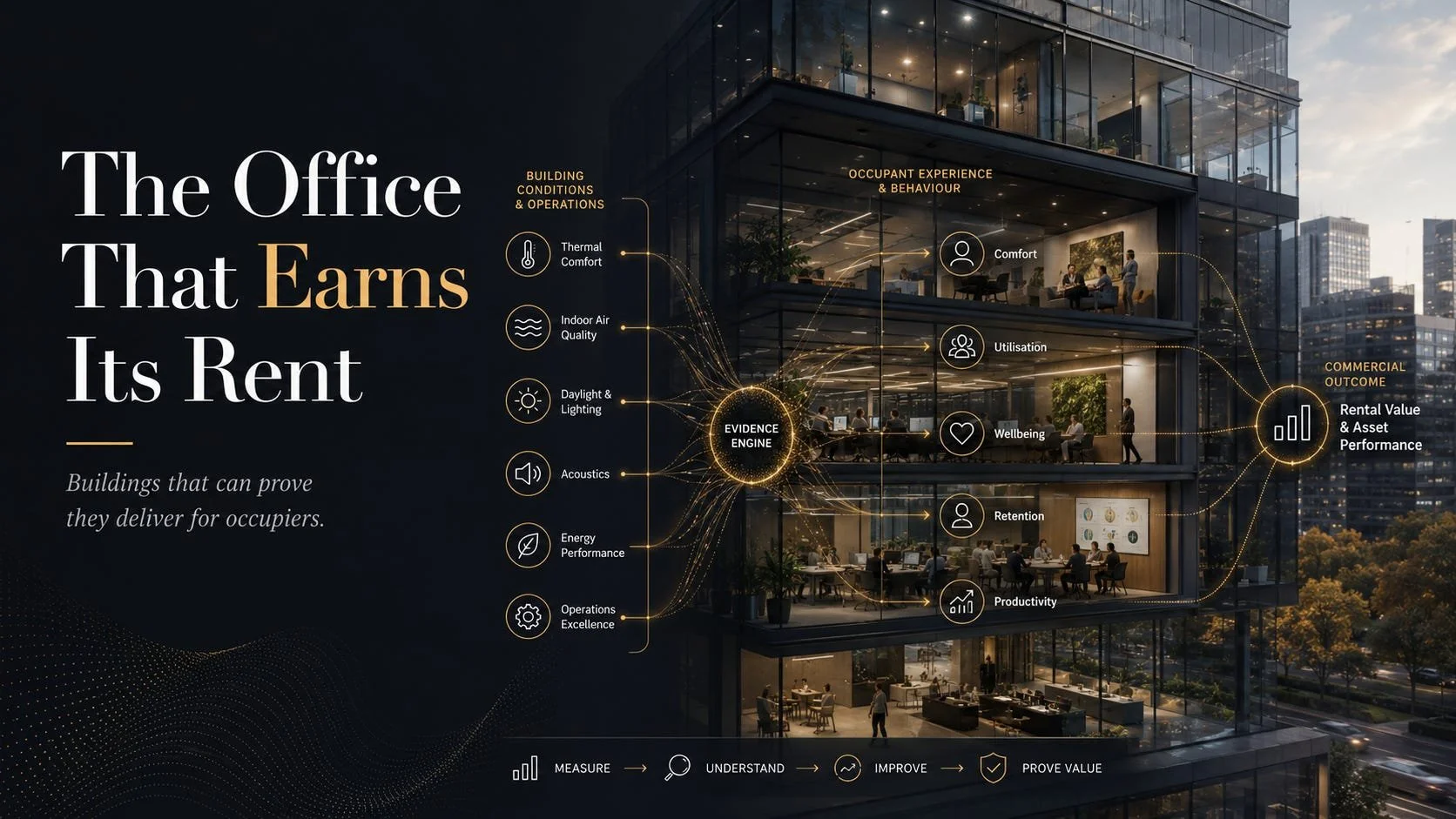
Smart buildings optimise. Causal buildings prove. The next office advantage is not a smarter thermostat or a slicker tenant app: it is a building engineered to prove, causally, what it does for the people and businesses inside it. The capital that could build it is not yet pointed at it, and the players racing into AI cannot own it, which is exactly why it is still a moat.
There is a debate running through commercial real estate about how to wire up a building’s data: sensors or business systems, one cleaned central store or a layer over what you already have. I have sat with it for a while and come to think it is the wrong argument, or at best a second-order one. In a market culling offices that cannot justify their rent, the question is not how you plumb the data. It is what you are trying to build with it.
The short version. The industry is arguing about data architecture when it should be asking what the data is for. A building set up properly for AI can answer three escalating questions: what is happening, why it is happening and what happens if I intervene, and what to do about it. The hard part is causation, and it is half-solved already: physics-based control handles the engineering side and is now buyable; the commercial side, whether the building causally drives rent and retention, is the prize, and it is a portfolio capability that institutions are uniquely placed to own. Incumbents do not build it because their incentives forbid it, and even the new AI consortia arming the industry leave it untouched. The model is a commodity. The causal substrate is the moat, and it is most valuable retrofitted into the ageing offices fighting for their lives.
Two years ago I argued that real estate’s future was to become a Maven: not a passive provider of space but an active facilitator of human success, judged on outcomes: productivity, wellbeing, the things people actually come to an office for. I stand by every word. But a Maven makes a promise it has had no way to keep. It claims to improve the people inside it; ask it to prove that, causally, to a tenant weighing a renewal or an investor setting a price, and it goes quiet. The causal building is how the Maven keeps its promise.
THE ARGUMENT ABOUT PLUMBING
The current debate is narrower, and a long way from that promise. Strip away the jargon and it is an argument about plumbing. One camp wants a building’s intelligence to come from its own sensors and equipment: the data at the ‘edge’. Another wants it wired together from the business systems you already run, the leasing and accounting and management software: the ‘APIs at the core’. Beneath that sits a second quarrel about whether you haul everything into one clean central store or leave it where it lives and build over the top.
Plumbing matters. But choosing a side in it does not, by itself, give you intelligence, and it is downstream of a better question: what would a building look like if it were set up, deliberately, to produce causal evidence about what it does to the people inside it, and to act on that evidence?
Call it the causal building. Not a ‘smart’ building, the connected-automated-efficient-pleasant thing the industry has promised for thirty years and the best new towers now deliver. A building that works as an evidence engine. It knows not only what is happening and what will happen, but why, and what changes if it acts. And it can prove it to an audit committee.
THREE QUESTIONS A BUILDING SHOULD ANSWER
There are three kinds of AI doing the rounds, and they are not interchangeable. They make escalating demands, and a building set up properly answers all three:
Analytical AI answers what is happening, and what will happen. Prediction, anomaly detection, the energy curve. This is the commodity layer.
Causal AI answers why it is happening, and what happens if I change something.Explanation and counterfactual. This is where the money is.
Generative AI answers given all that, what should we do, and can you do it. The interface, and the hands.
Almost every ‘smart building’ on the market answers only the first. It senses, predicts and optimises beautifully, and stops there. The value, and the difficulty, climbs with each step. Causation is the one the industry has skipped.
THE CAUSAL PROBLEM IS HALF-SOLVED
Here is the good news, because the causal question sounds impossibly demanding and is not. It splits in two.
The engineering half, energy and comfort and the behaviour of the plant, is governed by physics, and a physics model is already a causal model. It knows that opening the damper moves the air without having to run an experiment to find out. Correlation has to be taught; physics comes knowing. Troy Harvey’s PassiveLogic is the clearest example: a physics-based digital twin that runs autonomous control at the edge and infers what it cannot directly measure. You can buy a version of this, or build a generic one with decades-old model-predictive control. Either way you specify engineering causality. You do not invent it.
The commercial half is the prize, and no physics will help you. Does comfort causally lift renewal? Does a floor’s configuration causally raise the tenant’s own productivity, and so their willingness to pay? These are questions of cause and effect in human behaviour, and they need experiments: matched floors, staggered rollouts, the boring discipline of logging every intervention and its result. The methods are standard econometrics. What is scarce is the will to use them.
In practice it looks like product experimentation pointed at space. One floor runs an altered lighting or thermal regime while a matched floor holds steady; an amenity change goes to one building and not its twin; every intervention is logged against the things that actually move money, renewal risk, utilisation, complaints, helpdesk tickets, sentiment. The aim is not laboratory perfection. It is disciplined comparison, repeated across enough assets to learn faster than the market.
A single building cannot run good experiments; a portfolio can. Scale, which usually buys you nothing but procurement leverage, here buys a causal-learning advantage no rival can copy without the same fleet. Better still, the autonomous control that delivers the engineering half is the very instrument that makes the commercial half feasible: a building that can hold a variable exactly, or vary it cleanly across two floors, is a controllable experiment. The thing everyone wants for energy is the thing that lets you finally answer the questions that move NOI.
There is a red line, and it is not optional. This works at the level of the floor, the cohort, the tenant and the portfolio. It does not work, and must never work, at the level of the named employee. The moment the causal building becomes workplace surveillance dressed as building intelligence it is unlettable, and rightly so. The trust architecture matters as much as the data architecture: consent, aggregation, governance.
WHY JP MORGAN STOPPED SHORT
If this is so valuable, why is it not being done? The answer is structural.
The brokers are disqualified by their own model. JLL has Hank, a genuinely capable autonomous-HVAC platform; CBRE runs Smart FM across a billion square feet with its Nexus data platform and Ellis AI assistant. Both are excellent at the analytical and automation layers, and their research arms make causal-sounding claims all day: the green premium, the flight to quality, the amenity that lifts rent. But that is market-level correlation sold as advice, the average across everyone’s buildings. It is not an owned, instrumented engine that proves what this building does to these tenants. And a broker has little reason to build that: the deep, asset-specific version is the client’s moat rather than its own, sits on an asset it may lose at the next tender, and needs commercial data owners guard. The broker’s economics reward the opposite, a shallow benchmark spread across a billion square feet. Useful, but not the same thing.
The more telling case is JPMorgan’s new headquarters at 270 Park Avenue: thousands of sensors, AI trimming light and temperature in real time, solar shades wired to the HVAC, all-electric and net-zero. JPM owns it, occupies it, and holds every scrap of commercial and workforce data needed to close the causal loop. A caveat: I am reading this from the outside, from what is public, so take it as inference, not fact. JPMorgan may do more behind closed doors than it says. But the public story is sustainability, intelligence and prestige, not causal proof of how the building changes the people and the business inside it, and a firm that had built the evidence engine would be telling that story. One of the most expensive and ambitious corporate headquarters ever built, and on the public record it still cannot show you whether the building earns its keep. It built the most advanced energy-and-experience building on earth, not the most advanced evidence building, because the causal-commercial question is nobody’s job. Buildings get commissioned against carbon, air quality, daylight, amenity and cost: legible, certifiable, defensible. Causal social science on your own workforce is messy and politically fraught, so even a firm with near infinite money defaults to the certifiable.
The gap, then, is not technology. The apex buildings are stuffed with technology. It is framing and incentive. The industry defines a smart building as connected and efficient and pleasant, and operates inside that definition brilliantly. The causal building asks a different question, and the brokers’ economics and the occupiers’ incentives both point away from it.
AI DID NOT GIVE YOU THE ANSWER
A fair challenge: hasn’t generative AI changed all this? It has, in one half and not the other.
Much of the optimisation was always possible and shamefully neglected; AI just removes the alibi by making it cheap. What is genuinely new is that frontier models can finally read the commercial half of the building, the leases and contracts and reports that were locked in PDFs, which is what lets you join how a building behaves to what it earns. That, plus agents that can act rather than merely build dashboards, is the real change.
But the causal core is the one thing AI does not hand you. A frontier model is the most articulate pattern-matcher ever built. Ask it why your renewals are sliding and it will give you a fluent, confident answer stitched together from correlation. Fluent is not the same as right. That is ‘workslop’ at the level of analysis. Causation comes from physics or from experiments, never from the model alone. AI is the connective tissue and the interface. It is necessary, and nowhere near sufficient.
The people building the biggest AI bets agree. In May, Anthropic launched a $1.5bn venture with Blackstone, Hellman & Friedman and Goldman Sachs to embed engineers inside portfolio companies and rebuild their workflows, with real estate named as a target. Days later OpenAI stood up a $4bn-plus ‘Deployment Company’ to do much the same. Their pitch is that the model alone changes nothing: the value is in the deployment and the redesign around it. They are right, and proving my point at scale. They will hand the whole industry the commodity workflow layer. But their incentive is to sell workflow transformation, not to build you an owner-controlled evidence substrate for your own portfolio, and you should think hard before renting your operational intelligence from a consortium whose anchor is one of the largest landlords on the planet. Rent the model. Own the substrate.
WHO THIS IS ACTUALLY FOR
It is not for everyone, and the reason is the holding period. Offices change hands every five to ten years on average, and the commercial-causal payoff matures over a lease cycle. If you are a three-year value-add buyer, do the energy layer that pays for itself and stop there.
For everyone else it stands up. It is built for the long-capital owners and the owner-occupiers, the pension funds and insurers and sovereign wealth and the firms that sit in their own buildings for decades: the natural owners of prime office, not a fringe. The right unit of return is not the building but the portfolio capability, which compounds across assets and outlives any single hold. It rests on a hypothesis, and I will flag it as one: that the market will learn to price causal proof of performance the way it learned to price energy, where green moved from unpriced to a measurable premium with a brown discount for the laggards. I think that bet is sound, and the early mover helps set the price rather than pay it.
If this were in everyone’s interest it would already be commoditised and worth nothing. It is precisely because the short-hold majority cannot justify it, and the brokers err away from it, that the long-hold owner who acts captures something durable. The misalignment is the moat.
And it is not only for new towers; the opposite is true. A shiny headquarters lets on prestige and need not prove it earns its rent. It is the commodity 1990s and 2000s office, staring down obsolescence, that most needs to prove its worth, and the substrate retrofits into exactly that building as a defence against it emptying. The hardest case is where the thesis pays best.
WHAT GREAT LOOKS LIKE
The perfect office is not the one with the most sensors or the cleverest app. It is the one that can prove what it does to the people inside it, built on a data substrate you own, with the frontier model as a commodity bolted on top and swapped out whenever a better one arrives. This is the Maven I described two years ago, finally handed the one thing it lacked: the means to prove itself. It is #SpaceAsAService with the evidence attached, and it is where ‘Human is the New Luxury’ stops being a slogan and becomes a number you can defend.
The technology is here. The methods are mature. The excuses are running out. What is missing is the will to treat a building as something that learns, and whether your buildings ever do is entirely down to you.