
THE BLOG
10 Themes for the Next Ten Years - No 6

Number 6: Outcomes as a Service - Beyond Software to Solutions
“Outcomes as a Service represents a shift from simply providing software or tools to delivering comprehensive solutions that guarantee specific results.”
This statement encapsulates a burgeoning hypothesis that promises to fundamentally reshape the technology landscape, particularly in industries like CRE.
Why SaaS Isn’t Enough Anymore
The traditional Software as a Service (SaaS) model, while revolutionary in its own right, is increasingly seen as a stepping stone to a more outcome-focused future.
This future is defined by Outcomes as a Service (OaaS), a paradigm shift where the value proposition moves beyond access to software and towards the guaranteed achievement of specific, measurable business results.
Driven by the demand for tangible value and empowered by advancements in Artificial Intelligence, particularly the emergence of sophisticated AI Agents, OaaS is poised to become the dominant model, profoundly altering the supply side of industries like PropTech.
The limitations of the pure SaaS model are becoming increasingly apparent. While SaaS democratised access to powerful software and streamlined operations, it often left the burden of achieving desired business outcomes squarely on the shoulders of the client.
Companies purchased software subscriptions, but the responsibility for successful implementation, user adoption, and ultimately, achieving tangible improvements, remained with them.
How AI and IoT Make OaaS Possible
OaaS addresses this gap directly. Rather than just providing a tool it offers a comprehensive solution, often combining software, hardware, services, and expertise, with the explicit commitment to deliver predefined business results.
The fundamental issue with Software as a Service is that in an AI mediated world there are things beyond just software that matter. With AI we need to understand what is possible, what data is required, how to collect it, how to cleanse it and then how to apply models to it that give us the outcomes we desire. It’s complicated. The number of moving parts has multiplied and a wide range of skills are needed to orchestrate a complete solution.
Software alone won’t get us where we want, and need, to go. And actually, we don’t want the process, we want the outcome.
It’s the difference between subscribing to, say, an energy management platform, and partnering with an OaaS company who will guarantee a specific percentage reduction in energy consumption, with their fees directly tied to achieving that target.
Other examples might be:
Tenant Satisfaction Assurance: Committing to specific tenant satisfaction scores
Sustainability Outcomes: Delivering specific environmental performance metrics
Space Utilisation & Optimisation: Ensuring efficient use of space based on agreed metrics
This is the essence of OaaS – a move from selling (or buying) access to software to selling (or buying) tangible, measurable outcomes.
And several factors are converging to make OaaS the logical next step beyond SaaS.
Crucially, the demand for demonstrable Return on Investment (ROI) from technology investments is intensifying. Businesses are no longer satisfied with the promise of efficiency; increasingly they are demanding quantifiable improvements to their bottom line. Not least of all because, (whisper it quietly), they don’t know how to get the best out of all the software they’ve signed up to. We all know that installing software is one thing - getting your people to use it effectively is quite another.
But it is also because other technologies have matured and we now have access to IoT devices spitting out copious data points that have to be analysed in order to accurately measure and track progress towards specific outcomes. Our ‘Smart Buildings’ are outsmarting us!
The big push though is the new reality that AI is defining. We now have algorithms that can analyse massive datasets, identify patterns, predict future outcomes, and proactively optimise systems to achieve predefined goals. But …. it’s all very complicated.
On top of which we’re now seeing the emergence of AI Agents – autonomous software entities capable of performing complex tasks with minimal human intervention – and these are opening up whole new worlds of opportunity. Which, again, we mostly don’t understand but ‘know’ will be transformative.
These agents can continuously monitor building performance, adjust settings, even interact with tenants or building systems in real-time to drive specific outcomes like optimised occupancy or enhanced tenant satisfaction.
For example, an AI agent could dynamically adjust HVAC settings based on occupancy patterns and weather forecasts to minimise energy consumption, or proactively address tenant requests to improve satisfaction scores. This level of proactive, intelligent automation makes the delivery of guaranteed outcomes increasingly feasible and scalable. If only we had a way to get it all working.
Enter the OaaS providers. The ‘middleware’ if you like, between the technology and desired destination.
The Shift for PropTech Companies
It’s not just the demand side though that will be affected by all of this. The fundamental shift from selling software to selling outcomes will necessitate a dramatic transformation on the supply side, particularly for current PropTech companies. Their existing organisational structures, pricing models, and overall business models will need significant overhauls to effectively deliver on the promise of OaaS.
Organisational Changes Needed
First, organisational structures will need to evolve beyond feature-driven development and sales. Sales teams will need to become adept at understanding client business objectives and translating them into quantifiable outcome targets.
New roles, such as "Outcome Managers" or "Value Engineers," will become crucial, responsible for defining, orchestrating, and ensuring the delivery of agreed-upon outcomes. This will require strong project management skills, a deep understanding of both the technology and the client's business, and the ability to collaborate effectively across internal teams.
Data science and analytics will move from a supporting function to a core competency, critical for measuring progress, demonstrating value, and continuously optimising solutions.
Customer success teams will transform from reactive support providers to proactive partners, focused on driving adoption and ensuring clients achieve their desired results.
New Pricing Models
Secondly, the traditional pricing models of current SaaS companies will be disrupted. The predictable recurring revenue of subscription-based pricing will likely give way to more complex, performance-based models. We will see an increase in:
Performance-based pricing: Fees directly tied to the achievement of specific outcomes (e.g. a percentage of cost savings, a fee per successful tenant placement).
Risk-sharing agreements: Vendors share the financial risk, potentially taking lower upfront fees with larger payments contingent on achieving predefined targets.
Value-based pricing: Pricing reflects the perceived value delivered to the client, directly linking costs to the realised business benefits.
This shift will require PropTech companies to develop sophisticated methodologies for measuring and tracking outcomes, along with robust contractual frameworks that clearly define the responsibilities and liabilities of both parties.
Evolution of Business Models
Finally, the overall business model will need to evolve from being primarily a software provider to becoming a comprehensive solution provider.
The software itself will become an enabler, but the true value will lie in the integrated suite of services, expertise, and partnerships that guarantee the delivery of outcomes.
This implies a significant increase in investment in areas like consulting, implementation, data analysis, and ongoing support.
PropTech companies will need to forge long-term, strategic partnerships with their clients, moving beyond transactional relationships to collaborative ventures focused on achieving mutual success. This also necessitates building ecosystems of partners to cover the diverse expertise required to deliver a wide range of outcomes.
What’s Next for the CRE Industry?
The question then becomes: who will be best positioned to capitalise on the OaaS opportunity? Several scenarios are plausible:
Evolving Existing PropTech Companies: Some companies are beginning to experiment with outcome-based elements (Salesforce with their Agentforce service - Intercom with Fin, their customer support bot), though I’ve not seen it yet in PropTech. But they possess the core technology and understanding of the CRE industry. To succeed with OaaS, they will need to invest heavily in building out their service capabilities, developing robust data analytics infrastructure, and forging strategic partnerships.
Emergence of Specialised Startups: We are likely to see the rise of new startups specifically designed to deliver niche outcomes within the CRE space. These agile companies can focus on specific problem areas and build deep expertise in delivering those particular results, potentially becoming acquisition targets for larger players.
CRE Professional Services Firms: Established players like JLL, CBRE, and Cushman & Wakefield possess deep industry knowledge, extensive client relationships, and a strong understanding of client needs. They are uniquely positioned to integrate technology into their existing service offerings and offer comprehensive, outcome-based solutions. They could achieve this by developing their own in-house PropTech capabilities, acquiring promising startups, or forming strategic partnerships with existing technology providers. But, as history tells us, this is easier said than done. Particularly the adjustment to new core business models. How much of an ‘Innovators Dilemma’ does this constitute?
Ultimately, the future of technology in commercial real estate is likely to be shaped by a combination of these forces.
We may see the emergence of "ecosystem orchestrators" – potentially the larger CRE service firms or some of the more forward-thinking PropTech companies – who build platforms and cultivate partnerships to offer a broad spectrum of outcome-based services.
Regardless of who leads the charge, the shift towards OaaS would seem to be inevitable.
It represents a fundamental re-evaluation of value, placing the focus squarely on tangible business results and ushering in a new era of partnership and accountability.
It is an example of ‘Human + Machine Synergy’ - where new technologies enable things that were not possible before but maximising the potential requires a deep integration of human and computational capabilities. The very best outcomes will not be achieved by automation, but by a subtle blending of the quantitative with the qualitative.
We are humans after all.
Next Steps
If you’re curious about how OaaS might transform your business or want to share your experiences, let’s start a conversation. Your insights could shape the future of this paradigm shift.
10 Themes for the Next Ten Years - No 5

Number 5: Redefining 'what is the best affordable option?’
‘AI is not just making existing services more affordable; it's enabling access to high-quality services and products that were previously out of reach for many.’
We hear a lot about the downsides of Generative AI. It’s just a ‘Stochastic Parrot’, a plagiarism machine, a regurgitator of ‘average’. And, of course, ‘it’s not as good as a human’. And there are degrees of truth in all of this. But in a business context it all misses the point. Which is ‘can you afford better?’.
In business, the quality of service we receive is directly tied to what we can afford—and the same applies to the quality we provide. Every service operates within defined price points: pay more, get more. For decades, this has created a clear divide between those who can afford premium offerings and those limited to more basic options.
Generative AI is going to upend this apple cart. It is going to redefine what is meant by ‘affordable’. In terms of the services you receive, or the services you supply. In short, it is going to massively redefine ‘the best affordable option’.
In seven key ways:
1. Accessible Expertise: Generative AI-driven tools enable expert-level analysis and services at a fraction of conventional costs, making capabilities once reserved for large enterprises or high-net-worth individuals accessible to a much broader audience. Although these insights might not always be perfect, they are often “good enough” for immediate operational decision-making—and can then be refined through human oversight where needed. This opens the door for smaller companies to provide such things as strategic advisory at scale, low cost legal and compliance services, as well as rapid prototyping.
2. Generative AI as ‘Infinite Interns’: Think of these tools as a limitless pool of junior-level support—tirelessly parsing data, generating drafts, performing research, and handling repetitive tasks. This offloads routine work from expensive human resources, who can instead focus on higher-value activities. Think of using AI for research & data aggregation, customer service & lead qualification or content generation.
3. Co-intelligence Augmentation: Rather than treating Generative AI and humans as separate or competing entities, co-intelligence augmentation emphasises collaborative problem-solving. AI handles large-scale pattern recognition, humans handle strategic oversight, judgement, and creativity, resulting in solutions that neither could achieve in isolation. An example might be AI generating proposals optimised for energy efficiency or occupant wellbeing, with human experts refining for aesthetics and regulations.
4. New Product Enablement: Generative AI’s ability to rapidly analyse, adapt, and improve, can lower barriers for products and services that were previously too resource-intensive or complex to develop. By automating high-cost processes, AI frees budgets and human resources for innovation and experimentation. Dynamic pricing, space as a service marketplaces, new categories of health-focused living and working environments - what might we conceive of with a little more time to think?
5. Democratisation of Luxury: Previously exclusive, high-end experiences can now be delivered at scale through AI-driven operational efficiencies. By automating costly service components, businesses can offer premium experiences to broader market segments at more accessible price points. What might be possible in areas like personalised virtual experiences, or concierge services?
6. Scalable Personalisation: Generative AI can process large amounts of data about individual customers, tenants, or partners, allowing companies to deliver tailored offerings at a mass-market scale. This merges the best of mass production (cost efficiency) with the best of customisation (unique user experiences), opening up opportunities for exceptional tenant-focused solutions, on-demand amenities or custom financial products etc.
7. Augmented Decision-Making: Generative AI-powered analytics bring predictive insights, risk modelling, and scenario planning capabilities that were once the domain of top consulting firms or large corporate strategy teams. This levels the playing field for smaller companies competing in complex or rapidly shifting markets such as real-time market forecasts, scenario planning or financial & risk analytics.
Collectively, these 7 demonstrate how Generative AI is reshaping the business landscape by lowering barriers, boosting efficiency, and unlocking new forms of value creation.
What’s more it is important to appreciate that this is a moveable feast.
In autumn 2024, Klarna announced that they were planning on replacing Salesforce and Workday with internally developed AI-driven workflows. Now they are a tech company and have the internal skills to do something like this, whereas most companies could not. But with every month that passes the capability of off the shelf tools is increasing and this is enabling more and more companies to create sophisticated, customised solutions that were previously only available through high-end SaaS providers.
We’ve previously discussed (Theme Number 3) the rise of ‘Fast, Agile, Ultra-Productive Superteams’ and it is companies made up of these that will be pushing hardest in the 7 areas above. As they do, we’re going to see the landscape of who does what in real estate undergo a lot of change.
All of this amounts to a level of competitiveness that is new to the real estate industry. Combine deep domain knowledge and advanced, cutting edge technologies and the ‘best affordable option’ is not what it was just a few years ago. Extrapolate forward a few years - where might it be then?
10 Themes for the Next Ten Years - No 4

Number 4: Removing Friction and Enabling Discovery
What Does Not Change
Jeff Bezos said in 2021 that he thinks less about what’s going to change and more about 'What's not going to change in the next 10 years?' …. because you can build a business strategy around the things that are stable in time. ... in our retail business, we know that customers want low prices, and I know that's going to be true 10 years from now. They want fast delivery; they want vast selection.’
In the commercial real estate industry I’d posit that ‘Removing Friction and Enabling Discovery’ will be forever a constant. Our customers, and actually all our stakeholders, want to be able to do what they need to do painlessly, and based on the best possible information.
From a Bond to a Business
Historically, the commercial real estate industry has been designed to operate like a Bond, a financial instrument. What mattered was security and constancy of income. 25 year Leases, with 5 yearly “upwards only” rental increases were the norm at the start of my career. These morphed into 15 years, with 3 yearly reviews and have slowly gone down from there. Some still occur, but the norm now is for single digit lease lengths and ‘maybe’ a mid term review.
In practice, and despite the ‘living in denial’ mindset of much of the Investment community, the real estate industry is now, at core, an operational business. The days of effectively ‘lock up and leave’ being the ‘operating model’ are over. As such, our customers are now our users, not our investors. For investors to achieve the returns they want we have to put their interests behind those of our customers. Sure, they do not like this, and many are refusing to accept the new reality, but the smart ones are onboard and realise this is a massive opportunity to outperform. We are moving beyond everyone rising or falling in lockstep; today, you can differentiate yourself like never before.
And removing friction and enabling discovery are the foundations upon which you’ll build your differentiation.
Removing Friction
We all know that ‘friction’ has traditionally been endemic within real estate. How we consume or interact with space has been riddled with clunky processes that make it uncomfortable, time-consuming and inconvenient. And the same has applied to real estate transactions and business models.
For example:
Complicated lease agreements: Lengthy, jargon-filled contracts that are difficult to understand and negotiate.
Inflexible lease terms: Long-term commitments that don't adapt to changing business needs.
Manual and inefficient processes: Think slow payment systems, manual access control, clunky visitor management, or outdated communication methods.
Poorly designed spaces: Workspaces that don't support the activities people need to perform, are uncomfortable, or lack necessary amenities.
Lack of transparency: Opaque pricing, hidden fees, and difficulty finding accurate information.
Inefficient property searching: Difficulty filtering for spaces which meet the specific needs of a user.
And all this ‘friction’ has been at the expense of user experience. Which, to be honest, no-one cared much about in the ‘Real Estate as Bond’ days. It was just the way the industry worked. Today though, as we were learning before the pandemic but which those years made absolutely clear, no-one NEEDS an office, or a retail store - they have to be made to WANT them. And in this new world the old ways of real estate have no place.
Friction is the enemy of user experience, and has to be ruthlessly expunged, if you want to achieve product/market fit. As demand changes, so must supply. And this is not going to change.
Customer-centric design, technology integration, flexibility, adaptability, and all round operational excellence - these must form the core of our new operating procedures.
And mostly the user must not notice - the joy of a great user experience is the absolute removal of friction. Everything just works, exactly as you need it to.
Discovery: Empowering Choice and Efficiency
On the flip side, "enabling discovery" is about making it easy for people to find what they need, when they need it, and how they need it within the real estate context. This involves:
Seamless access to information: Providing clear, concise, and readily available information about spaces, services, availability, pricing, and building performance.
Personalised experiences: Tailoring the user experience based on individual needs and preferences. Think recommendations for spaces, services, or even connections with other users or occupiers.
Data-driven insights: Leveraging data to understand user behaviour and preferences, enabling better space utilisation and informed decision-making.
Intuitive interfaces: Using technology to create user-friendly platforms for booking spaces, managing services, and interacting with the building ecosystem.
Serendipitous encounters: Designing spaces and experiences that facilitate chance meetings and connections between people, catalysing collaboration and innovation.
The key is to anticipate user needs, even before they are aware of them, and ensure resources are readily available when required.
The Role of Technology
Technology, of course, is the key to removing friction and enabling discovery. We need to:
Automate processes: Streamlining tasks like lease administration, payment processing, and maintenance requests.
Provide real-time data and analytics: Offering insights into space utilisation, energy consumption, and user behaviour.
Create digital marketplaces: Connecting occupiers/customers with landlords and service providers through online platforms.
Enhance the user experience: Providing mobile apps for booking spaces, controlling building systems, and accessing amenities.
Facilitate flexible space models: Enabling on-demand access to workspaces, meeting rooms, and other resources.
Enable smart buildings: Using sensors and IoT devices to optimise building performance and create more responsive environments.
Essentially we need to understand the ‘wants, needs and desires’ of our customers in highly granular way, and then over satisfy them. Doing so is in reality about more than just technology, and the human creation and curation of the user experiences is a critical component, but with new technologies, especially AI, we can automate a lot of the ‘human touch’. Doing so authentically, rather than robotically, is going to become a super skill of real estate operators, but it is a necessity as the level of services now required is such that it cannot be provided economically through ‘humans’ alone.
The Foundations of #SpaceasaService - The TrillionDollarHashtag
Removing friction and enabling discovery is only possible with a deep knowledge of, and empathy for, the customer, but it is what provides the foundations for true #SpaceasaService. That is:
User-centric: Focused on meeting the needs and expectations of the people who use the space.
Flexible and adaptable: Able to respond quickly to changing business and market conditions.
Efficient and sustainable: Optimising resource utilisation and minimising environmental impact.
Data-driven and intelligent: Leveraging data to improve decision-making and create better experiences.
Transparent and accessible: Providing clear information and easy access to services.
This is a call for a fundamental shift in the real estate industry. By embracing technology and adopting a user-centric approach, real estate can transform from a static asset into a dynamic service that empowers people and enhances their lives.
It isn’t just about improving existing processes, but developing entirely new business models. That recognise that the way to maximise value is by providing more than just space. In an AI mediated world (that is become more pervasively so each year) we need to focus on what can be done in our ‘assets’ that cannot be done in others. That act as a maven and a magnet for successful, forward thinking, businesses attuned to the new dynamics of business.
The commercial real estate industry ‘knows’ that it is at a liminal point, where it is morphing from what is to what will be. Importantly investors are slowly working their way to acceptance of this fundamental change from being a Bond to a Business. Last week I read a well known investor comment ‘Can real estate survive as a distinct asset class, or will it be absorbed in the real assets and private equity envelope?’. My instinct is that the industry is going to become ever more operational, ever more focussed on user experience, and ever more technologically savvy. And underpinning everything will be the quantitative and qualitative tools that ‘remove friction and enable discovery’.
We all want to spend our lives inside great real estate. Whoever provides that is going to win!
Next Steps
What's the first step your organisation could take tomorrow to remove friction and enable discovery? Would you want to be your own customer? Imagine your were - what then?
We’d love to hear your thoughts—what’s your biggest friction point, and how are you addressing it?
10 Themes for the Next Ten Years - No 3

Number 3: Fast, Agile, Ultra-Productive Superteams
The New Paradigm
The future of work will be characterised by small, highly skilled teams that leverage AI and advanced technologies to achieve exceptional productivity and innovation.
Seven Key Characteristics of Superteams
These "superteams" represent a new paradigm in organisational structure and performance. And they share key characteristics:
First off, they lean in heavily to AI augmentation, automation and synergy. Augmentation is where an AI enables you to achieve more in a given time, automation where you offload entire tasks (perhaps even goals - see last weeks newsletter), and synergy is where by working with AI you are able to create levels of output neither you, or an AI, can achieve on their own. Every task is assigned to one or other of these buckets.
Secondly roles tend to be fluid and team members adapt quickly, taking on various roles as needed. No-one is defined by their title - indeed titles are often done away with altogether.
Thirdly this is a world of rapid Iteration. Superteams are predicated on being able to prototype, test, and refine ideas at unprecedented speeds. This emphasis on rapid iteration isn't about 'move fast and break things.' Rather, the very act of working at speed necessitates a heightened level of focus and precision. Speed concentrates the mind not through recklessness, but through the need for careful, deliberate action.
Fourthly there is an emphasis on cross-functional expertise. Teams combine diverse skills and perspectives for holistic problem-solving. This approach not only breaks down traditional departmental silos but also enables teams to identify interconnected issues and opportunities that might be missed when viewed through a single disciplinary lens.
Fifth is a belief in data-driven decision making, often leveraging AI for real-time insights and predictive analytics. This does not eschew “gut” feeling (which is the brains synthesis of knowledge and experience) but does ground the team in reality. Realities can be changed, but not without acknowledging them first.
Sixth, and very much in the spirit of our times, continuous learning is core to these teams’ success. Team members constantly upskill and adapt to new technologies. The more you know the more you realise you don’t know.
And finally, these teams are very likely to be experts at remote collaboration. Our Cities have historically been the best venues for talent matching, but in an AI mediated world, nowhere agglomerates like the Internet. Often the best teams are dispersed because that is how you get the best people together. Increasingly we’ll be seeing seamless integration of in-person and virtual teamwork. Now the market for distributed working tools is so large, the supply of them is growing rapidly. Yes we need to be together, but we also need to be apart. Super productive teams work accordingly.
Some large companies will be able to create and curate superteams internally, but the natural habitat of such teams is going to be startups and smaller entities, often forming collaborative ecosystems to tackle complex projects. This dynamic is increasingly resembling the film industry, where individuals and small companies coalesce and disperse as projects begin and end.
The Economics Behind the Shift
Everything boils down to co-ordination costs, as the economist Ronald Coase pointed out in "The Nature of the Firm”, in 1937. This provides a fundamental explanation for why companies exist and how they determine their optimal size. He wrote about transaction costs and co-ordination (organisation) costs. His theory suggests that a company should expand until the cost of organising one more transaction within the firm equals the cost of carrying out that transaction in the market. In other words:
If it's cheaper to do something internally (lower coordination costs than transaction costs), the firm should grow.
If it's cheaper to outsource something to the market (lower transaction costs than coordination costs), the firm should remain smaller or contract out that activity.
How AI Lowers Coordination Costs
Now AI is poised to have a significant impact on both transaction costs and coordination costs, and will reshape how companies are structured and how they compete.
With transaction costs, AI enhances search and information acquisition, enables automating contracting and negotiation, and improves monitoring and enforcement.
With coordination costs, AI improves communication and collaboration, can automate task management and workflow optimisation, and power more informed decisions.
From Ecosystems to Micro-Multinationals
This, in turn, will make smaller companies more competitive, give rise to the ‘Micro-Multinational’, and opens up the potential for more decentralised organisations. Meanwhile enabling larger companies to focus on their core competencies, and outsource the rest.
This ‘feels’ inevitable.
Sure, these small, fast, agile, ultra-productive superteams are not appropriate everywhere in business, definitely have the potential to ‘combust’, and need smart, sophisticated management, but the upside from the wise pairing of ‘Human + Machine’ is so great that one can’t help but believe that at least some of them are going to perform outstandingly well. There are memes about ‘One Person Unicorns’ which seems outlandish, but it no longer feels impossible.
Y Combinator, the startup accelerator and venture capital firm, has recently been briefing about the potential for companies operating AI ‘Agents’ to be bigger than the SaaS industry. As they say:‘
Al replaces both software AND labor costs
Companies spend far more on employees than on software, making these smaller companies far more efficient and requiring far fewer employees’
The Real Estate Perspective
Commercial real estate is an intensely personal but also deeply technical industry. As such it is almost perfectly shaped to adopt AI. Last week we wrote ‘We need to look for workflows where AI and humans can each play to their strengths while compensating for each other's weaknesses.’ - CRE is full of these.
This further fuels the rise of superteams, given their complementary nature. What we need is to find the people with the characteristics mentioned above AND the sensibilities of a Real Estate person. People who can add intuition and judgement to analysis. Causal understanding to correlation.
This shift will likely present a significant challenge, especially for the largest incumbent firms. While smaller, more agile players may readily embrace this new approach, the largest firms face significant inertia. Their current market dominance may offer short-term protection, but a major digital transformation will be essential for long-term competitiveness.
Looking Ahead
My bet is that we’ll see the rise of a new breed of real estate company, with entirely different operating procedures, that embraces AI and all new technologies, and that will unbundle and re bundle the industries workflows (as discussed in last week’s newsletter), and lead us to somewhere very different.
These companies are going to be enormously productive. By optimising around the seven key characteristics of superteams, they will be very much working with AI, whereas many are going to be stuck competing against AI. And that is somewhere you really do not want to be.
Food for Thought
"What's the first step your organisation could take tomorrow to move towards enabling these kinds of high-performing, AI-augmented teams? And what's stopping you from taking that step today?"
10 Themes for the Next Ten Years - No 2

Number 2: Unbundling & Rebundling
The Great Job Transformation
What if your job as you know it today will cease to exist in 4 years? Here's why you should prepare now
There is no question that there are going to be winners and losers in an AI mediated world. Where you end up is largely going to be a function of how well you understand the way AI is going to unbundle and rebundle almost all knowledge work.
Let me explain.
Understanding the Building Blocks of Work
Currently each of us has a job, a role. This typically involves a series of goals that we have to achieve in order to fulfil our responsibilities. In turn each of these goals consist of a series of tasks we need to perform, or execute, to fulfil each goal. In effect, this is what every job description is specifying.
As technology develops it can perform 'some' of our Tasks. But Goals and Roles are still overseen by Humans.
Over time technology will enable a series of Tasks, that make up specific Goals, to be performed entirely by an 'AI Agent'. These will be discreet mini applications that are tasked with performing X, and provided with the necessary capabilities to do so.
This means that some tasks will remain as a collection of tasks performed in part by humans, and in part by technology, whereas other goals will be possible to achieve solely through the application of technology. That goal can then be removed from the ‘job description’ and handled separately.
What might also occur is that multiple goals can be fulfilled by pulling from a repository of ‘AI Agents’ that can be combined in ways that enable them to have utility across multiple domains. Maybe with 30 ‘AI Agents’ we can deal with 50, or 100 goals.
Think of it like Lego; with the same pieces we can combine them in different ways and create a multitude of different things.
Let me bring this to life with a practical example from the marketing world, where we're already seeing the early signs of this transformation. Imagine a Product Marketing Manager's role today. Their goals typically span market research, competitor analysis, content creation, campaign management, and performance tracking. Each of these goals encompasses dozens of individual tasks.
Now picture how this unbundles and rebundles with AI agents: One agent might continuously monitor competitor websites, social media, and pricing, synthesising changes into actionable insights. Another could generate first drafts of marketing copy across multiple channels, maintaining consistent brand voice. A third might analyse campaign performance in real-time, automatically adjusting parameters for optimal results. Together, these agents could handle what previously required a team of specialists.
But here's where it gets truly fascinating: These same agents could be recombined to serve entirely different goals. That competitor monitoring agent? It could also feed insights to product development. The copy-writing agent could support customer service responses. The analytics agent could inform inventory management.
This is where the 'rebundling' becomes transformative. Our Product Marketing Manager isn't replaced – they're elevated. Instead of being caught in the weeds of daily execution, they're now orchestrating these agents, focusing on strategy, creative direction, and the deeply human aspects of brand storytelling that no AI can fully grasp. They're identifying new opportunities for agent collaboration that we can barely imagine today.
What must also be noted though, is that for a fixed amount of work, fewer such well equipped humans will be required.
With that caveat this transformation of the Product Marketing Manager's role illustrates a broader pattern we're going to see across knowledge work: roles will be decoupled, tasks will be redistributed, and entirely new forms of value will emerge. But crucially, this isn't just about efficiency – it's about unleashing human potential in ways we're only beginning to grasp.
So how do we navigate this transformation in our own work? How do we ensure we're architects of this change rather than merely responding to it? The path forward requires both systematic thinking and creative imagination.
Ideally, like this:
Taking Action: Your Personal Job Audit
First, you need to go through this process of breaking down jobs and processes into their component parts. I advise you to do this for your own job. Map out (ChatGPT and markmap.js.org are great for this) the goals you are tasked with then think about everything you need to do to get them done. Often it is worth digging a layer or two further; what are the sub-tasks, and then how are they achieved? As seen in the mind map below, here’s how a common goal like 'Identifying Optimal Locations' can be broken into its component tasks.
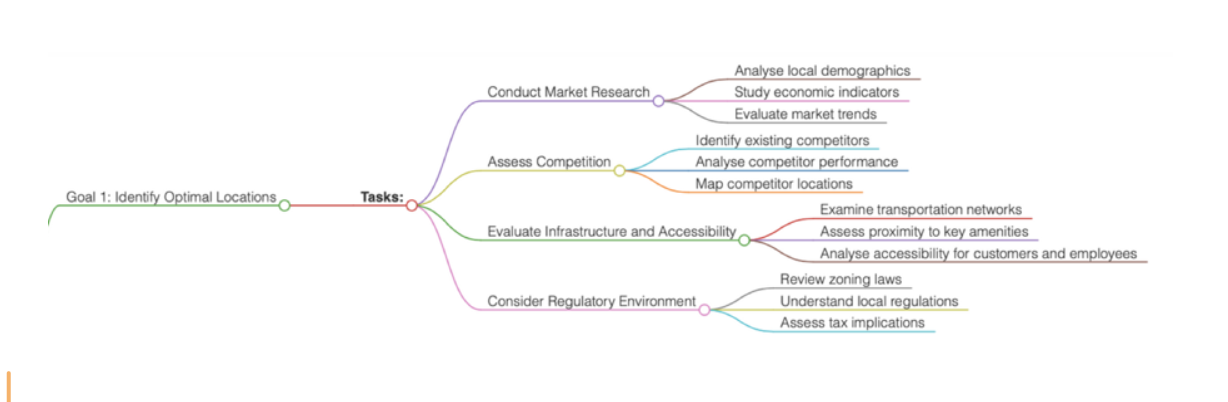
Once you’ve defined these, you can identify which tasks can be automated, augmented by AI, or should remain fully human.
Now you’re getting to the upside - the rebundling process.
You can start reconstructing your workflows: rebuilding processes with optimal human-AI collaboration.
And thinking about how you redistribute skills: where do you reallocate human skills so that they add the most value.
Now clearly there is a lot of devil in the detail with all of this, but I hope the abstract principle is clear that we’re moving very much to a ‘Human + Machine’ world and we need to redesign the work we do accordingly. Processes and workflows can, and need to be, reworked to optimise our capabilities, and those of ‘the machines’.
Learning from History: The Electricity Parallel
It took 40 years for electricity to transform factories. And the productivity gains (which were dramatic) only occurred when the form factor of steam powered factories was completely overhauled. From being one monolithic machine, driven by a central drive shaft with chains and pulleys, to a patchwork of interlinked but separate processes each with their own, electric, power.
We are at a similar inflection point, where to achieve the gains we have to jettison the past, and build for the future. This time though I expect the timeline to be compressed. Sure, every such change takes a while to permeate through society, often longer than the optimists expect, but the gains to being an early adopter with AI are such that progress might well be 10X faster this time around. After all we are building on an installed base of 50 years of computing and 30 of the Internet.
The Human Factor: MIT's Surprising Findings
There is an interesting twist though to achieving strong productivity gains with AI, a peculiarly human one. Researchers at MIT recently published the results of a meta study of 106 individual papers discussing the successes of human + ai collaboration. It turns out that In many cases the AI performed best when left alone and often when humans and AI worked together it performed worse than either could have achieved on their own. Rather amusingly it seems that we humans often think we know best when we don't and are minded to overrule our AI helpers.
Where real human + AI 'Synergy' occurred, where the combination produced better results than either could apart, followed four patterns, and for these reasons:
Four Patterns of Successful Human-AI Collaboration
When Tasks Have Both Pattern AND Exception:
AI excels at recognising patterns, while humans are better at handling exceptions. Together, they create robust systems neither could achieve alone.When Scale Meets Judgment:
AI processes vast amounts of information; humans bring contextual wisdom. Combining these strengths leads to smarter, more nuanced decisions.When Creativity Needs Structure:
AI generates countless variations; humans curate and refine. This synergy drives more effective innovation.When Analysis Meets Intuition:
AI finds correlations; humans provide causal understanding. Together, they solve complex problems that neither could tackle independently
The Human-AI Symphony: Our Path Forward
From which we can deduce a The Key Principle:
We need to look for workflows where AI and humans can each play to their strengths while compensating for each other's weaknesses.
I think we all have a natural aversion to thinking machines can be smarter than us (whether or not we believe it to be possible), whereas we are happy if we can retain agency over what matters to us. So if we can find ways to work with technology without our egos being impacted, we are far more comfortable letting 'whatever will be, be'. In the end, mastering this technological revolution demands as much wisdom about human nature as it does technical understanding.
The winners in this transformation won't just be those who adopt AI fastest, but those who learn to collaborate with it most intelligently. There is a phrase going around about how ‘Language models are the revenge of the humanities graduate’ and this resonates with me. There is something strange about interacting with them. You know it is science, but it feels like Art. What it isn’t is more of the same.
‘The times - (most definitely) - they are a-changin'
Your Next Step:
This week, pick one goal from your role, break it into tasks, and identify where AI could amplify your impact. You'll be surprised by what you discover.