
THE BLOG
The AI Diffusion Dilemma: What It Means For The Office Of 2035

‘Will AI follow the decades-long, bumpy rollout of electricity, or will AGI automate most knowledge work by 2027? Experts are fiercely debating, and the answer could determine whether the office towers we build today are essential hubs or expensive relics by 2035’
Commercial Real Estate is really a game for futurists isn't it? Most industries go from input to output in a matters of days, weeks, months, but in real estate when we commit to a new project, or when we buy or sell an asset, we are really betting on how the world will be many years, if not decades hence. We develop all these models explaining, to two decimal places, what our returns will be over the next decade, but we know we’re dressing up educated guesses as scientific fact. All models are wrong, but some are useful etc. Even if we mostly keep quiet about this.
Last week, we took the line that in a world where generic real estate is increasingly challenged by technological shifts, a wise strategy would be to invest in the real estate those shifts create—not in the real estate they leave behind.
Few assets sit more squarely in the blast radius of this debate than the office. If AI augments, the office adapts. If AI replaces, the office shrinks. And fast.
In the AI world we are heading into, the problem is there are experts to support both arguments.
Two Futures of AI: Slow Burn or Flash Fire?
Two major publications have recently come out. One (‘AI as Normal Technology’), by senior, highly respected academics at Princeton University, and one (AI 2027 - ai-2027.com) by a team of senior, highly respected AI researchers.
The Princeton View: AI Will Take Decades
Let’s start with the Princeton paper ("AI as Normal Technology"): In this, Arvind Narayanan and Sayash Kapoor…..
"explain why we think that transformative economic and societal impacts will be slow (on the timescale of decades), making a critical distinction between AI methods, AI applications, and AI adoption, arguing that the three happen at different timescales.”
Whilst they agree that AI is a ‘General Purpose Technology’ and thus of great importance, they justify their timeline of decades because:
"It is guided by lessons from past technological revolutions, such as the slow and uncertain nature of technology adoption and diffusion... With past general-purpose technologies such as electricity, computers, and the internet, the respective feedback loops unfolded over several decades, and we should expect the same to happen with AI as well.”
The key arguments for a long, drawn out impact scenario for AI is that:
Innovation is one thing and diffusion quite another. Getting to broad adoption always takes a long time because reality gets in the way and that flat clear road ahead turns in to a glacial moraine.
Speed limits are everywhere - safety concerns, especially in high stakes areas, regulatory hurdles, organisation inertia, the need to redesign workflows, and the fact that Generative AI is probabilistic not deterministic; so it just sometimes fails, in unexpected ways.
Humans will get in the way (a point incidentally that Tyler Cowen elaborated on recently). They just tend to slow things down. Turkeys seldom vote for Christmas, so we can expect endless workflow engineering, a desire for ‘Control’, and the re-engineering of work that involves ‘humans in the loop’, sometimes where they absolutely will be required, but often for more spurious, dubious reasons.
Under this scenario knowledge work will likely be augmented by AI, which will mean offices change their exact purpose and internal form factors, but the fundamental need for human workers, gathering, collaborating and managing processes (include of course AI itself) will persist and evolve relatively slowly. So mass obsolescence gets kicked a long way down the road.
Current support for this view is in the old saw that most enterprises are only now rolling out technology that was ‘hot’ 10-15 years ago, whilst startups have got long bored by this and moved on, and are developing the mainstream tech of 10-15 years hence.
So all is OK: the largest commercial real estate asset class is alive, kicking and has a healthy future.
The AI 2027 View: Cognitive Labour is Going Exponential
Ah, but…
If Princeton sees AI as a slow-burning revolution, the AI 2027 authors see it as a flash fire—one that could consume entire categories of cognitive work in just a few years.
Their perspective, laid out on ai-2027.com, is starkly different. They argue that:
"AGI is defined as AI capable of performing the vast majority of human knowledge work."
"Recent breakthroughs indicate that the timeline for AGI could be significantly shorter than previously anticipated, measured in years, not decades."
"The arrival of AGI by 2027 would represent an unprecedented transformation, automating most cognitive tasks and fundamentally reshaping the economy and society."
"Understanding this timeline is crucial for individuals, organizations, and governments to prepare
for the profound changes ahead.”
And yes, it might be different this time:
"Unlike previous general-purpose technologies, AGI's ability to automate cognitive labor itself could lead to recursive self-improvement and an exponential acceleration of progress.”
In a nutshell the authors predict imminent, revolutionary change driven by rapid capability gains in cognitive automation. This will be driven by what is known as ‘recursive self improvement’ (RSI) which is essentially where a human is no longer needed to help a computer learn. They start to learn by playing against themselves. It is why, a year after Google Deepmind’s AlphaGo programme famously beat the world’s best player of Go, Lee Seedol, its successor (which incorporated RSI), Alpha Zero, beat it 100-0 after just a few hours of training.
Once RSI kicks in the speed of improvement moves to an entirely different level.
At this stage, one refers back to the academics argument and thinks, yes but …. all those constraints. Do they disappear?
The Office in the Blast Radius
To which the ‘2027’ authors respond with:
Safety/Reliability? Sorted, because the AI will debug, test and validate itself far faster and more thoroughly than any human can, and will rapidly overcome these obstacles.
Integration/Workflow Redesign: Same again, the AI will be able to design optimal, new workflows, and then create compelling user interfaces that drastically reduce the normal friction of adoption. The new systems will simply be so much better, so quickly, that rolling them out will be nowhere near as painful as it has historically been.
Learning Real-world Nuance: And again, by being such a fast learner, and so easily plugged in to all the systems a company has, the AI will be able to gain an appreciation of the ‘tacit knowledge’ of any organisation, very quickly. Achieving quality ‘gut-feeling’ is no longer going to take years, decades of experience.
Overall this AI will be able to demonstrate deep domain knowledge and high-value utility at a speed no previous technology could. And whilst the authors explicitly acknowledge the arguments put forward by the Princeton academics they point to the key differentiator, this time, is the nature of the technology itself.
For instance they emphasise that we are talking about the automation of cognition. The AI will be automating cognitive labour, including the development of the technology itself. Electricity didn't design better power plants; the early internet didn't autonomously code better network protocols. AI, they argue, can do this.
They also discuss the generality of this technology in that LLMs (and future AGI) just has so much more utility straight ‘out of the box’. They aren’t reliant on much else needing to happen before they can be run at full power. And this is software, not hardware, so scaling is nigh on infinite, there are no marginal costs and deployment can be in hours, not months or years.
Returning to the fundamental point, once the underlying mechanism (self-improving cognitive automation) is in place, we are genuinely talking about technologies the likes of which we’ve never seen before.
The Planning Dilemma: What to Believe, and When?
So we have two, credible, well-articulate arguments reaching diametrically opposed conclusions. In one, offices are pretty much safe for decades to come, but with the other the assumption would have to be that we’d be needing a bare fraction of the global office stock that exists today.
I think it would be quite easy, because the conclusions sound so ‘out there’, to dismiss the ‘AI 2027’ argument, and comfortably luxuriate in the ‘so slow I don’t really need to think too much’ prognosis of the Princeton academics. And I am equally certain many will.
But, for me, that is the high-risk route to take. Yes, they are all, to varying degrees, talking their book, but whenever you read, or listen to, the senior researchers from all the major AI research labs (not just the admittedly most adamant 2027 authors) they all paint a picture of a technology developing at crazy speed and capabilities arising that amaze them constantly. Everyone is assuming extraordinary things by 2030. And no-one is talking decades off anymore.
The 2030–2035 Danger Zone: A Strategic Red Flag
So the really critical issue is whether the arguments that the ‘normal’ diffusion speed of technology will be accelerated due to the new capabilities delivered via RSI, are valid? I think they are, though my accelerator is less ‘to the metal’ than the ‘2027’ authors. I would say the asset class is safe until 2030. But 2030-2035 is the danger zone.
Even without full-blown AGI, highly capable, specialised AI systems could automate vast swathes of tasks within knowledge jobs, leading to:
Significant job restructuring even if not mass unemployment.
Reduced overall headcount needed for certain functions.
Downward pressure on wages for easily automated cognitive tasks.
A potential bifurcation – high demand for those who manage/direct AI and perform complex non-routine tasks, lower demand elsewhere.
This feels very reasonable and, I would guess, likely to highly likely.
And that is just up to 2035, a decade hence. Beyond that, being worried about the state of office demand in 2035 is entirely rational and prudent. I think the inertia elastic band will snap by then. In a future newsletter we’ll look closely at how to be ready when it does.
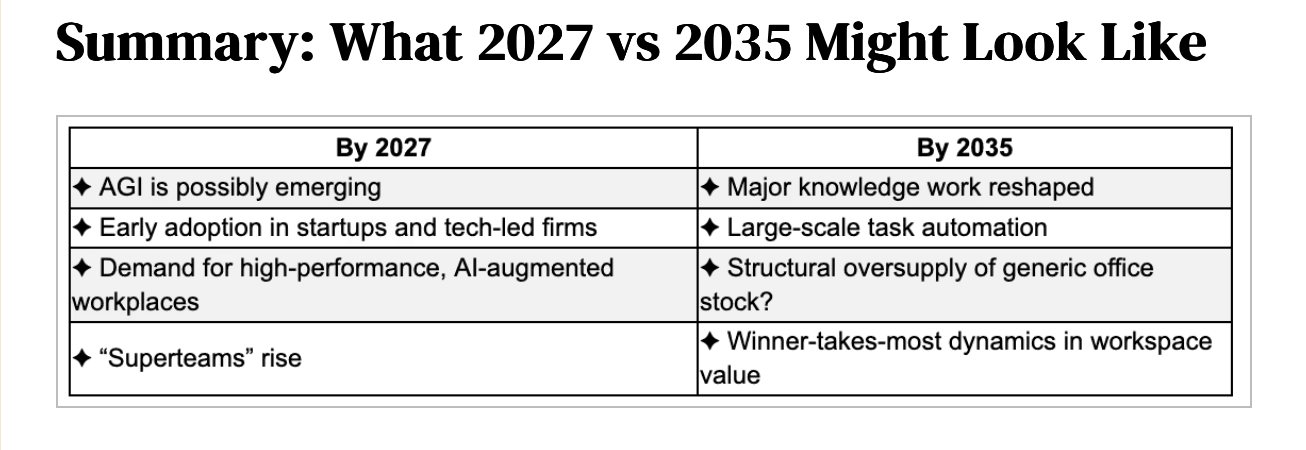
Strategic Takeaways for the Office Asset Class
Which does not mean NO offices will be required. But I’d sure as hell be concerned about owning the ‘right’ offices. What ‘right’ means we have covered before and will cover again.
The bottom line though appears to be that offices as an asset class are getting riskier. I do understand the Princeton academic’s arguments, but find it hard to believe the coming decade is going to be as stodgy as they believe. Most pertinently, I think there will be very many slow moving enterprises, maybe a majority, but I also believe that we’re morphing into an age of fast, agile, ultra-productive superteams (see https://www.flexos.work/trillion-dollar-hashtag/10-themes-for-the-next-ten-years-number-3-trillion-dollar-hashtag-4), and they WILL be utilising all the power of all these new tools asap.
Over to You: Long or Short on the Office?
Offices 2030–2035: Are you betting on augmentation or automation? On inertia or exponentiality?
Because buildings built today will still be around in 2035. The only question is: will they still be needed?
What are you seeing? Let’s map the risk together.
‘AI as Normal Technology’ - https://kfai-documents.s3.amazonaws.com/documents/cb012bac2c/AI-as-Normal-Technology---Narayanan---Kapoor-Final.pdf
Exponential Industries: Real Estate's Next Frontier

Executive Summary: The next decade will be shaped by exponential industries – high-growth, high-dynamism sectors ranging from AI and robotics to new energy and biotechnology – that are poised to reshape the global economy .
These industries, identified in the McKinsey Global Institute’s 18 “arenas of tomorrow,” could generate $29–$48 trillion in annual revenues by 2040 . Critically, many of these emerging arenas require highly specialised real estate and infrastructure to reach their potential, presenting a compelling opportunity for a global CRE fund focused on “Exponential Industries & Advanced Infrastructure.”
This thematic strategy prioritises flexible investment across cutting-edge sectors with unique property needs – from semiconductor fabs and life science labs to AI data centers and spaceports – while avoiding areas that rely only on generic, oversupplied real estate (e.g. traditional offices or standard warehouses). By aligning with fast-evolving industries and their infrastructure requirements, the fund can capitalise on premium yields, resilient demand, and long-term defensibility.
The approach emphasises adaptability: rather than anchoring to a fixed sector taxonomy, it focuses on the underlying drivers (tech innovation, R&D intensity, policy support) that cut across sectors, ensuring the portfolio can pivot as technologies converge and new industries emerge. Below, we detail the investment thesis in five parts: (1) filtering McKinsey’s arenas to prioritise those with specialised CRE needs, (2) defining “exponential industries” and adjacent sectors beyond McKinsey’s list, (3) justifying a thematic flexible strategy over a static sector approach, (4) outlining the specialised real estate requirements of priority industries, and (5) quantifying the global market opportunity for such specialised CRE over the next 10–15 years, including expected demand growth and superior investment characteristics.
1. Prioritising High-Impact Arenas Requiring Specialised Real Estate
Not all of McKinsey’s 18 arenas of the future are equal from a real estate perspective. We focus on those arenas (or logical clusters thereof) where highly specialised properties are a prerequisite for industry growth. These are the arenas in which cutting-edge facilities – with features like cleanrooms, high power density, advanced logistics, or proximity to talent hubs – form a critical bottleneck or enabler for the sector. Conversely, arenas that primarily use generic offices or warehouses (or those already overserved by existing real estate) are de-emphasised, except as part of broader mixed-use ecosystems. Table 1 categorises the arenas of tomorrow by their CRE intensity and investment priority:
Arena of Tomorrow (McKinsey)
Specialised CRE Needs
Investment Priority
Semiconductors – e.g. chip fabrication Extremely high:
Requires semiconductor fabs with cleanrooms, ultra-clean power, water and chemical handling, plus proximity to supply clusters .
Highest – core focus (advanced manufacturing hubs)
AI Software & Services – incl. AI infrastructure High:
Requires large-scale data centers and edge computing sites with massive power and cooling for AI training .
Highest – core focus (digital infrastructure)
Cloud Services – hyperscale & cloud computing High:
Data centers (often overlapping with AI needs); network fiber connectivity hubs.
High – (digital infrastructure, established but growing)
Cybersecurity (services) Low:
Largely office-based or cloud-based; no unique property beyond secure ops centers (can piggyback on data center/office).
Low – deprioritised (generic office/IT)
Robotics (industrial robotics, automation)
High: R&D and assembly facilities with high ceilings, heavy floor loads, robotics testing labs. Often co-located with manufacturing or warehouse space designed for automation.
High – core focus (advanced manufacturing)
Autonomous Vehicles (shared self-driving fleets) Medium:
Testing tracks, sensor-laden infrastructure, and fleet depots with charging; many needs overlap with robotics and EV infrastructure.
Medium – selective (as part of mobility hubs)
Electric Vehicles (EVs) – incl. batteries High:
Gigafactories for batteries and EV assembly plants, requiring large sites, high power, and skilled workforce proximity; also charging network infrastructure.
High – core focus (transport manufacturing)
Batteries (Advanced energy storage tech) High:
Battery cell manufacturing facilities (similar to EV needs), with chemical handling and clean environments; co-location near auto or grid hubs.
High – core focus (energy infrastructure)*
Future Air Mobility (e.g. eVTOL, drones) Medium:
Vertiports and charging hubs in urban areas; airspace integration. May use retrofitted rooftops or new helipad-like structures. Early-stage, but infrastructure will be needed in cities and airports.
Medium – emerging focus (city infrastructure)
Space (commercial space launch, satellites) High:
Spaceports and rocket test facilities (special siting – remote/coastal), satellite assembly cleanrooms, control centres. Few global sites exist – significant greenfield development potential.
High – selective (as part of “NewSpace” infrastructure)
Industrial & Consumer Biotechnology (non-medical)
High: Biotech production labs (fermentation plants, bio-manufacturing) requiring sterile environments, specialised HVAC, and often near research universities. Clusters in biotech hubs .
High – core focus (life sciences manufacturing)
Drugs for Obesity & Conditions (biopharma) High:
Life science R&D labs and pharma manufacturing facilities (GMP compliant) – e.g. lab-office campuses, cleanrooms for biologics. Benefit from established life science clusters.
High – core focus (life sciences R&D)
E-commerce (online retail) Medium:
Large distribution centres and automated warehouses. While e-commerce drove huge warehouse demand, much of this is standard big-box industrial space. Supply has expanded rapidly (1.1 billion sq ft added 2022–23 ), creating oversupply in some regions. Generic warehousing yields are under pressure.
Low – deprioritised standalone (except as part of mixed logistics campuses)
Digital Advertising (ad-tech) Low:
Generic office space for tech workers; computation on cloud (no unique real estate). No specialised footprint – essentially part of the digital economy supported by data centers.
Low – deprioritised
Streaming Video (media streaming) Low:
Offices and existing data/network infrastructure (CDNs). Content production uses studios (a niche CRE segment) but not core to streaming platforms themselves.
Low – deprioritised
Video Games (gaming industry) Low:
Offices for developers and generic server space. No special CRE beyond perhaps creative studio space.
Low – deprioritised
Digital Services (Consumer Internet) – e.g. segments of “consumer internet” arena
Low: (Similar to above digital categories – primarily office or standard tech space; relies on generic cloud infrastructure.)
Low – deprioritised
Modular Construction (off-site prefab) Medium:
Factories for modular building components. While this is manufacturing, it uses standard industrial facilities (warehouses adapted for construction assembly). Some specialised needs (heavy cranes, large bays) but generally can use or retrofit existing industrial stock.
Medium – opportunistic (as part of broader industrial portfolio)
Nuclear Fission Power (next-gen fission reactors) High:
Sites for small modular reactors (SMRs) or advanced reactors. Requires significant land, regulatory compliance, and robust infrastructure (cooling water, grid connection). Real estate is highly specialised (often government-partnered).
Medium – selective (depends on policy and partner opportunities)
Key priorities – Based on the above, the fund would prioritise arenas in advanced manufacturing, life sciences, and digital infrastructure: sectors like semiconductors, biotech/pharma, robotics/automation, EVs/batteries, and AI/cloud infrastructure all exhibit high specialised CRE intensity and strong growth drivers. These industries cannot scale without new state-of-the-art facilities – for example, semiconductor and battery plants have seen a dramatic surge in construction, with U.S. manufacturing construction spending doubling since 2021 due to chip fabs and gigafactories being built under government incentives . Such facilities often cannot be met by existing stock and must be built new, as they have “highly specialized requirements not easily met by existing buildings” . This supply-demand gap creates an opening for investors to develop or repurpose real estate tailored to these needs.
By contrast, arenas like digital advertising, streaming, or gaming are booming industries but primarily digital in nature – their growth does not hinge on specialised buildings. A video game studio or ad-tech firm can reside in a standard office (of which there is ample supply in the market – indeed global office vacancy hit a record ~16% in 2023 due to remote work). Investing in generic offices for “hot” digital sectors would thus not yield differentiated value – in fact, it could expose the fund to oversupplied asset classes with secular headwinds (e.g. traditional offices). Similarly, e-commerce logistics, while a major growth driver for industrial real estate, has in many areas become a victim of its own success with vacancies rising due to a wave of supply . Unless targeting a unique niche (such as cold storage or robotics-automated warehouses), plain vanilla big-box warehouses for e-commerce are not a scarce resource.
Integrated ecosystem plays – However, the strategy doesn’t outright ignore the lower-priority arenas. Rather, we deemphasise direct investment in those unless they are part of an integrated development that supports the exponential industries. For instance, a large innovation campus might primarily feature lab and manufacturing space for life science and robotics companies, but could also include some flexible office or co-working space for digital startups (digital advertising, gaming, etc.) to foster an innovation ecosystem. Likewise, an advanced industry park might have a logistics centre supporting an e-commerce or AI-driven supply chain as a complement to a cluster of high-tech manufacturing tenants. In such cases, generic CRE uses are included as secondary components to enhance the value of the overall cluster (providing amenities, services, or vertical integration), rather than standalone investment themes.
In summary, our filter produces a concentrated focus on “hard tech” arenas – those where the physical infrastructure is as cutting-edge as the technology it houses – and places on the backburner the “asset-light” arenas that ride on existing real estate. This ensures the fund’s capital is deployed where it is most indispensable and where competition from generic landlords is minimal.
2. Defining Exponential Industries and Emerging Sectors Beyond the List
The term “exponential industries” in our theme refers to sectors characterized by rapid, compounding growth driven by technological innovation – essentially, industries on the steep part of the S-curve. Key hallmarks include:
• High R&D Intensity and Innovation Rates: Exponential industries invest heavily in research and embrace frequent technology upgrade cycles. They often feature step-change innovations in business models or technology – what McKinsey calls “technological or business model step changes” that are one ingredient of an “arena-creation potion” . Examples include AI (breakthroughs in deep learning), advanced materials (nanotech), or biotech (gene editing) – each of these can upend previous limits and unlock new markets.
• Escalatory Investment and Capital Formation: These sectors see surging investment as firms race to build capacity or capture leadership (another arena ingredient noted by McKinsey ). Think of the current “AI arms race” or the battery manufacturing boom – companies plough in capital despite short-term losses, creating self-reinforcing growth cycles . This often yields fast growth but also high dynamism (market shares shuffle quickly as new entrants can displace incumbents).
• Advanced Infrastructure Requirements: Exponential industries typically push the limits of existing infrastructure, necessitating new types of facilities or networks. Their operations may be mission-critical 24/7 (for example, data centers for digital services must run continuously ) and they often have extreme demands (power, precision, etc.) that standard facilities can’t accommodate. The need for specialised real estate – whether it’s a climate-controlled lab, a high-performance computing center, or a high-throughput manufacturing line – is a common thread.
• Policy Support and Strategic Importance: Many exponential sectors align with government priorities (for economic competitiveness or societal needs), attracting subsidies, favorable regulation, or public-private partnerships. Recent examples include the CHIPS Act for semiconductors, the Inflation Reduction Act for clean energy, and various national strategies for AI or biotech. This support lowers risk and increases the scale of what these industries can achieve (and by extension, the scale of facilities they will build).
• Large and Growing Addressable Markets: By definition, an exponential industry targets a substantial market opportunity that can support its growth ambitions . Often they create new markets or radically expand old ones – e.g. the rise of electric mobility expanding the market for batteries, or precision medicine expanding healthcare markets. This ensures that investments in capacity (factories, labs) aren’t in vain; demand is expected to catch up or exceed supply.
Using these criteria, we not only encompass the 18 McKinsey arenas but can also identify adjacent or emerging sectors that fit the profile yet weren’t explicitly listed by McKinsey. Some such sectors on our radar include:
• Quantum Computing and Quantum Technologies: Quantum computing is on the cusp of moving from lab research to industry. It squarely meets the exponential criteria: R&D heavy (countries and companies investing billions into quantum research), frequent tech breakthroughs (e.g. higher qubit counts, new quantum error correction methods), and infrastructure intensity (quantum computers require extreme conditions – cryogenic refrigeration, vibration isolation, etc., meaning custom-built lab facilities). Policy support is evident (national quantum initiatives in the US, EU, China), and the addressable market (revolutionising drug discovery, cryptography, etc.) could be enormous. CRE Opportunity: Quantum research hubs – specialised facilities with shielded, low-temp environments – and eventually quantum data centers. If quantum hardware scales, one can envision quantum computing centres akin to today’s supercomputing centers, potentially co-located with universities or major tech clusters. Few such facilities exist today, pointing to a future niche for development.
• Hydrogen Economy and Green Industrial Processes: As part of the broader clean energy transition, green hydrogen and related technologies (fuel cells, e-fuels, carbon capture) are emerging industries that require physical infrastructure at scale. For instance, green hydrogen production needs electrolysis plants (essentially new industrial facilities often built near renewable power sources), distribution networks (pipelines, storage tanks), and end-use stations (e.g. hydrogen fueling stations for vehicles). These projects have strong policy tailwinds (e.g. EU hydrogen strategy, US tax credits) and involve high-tech engineering (electrolyzers, etc.). Exponential characteristics: high innovation (improving electrolyzer efficiency, new catalysts), escalatory investment (over $100 billion of hydrogen projects announced globally), and a large addressable market (decarbonising industrial feedstocks, heavy transport, etc.). CRE Opportunity: Development of hydrogen hubs – industrial parks where hydrogen is produced and consumed – or adaptive reuse of port sites and refineries for new hydrogen plants. While not on McKinsey’s list (perhaps because it overlaps with “energy transition” rather than a discrete arena), hydrogen infrastructure aligns well with our theme of advanced infrastructure.
• AgriTech and Controlled Environment Agriculture: With food demand rising and sustainability concerns, there’s an emerging sector around high-tech farming – e.g. vertical farming, hydroponics, and lab-grown foods. These ventures blend biotech, robotics, and AI – for example, vertical farms use automated systems in warehouse-like structures to grow produce year-round. They tick the boxes of exponential industries: innovative tech (from LED lighting to AI crop monitoring), heavy upfront investment, policy interest in food security, and specialised real estate (custom-built indoor farms with climate control). The addressable market (global food and agriculture) is huge, though this sector is still nascent in proving its economics. CRE Opportunity: Converted or new-build “agri-factories.” There’s growing interest in repurposing urban warehouses or building greenfield facilities for vertical farms. These require high ceilings, extensive HVAC and water systems, and proximity to city markets (for fresh delivery). While some early ventures struggled, the sector continues to evolve, and a flexible strategy allows optionality to invest when technologies mature – for example, if a particular vertical farming model achieves profitability, the fund could finance its real estate rollout as part of the exponential industries portfolio.
• Fusion Energy and Advanced Nuclear: In addition to fission (which was on McKinsey’s list), the pursuit of nuclear fusion power is an archetype exponential bet – high R&D (decades of research nearing potential breakthroughs), massive prize (virtually limitless clean energy), and requiring colossal specialised infrastructure (experimental reactors and, in success, commercial fusion power plants). Several private companies aim to demonstrate viable fusion in the 2030s, supported by public programs (e.g. US DoE fusion milestone grants, UK’s STEP program). CRE Opportunity: Positioning for the long term, the fund could target partnerships for building sites for fusion pilot plants or components factories. This would be a higher-risk, longer-horizon play (fusion is uncertain), but it exemplifies the benefit of a flexible thematic approach – we can allocate a modest portion to “moonshot” infrastructure that, if it succeeds, would generate outsized returns and cement the fund’s reputation in truly advanced infrastructure.
• Other Cross-Sector Convergence Plays: The convergence of technologies is itself spawning new sub-industries. For example, autonomous logistics (drones and last-mile delivery robots) is at the intersection of robotics, AI, and e-commerce. Smart cities infrastructure (sensors, IoT networks, 5G small cells) sits between telecom and urban development. While individually these might be smaller niches, they collectively reinforce the need for flexible investment mandate – the fund can allocate to emergent themes as they arise, provided they meet our criteria of high growth potential and specialised physical infrastructure needs.
By defining “exponential industries” in terms of these fundamental characteristics rather than a static list, we ensure our scope remains open-ended. Today’s list of 18 arenas is a starting point, but history shows that entirely new industries can emerge within a decade. (For instance, ten years ago, industries like commercial space launch or AI-as-a-service were barely on investors’ radar; today they are multi-billion dollar arenas.) Our strategy is to be forward-looking and opportunistic in capturing these adjacencies. If a sector demonstrates the exponential DNA – say, a sudden breakthrough in food-tech or metaverse hardware that creates new demand for specialised real estate (e.g. mega data rendering farms or VR experience centers) – the fund’s theme allows us to pivot and invest there, whereas a rigid sector-specific fund might miss the boat.
In essence, “Exponential Industries” is deliberately defined by attributes and outcomes (rapid growth, innovation, infrastructure intensity) rather than narrow industry definitions. This keeps the investment universe expansive and adaptable, encompassing both the known high-growth arenas and the “unknown unknowns” that may arise.
3. Strategic Rationale: Flexibility Over a Fixed Taxonomy
Anchoring the fund to a broad thematic of Exponential Industries & Advanced Infrastructure – rather than, say, picking a fixed subset of sectors (like “life sciences, data centers, and logistics only”) – provides crucial strategic flexibility. Given the pace of technological disruption, an agile approach is essential for long-term outperformance. Key justifications for this flexibility include:
• Adaptation to Technological Disruption: We are living in an era where disruption is accelerating across multiple fronts, and yesterday’s niche can become tomorrow’s necessity (and vice versa). A static sector-based strategy could quickly become obsolete if a chosen sector falters or a new one rises. By contrast, a thematic approach can “stay agile and rapidly adapt” to structural changes . For example, if advancements in biotech automation lead to lab layouts changing, we can adjust our development specs; if a currently unforeseen industry (like quantum computing) suddenly takes off in 5 years, we can include it under our theme without needing a mandate change. This agility is echoed in investment commentary: “Disruption is accelerating, making thematic investing an essential tool for investors to stay agile and rapidly adapt” .
• Cross-Sector Convergence: Many exponential technologies are converging, blurring the lines of traditional sectors. AI is not a siloed sector; it’s permeating healthcare, transportation, manufacturing, and more. Similarly, advances in materials or energy storage impact multiple industries. A flexible theme allows us to invest along these convergence points. For instance, consider autonomous electric vehicles – this sits at the intersection of automotive, AI, and clean energy (EV batteries). A rigid fund might struggle: Is that “transport” or “tech” or “energy”? For us, it squarely fits the exponential industries theme and we can invest in, say, an R&D campus or a test facility for autonomous EVs as easily as in a battery plant. The modern economy is defined by such “digital and physical worlds fusing, accelerating adoption curves and compelling companies to rethink investments”, as noted by Global X analysts . Our strategy inherently embraces this fusion. We ignore artificial boundaries (like NAICS codes or traditional sector silos) and instead focus on the underlying drivers and needs.
• Risk Management Through Diversification of Innovation: While all our target sectors are high-growth, they will not all succeed or cycle at the same time. A flexible basket of themes provides diversification within the high-tech universe. For example, if one arena (say, streaming media) saturates or faces a downturn, another (say, biotech manufacturing) might be in an upswing. The fund can rotate emphasis accordingly. This is analogous to multi-theme investment strategies in equities, which use momentum or conviction to tilt towards currently outperforming themes . Similarly, our portfolio construction can dynamically allocate capital to sub-themes that show the strongest indicators (demand, rent growth, government support) while pulling back on those that cool off. The overarching exponential theme ensures we remain in growth areas, but we are not married to any single one if fundamentals shift.
• Capturing “Ecosystem” Opportunities: A strict taxonomy (e.g. an “AI Real Estate Fund” or a “Life Science Fund”) might limit investments to properties that neatly fit one label. In reality, innovation happens in ecosystems – think of innovation districts that host academia, startups, mature companies, and supporting infrastructure in one place. Our broad mandate means we can create or invest in mixed-use innovation hubs that encompass multiple exponential industries. For instance, a large campus could have a data center (AI/cloud), a lab building (biotech), a prototype advanced manufacturing facility (robotics), and even an attached accelerator or office for software startups – all elements reinforcing each other. A flexible fund can underwrite such a project holistically. The benefit is synergy: tenants from different exponential sectors co-locate to collaborate (AI scientists working with biologists, etc.), driving demand for our space and creating a vibrant, defensible asset. We’re not forced to choose one narrow use; we can provide the full stack of infrastructure that tomorrow’s industries need.
• Long-Term Megatrend Alignment vs. Short-Term Fads: The thematic approach keeps us focused on long-term megatrends (e.g. automation, digitization, decarbonization, demographic shifts in health) rather than short-term fads. We use the theme as a north star but remain flexible on execution. For example, the megatrend is that healthcare and tech are converging – within that, today it might manifest as demand for biotech labs; tomorrow it could be facilities for personalized medicine production or AI-driven diagnostics centers. We don’t want to be stuck only investing in “wet lab space” if in a decade the key need shifts to a different type of life science facility. By articulating our strategy as “Exponential Industries (with Advanced Infrastructure)”, we send the message to investors that we’ll pursue whatever sub-sectors best deliver exposure to those megatrends at any given time. This mitigates the risk of being in the right church but the wrong pew, so to speak.
• Greater Resilience to Disruption: Ironically, a fund targeting disruptive industries must itself be designed to not be disrupted. If we pigeonholed ourselves (e.g. a pure-play “data center REIT”), we could be upended by an unforeseen technological shift (what if, hypothetically, future computing shifts to a completely new paradigm requiring different facilities than today’s data centers?). Instead, with breadth, we can evolve our asset mix. In practice, this could mean if decentralized computing (edge devices) reduces the need for giant central data centers, perhaps it increases the need for smaller edge server locations embedded in warehouses or cell towers – which we could pivot to, because our mandate is broad enough to treat it as still “AI infrastructure.” Essentially, optionality is built in.
In summary, the benefits of adaptability far outweigh any perceived focus dilution. We maintain coherence by the unifying idea of exponential growth industries, but we avoid the trap of false precision in defining what the future will look like. The world’s top companies today largely were born from agilely riding multiple waves of innovation – our fund mirrors that ethos, aiming to be “unconstrained in capturing innovation, ignoring traditional sector limitations” . This flexibility is not lack of strategy; it is the strategy – to always be where technological growth and specialised real estate demand intersect, regardless of how the labels evolve.
4. Specialised CRE Requirements of Priority Industries
A cornerstone of the thesis is that many exponential industries have non-negotiable real estate and infrastructure needs that differ markedly from conventional property. These needs create high barriers to entry but also attractive supply-demand dynamics for those who can fulfill them. We outline the nature of specialised CRE required for the key industries we’ve prioritised:
• Semiconductor Fabs and Advanced Electronics Manufacturing: The semiconductor industry’s fab facilities are among the most complex buildings ever constructed. They feature large cleanrooms (often tens of thousands of square meters) that must maintain extremely low levels of particles and vibration. These fabs require specialised MEP (Mechanical/Electrical/Plumbing) systems: for example, massive high-capacity power transformers and HVAC systems to support tools that consume tens of megawatts, as well as ultra-pure water and chemical delivery systems . The cost to build a state-of-the-art fab can exceed $10 billion, and location is influenced by access to skilled labour (engineers), a stable power grid, and often government incentives. Key features: Class 10 or better cleanroom standards, 100% backup power, air re-circulation systems, and often on-site process waste treatment. ESG note: Fabs are energy and water intensive, so newer projects incorporate sustainability measures (recycled water loops, renewable energy sources) to reduce carbon and ensure environmental compliance . Investment implication: These facilities tend to be built custom for a specific operator (e.g. TSMC or Intel). As a landlord, opportunities lie in partnerships or joint ventures (for example, providing capital and development expertise in exchange for partial ownership or long-term lease from the operator). Once occupied, tenants are extremely sticky due to the huge capital invested in equipment and the impracticality of relocation – a chip plant cannot move without halting production for months. This stickiness can translate to stable, long-term income.
• Life Sciences R&D and Biomanufacturing Space: The life sciences sector (biotech, pharma, medical research) relies on a spectrum of specialised properties:
• Wet Lab R&D Facilities: These are laboratory-office hybrids, often multi-storey buildings in innovation clusters (e.g. Cambridge (UK), Boston, San Francisco). Labs require reinforced structures to carry heavy equipment, enhanced ventilation and air filtration (fume hoods, 100% outside air systems), and piped utilities (lab gases, deionised water) that typical offices lack . Ceiling heights and floor-to-floor distances are larger to accommodate ductwork. Additionally, as science evolves, labs need flexibility – modular layouts that can be reconfigured, and increasingly, the ability to house computational research suites (for AI-driven drug discovery). Indeed, the rise of AI in pharma is “expanding the sector’s real estate strategy” – facilities now must plan for “onsite AI labs” with power-hungry computational nodes and secure high-capacity data storage alongside traditional wet labs . This means higher electrical loads and cooling capacity in lab buildings, blurring lines with data center specs. Cluster synergy is important: lab buildings thrive in clusters near universities or hospitals, and often we consider not just the building but the campus (shared amenities like conference centres, collaboration spaces, or an incubator wing for startups).
• Biomanufacturing & Pharma Production: These facilities (for example, cell and gene therapy production suites, vaccine manufacturing plants, or pharma pill production lines) take specialised to another level: they must meet stringent regulatory standards like GMP or even cGMP (current Good Manufacturing Practice) . They often contain cleanroom production areas (though typically less strict than semiconductor cleanrooms, still with controlled environments), specialized process equipment (bioreactors, filtration systems), and backup systems to protect valuable biological product in process (e.g. emergency power and refrigeration). Many are single-story large floorplate buildings in suburban tech parks or industrial zones. Zoning can be an issue due to handling of biological materials – sites often need appropriate zoning for light manufacturing and sometimes isolation from sensitive neighbours. According to CBRE, “Biomanufacturing facilities require unique quality assurances, infrastructure, architecture and zoning”, and developers have used strategies like build-to-suits and conversions to create them . They also tend to cluster in specific regions with talent and funding, such as Boston, Philadelphia, Basel, or Singapore . Investment implication: Demand for these facilities is rising as more biotech therapies reach clinical approval stages – CBRE notes “surging demand for specialized biomanufacturing facilities” in the cell/gene therapy era . These tenants (often big pharma or well-capitalised biotech) invest heavily in customising the space, leading to long leases and sticky occupancy. As one industry expert noted, “life sciences tenants tend to be ‘sticky’ because they are well-capitalized companies that invest a lot of capital [in their labs]” . We expect above-average tenant retention and the ability to command premium rents, especially when supply is constrained by the complexity of developing new lab space.
• Data Centers and AI Computing Infrastructure: Modern digital industries require physical backbone in the form of data centers – effectively the “factories” of the digital age. These are typically mission-critical facilities with high power density, robust cooling, and ultra-reliable uptime. There are a few sub-types:
• Hyperscale Data Centers: Large (often 100,000+ sq ft) server farms, usually in lower-cost areas or campuses, serving cloud providers or large enterprises. They demand huge power capacity (often 20–50+ MW per facility) and often significant water for cooling (though air and liquid cooling tech is evolving). Special requirements: dual or triple power feeds, multiple backup generators, battery UPS systems, and cooling plants (chillers, cooling towers or economizer systems). Many hyperscalers also now design for AI hardware, which is even more power-dense (racks filled with GPUs/TPUs). Goldman Sachs projects that by 2030, power demand from data centers will increase 165% due to AI workloads . This is causing occupancy in data centers to tighten – forecasted average utilization rising to >95% in the next couple of years . In some markets, power availability and grid constraints are the limiting factor – e.g. Northern Virginia (the largest data center market) is seeing project delays due to grid upgrades needed . ESG and location: Data centers are energy hogs, so access to renewable energy is increasingly a factor; also community pressure can arise over water use and noise (from cooling equipment), influencing design and sometimes favoring certain geographies.
• Edge Data Centers: Smaller facilities located closer to end-users to reduce latency (important for applications like autonomous systems, AR/VR, etc.). These might be 5,000–20,000 sq ft modules placed in urban areas or at network hubs. They still need strong power and cooling, but scale is smaller – could be within base floors of buildings or modular units on telecom sites. As industries like robotics, autonomous vehicles and smart cities grow, edge computing sites near city centers, highways, or cell tower aggregations become more important (for quick data processing).
Investment implications: Data centers have become a distinct real estate asset class with institutional interest due to their strong cash flows. Tenants often sign long leases (5-15 years) with significant upfront fit-out costs, which makes them sticky. In particular, “hyperscale data center tenants also tend to be stickier due to the significant investment they make to outfit the property, and relocating the critical infrastructure can be challenging” – leases average ~10 years with extension options and built-in rent escalators . This stickiness and built-in growth translate to reliable income. Furthermore, current market dynamics are landlord-favorable: in major markets, vacancy rates are at record lows (≈3–5%) and rents are rising sharply (e.g. US data center rents +19% year-on-year amid scarce supply ). This is in stark contrast to traditional office or retail. As AI adoption soars, one can reasonably project robust demand for new data centers globally for years to come. JLL predicts 10 GW of new data center capacity will break ground globally in 2025 alone . Each megawatt of capacity roughly equates to ~$10 million in development cost, underscoring the scale of investment. Our focus would be on both developing new facilities in high-demand markets (often in partnership with operators) and potentially acquiring existing data centers with expansion potential. Special considerations: We must navigate power procurement, fiber connectivity, and in some cases local moratoria (e.g. some cities have paused data center approvals due to power strain). We also would incorporate sustainability (modern designs aim for PUE – Power Usage Effectiveness – close to 1.2 or better, and some use renewable energy or innovative cooling like heat reuse).
• Advanced Manufacturing & Robotics Facilities: Aside from semiconductors (covered) and biomanufacturing (covered), there is a range of next-gen manufacturing that includes EV assembly plants, battery gigafactories, aerospace/space tech plants, and robotics assembly and testing centers. These typically share needs such as:
• Scale and Layout: Large single-storey structures (for assembly lines) or multi-storey with freight elevators (if footprint constrained). High bay ceilings (to accommodate equipment or cranes), extensive floor load capacity (for heavy machinery). Open spans (few columns) to allow flexible reconfiguration of production lines as technology evolves.
• Power and Utilities: High electrical loads to run automation, robotics, and in some cases high-heat processes (like battery cell production ovens). A battery cell factory, for instance, not only needs huge power but also special HVAC to maintain dry rooms (low humidity) for lithium handling. Similarly, aerospace factories may need built-in testing rigs or wind-tunnel facilities. Robotics R&D sites might include dedicated labs with their own power and data setups.
• Connectivity and Tech Integration: These “Industrie 4.0” facilities are bristling with IoT sensors and often require robust on-site data infrastructure (edge computing) to handle real-time data from machines. So they might have a small data center on-site or at least advanced IT rooms. Additionally, if autonomous vehicles or drones are being tested, the site might include dedicated tracks, airspace permissions, or RF communications infrastructure (e.g., private 5G networks on-site for robot communication).
• ESG and Worker Amenities: Modern advanced manufacturing sites differentiate themselves with sustainability and employee-friendly design – solar panels on vast roofs, energy-efficient lighting, water recycling (especially for batteries where water usage is heavy), and amenities like training centers or collaboration spaces to attract talent (engineers often work on-site alongside production). For example, many EV and battery plants being built in the US and Europe tout renewable energy integration and community benefits as part of getting local approval.
Co-location with talent & suppliers: These facilities benefit from being in clusters – e.g. automakers building battery plants near their assembly plants to streamline logistics, or robotics companies locating near top engineering universities. From a real estate standpoint, this means there is value in assembling “advanced industry parks” where multiple synergistic operations are neighbors (a battery plant, an EV assembly, a robotics supplier, and maybe a testing track, all in one campus). We would seek to facilitate such clustering, which increases the value proposition for tenants (they gain an ecosystem).
Example: The fund could develop an “Advanced Robotics Campus” outside a major metro – comprising high-spec industrial bays for robotics prototyping, a section for drone testing (with a netted enclosure or adjacent open field), and offices for associated software teams – effectively a one-stop hub for autonomous systems development. Such a project might cater to several companies (tenants) and perhaps a shared demo facility. The specificity of the infrastructure (flooring that can accept bolting of robot rigs, indoor GPS systems, etc.) becomes a selling point.
Notably, policy initiatives are heavily boosting advanced manufacturing in many countries, not only providing demand but also funding. For instance, U.S. federal incentives (CHIPS Act, IRA) and similar European programs have unleashed a manufacturing construction boom . This reduces risk for us as investors – public money often complements private capital in these projects (through grants, tax breaks, tenant covenants), meaning our developments can secure anchor tenants with support already in place.
• New Mobility Infrastructure (EV Charging, Vertiports, etc.): Supporting the exponential growth in electric and autonomous mobility will require new or upgraded infrastructure integrated with real estate:
• EV Charging Hubs: While individual charging stations are small-scale, we foresee the rise of large EV charging forecourts or “charging lounges” on highway corridors (akin to petrol stations of the future) and in urban centers (perhaps integrated into parking garages). These have real estate plays – e.g. redeveloping portions of underused parking lots to host fast-charging pods with amenities for drivers. Power access is the key constraint – sites might need their own substations or energy storage (which itself could be a real estate asset: battery storage facilities to buffer the grid).
• Autonomous Vehicle Depots: If autonomous taxis or delivery vehicles proliferate, they will need fleet depots for maintenance, cleaning, and overnight charging. These depots differ from today’s car garages by being optimised for automation – yard layouts that accommodate self-parking, wireless charging pads, and advanced telematics. Real estate wise, these could be retrofitted warehouses or new builds in logistic zones at city peripheries. They may not be huge drivers of rent, but as part of a broader portfolio, having some mobility infrastructure assets can complement an ecosystem (for instance, an autonomous vehicle depot next to a robotics industrial park).
• Vertiports for Air Mobility: Companies developing electric vertical takeoff and landing (eVTOL) aircraft (air taxis) anticipate the need for networks of “vertiports” in and around cities. These are essentially small-scale airports – a typical vertiport might consist of a takeoff/landing pad or two, a passenger terminal or lounge, charging stations for the eVTOLs, and maintenance hangar space. They could be on rooftops of large buildings, on repurposed parking structures, or on piers/greenfield sites at city edges. CRE opportunity: While experimental now, if air mobility takes off, owning strategic vertiport locations in major cities (either directly or via partnerships with infrastructure players) could be valuable. These would operate somewhat like airport real estate (with revenue from takeoff fees, retail in terminal, etc.). Initial projects (for example, planned vertiports in Singapore or Paris ahead of the Olympics) are already in motion, indicating this is moving from sci-fi to concrete planning.
• Space Infrastructure Facilities: As the commercial space sector grows (satellite constellations, space tourism, etc.), it drives demand for terrestrial facilities:
• Launch Sites / Spaceports: Historically government-run, now there is a trend towards commercial spaceports (e.g. in Cornwall UK, or Florida’s commercial pads) that cater to private launch companies. Real estate aspects: large land area, regulatory clearances, integration with logistics (to bring rockets and fuel), and range safety infrastructure. A fund likely wouldn’t own a whole spaceport (governments often involved), but could invest in components like the integration facilities or visitor centers around them.
• Assembly and Test Facilities: Rockets and spacecraft require huge assembly buildings (think SpaceX’s giant hangars in Boca Chica or Blue Origin’s factory in Florida). Satellite makers too need cleanrooms for assembly and testing (often in industrial parks). These are akin to specialized manufacturing discussed above. Given the niche nature, any such investment would probably be tenant-specific (built for a particular company under long lease).
• Downstream Space Data Centers: A subtle one – as thousands of satellites launch (for earth observation, communications), there’s growth in ground stations and data centers that receive and process satellite data. These sometimes are in remote areas (to catch satellites overhead) but networked to central facilities. It’s a convergence of space and data infrastructure.
Overall, the specialised CRE needs can be summarised as infrastructure-intensive, high-specification, and often requiring co-location with talent or resources. They are not commodity buildings; each often requires tailoring to industry-specific standards. This complexity means fewer developers deliver them, contributing to supply inelasticity. As JLL observed about advanced industries like manufacturing and data centers: “All have highly specialized facility requirements not easily met by existing stock… new construction is often a necessity… these sectors compete for the same specialized trade services” . For investors, this means that when you deliver a well-executed specialised asset in a growing market, you face limited competition and can attract top-tier tenants who have few alternatives, enabling premium rents and long leases.
It is worth emphasising the infrastructure intensity and ecosystem dependency of these assets: success is not just about the building, but its integration into a wider network (power grids, transport links, talent pools). For example, a data center must have not only its structure, but also guaranteed power supply (sometimes involving co-investing in substations) and fiber connectivity. A life science campus benefits from being near a university (perhaps involving partnerships or providing incubator space to start-ups spinning out of that university). Thus, our approach to development and acquisitions will often involve a broader development plan and stakeholder collaboration (with utilities, local governments, universities, etc.). This adds complexity but also defensibility – once these pieces are in place, it’s very hard for a competitor to replicate a similar integrated environment quickly.
5. Market Opportunity Size and Investment Outlook (10–15 Year Horizon)
The global addressable market for specialised CRE serving exponential industries is immense and set to expand dramatically in the next decade. We can quantify this opportunity by looking at both the demand side (the growth of the industries themselves, which drives facility needs) and the supply side (current stock vs. required stock of suitable real estate):
• Share of the Economy & Growth Trajectory: The 18 arenas of tomorrow are projected to increase their share of global GDP from ~4% today to between 10% and 16% by 2040 . That implies these sectors will triple or quadruple in relative size. In absolute terms, as noted, their revenues could reach ~$29–48 trillion by 2040 , with $2–6 trillion in profit. Even half of that growth occurring in the next 10–15 years will mean trillions of dollars in new economic output needing physical space. For context, the earlier generation of “arenas” (2005–2020 period) saw their GDP share triple and they captured half of global corporate profit by 2019 – and those included e-commerce, cloud, etc., which spurred an unprecedented wave of CRE development (warehouses, data centers, etc.). The coming wave could be even larger . This translates to an unprecedented building boom for advanced infrastructure.
• Volume of Investment in Facilities: We are already witnessing massive capital commitments to build out these industries:
• Data Centers: A Boston Consulting Group analysis finds that industry players “are readying a massive deployment of capital – $1.8 trillion from 2024 to 2030 – to meet data center demand” . This figure (if even roughly accurate) is staggering; it likely includes the entirety of global data center-related capex. Even a portion of that available to real estate investors (land, shell construction, power infrastructure) represents a multi-trillion dollar asset creation. By 2030, the global data center market is expected to reach ~$650 billion annually , growing ~11% CAGR. Importantly, near-term tightness means occupancy and rents will remain strong – Goldman Sachs projects data center utilization peaking >95% by 2026 before new supply catches up . High occupancy plus high investment typically yields high NOI growth for existing assets (we’re already seeing double-digit rent increases ). Compared to traditional CRE classes like office or retail which are struggling with high vacancies and modest growth, data centers offer both growth and income stability – an attractive combination.
• Life Science Real Estate: In the U.S. alone, the top life science clusters had over 40 million sq. ft. of lab space under construction or in planning as of 2024 . Global investment into life science properties has risen sharply in recent years (in Europe, life science real estate is now considered “the asset class of the future”, attracting new investors ). While there has been a short-term oversupply in some U.S. markets (vacancies ticked up to ~18–20% as a flood of new space delivered during a brief slowdown in biotech funding ), the long-term demand drivers – aging population, healthcare R&D spending, biotech innovation – point to robust absorption ahead. Indeed, life science employment is at record highs and big pharma is flush with cash for acquisitions and expansions, which will require more lab and manufacturing space. We anticipate the current inventory will be digested by expanding occupiers and that by late-decade new waves of demand (e.g. for AI-integrated labs as discussed) will spur further development. Scale perspective: A single major pharma might lease a 500k sq. ft. R&D centre; a big biotech manufacturing campus can be 1–2 million sq. ft. We expect dozens of such large facilities globally. The global life science real estate market size, though hard to pin down, is in the hundreds of billions (and growing at double-digit CAGR according to market analyses). For example, an industry report projects global life science real estate could reach on the order of $100+ billion by the early 2030s (though figures vary widely). What matters is the relative growth: few other CRE segments have the combination of low vacancy (historically) and secular growth that life science does. And notably, life science tenants often pay a premium for quality space (in some clusters, lab rents are 2–3x Class A office rents) and sign longer leases, boosting yield potential.
• Industrial/Manufacturing Space: The reindustrialisation trend (especially in North America and Europe) tied to advanced industries is driving record construction of manufacturing facilities. The US has over $200–300 billion in semiconductor fabs announced or underway , 120+ new battery gigafactories globally by 2030 are needed (with investments well over $100 billion) , and EV assembly and supply chain facilities tens of billions more. For instance, just one EV company, Tesla, invested over $5 billion in its Berlin Gigafactory; Ford and SK Innovation committed $11+ billion for twin battery plants and an EV plant in Tennessee/Kentucky. Each of those projects is multi-million square feet. According to SIA, global semiconductor industry capex will total $2.3 trillion in 2024–2032 (not all real estate, but a large chunk is facilities). Bottom line: the next decade will see trillions in advanced manufacturing facility construction worldwide, supported by government incentives and corporate necessity. The opportunity for our fund is to participate in this via development partnerships, sale-leasebacks (many corporates will seek to recycle capital after building – we can buy their facility and lease it back to them), or providing needed infrastructure (like an adjacent supplier park).
• Emerging Areas: For newer segments like space, quantum, etc., the absolute numbers are smaller but growth rates are very high. The space industry is expected to grow to $1 trillion by 2040 (per Morgan Stanley), up from ~$350 billion now – that implies dozens of new facilities (factories, launch pads) will be built. Quantum computing, while still in R&D, has seen >$1 billion in venture funding annually; if it commercialises, we could see specialized data centers for quantum by the 2030s. We treat these as high-upside options.
• Comparison to Traditional CRE Asset Classes: Traditional sectors like office, retail, and even standard residential are growing much slower and in some cases shrinking. Global office demand is stagnating due to remote work (with global office vacancy at ~16% and many markets struggling). Retail has bifurcated, with e-commerce pressure reducing need for physical stores (and much retail CRE being repurposed or facing vacancy). In contrast, the exponential industries present a new frontier for real estate – effectively creating new sub-asset classes (data centers were not a mainstream asset class 15 years ago; now they are). Investor capital is already rotating accordingly: alternative CRE (which includes life science, data centers, etc.) has grown from a niche to a significant portion of institutional portfolios. For example, specialized tech real estate platforms (like life science REITs, data center REITs) have generally outperformed their office peers in recent years, thanks to higher rent growth and occupancy. Alexandria Real Estate (life science REIT) and Digital Realty (data center REIT) have seen far higher revenue growth than most office REITs, illustrating the premium yield and growth potential. Cap rates in these sectors have historically been lower (reflecting higher investor demand), yet investors are willing to accept that because of perceived safety and growth – life science and data center assets in prime markets often traded at 4-6% cap rates in the low-rate environment, versus offices at 5-8%. Even with recent interest rate shifts, the spread in rent growth means total returns can outstrip others. Furthermore, tenant stickiness and long leases in specialised CRE mean cash flow stability is often better than in office or retail where tenant churn is higher. A lab tenant might sign a 10- to 15-year lease to amortize lab fit-out costs; a cloud operator might commit for 10+ years in a data center . This long-term income can underpin a core-like risk profile, but with growth that rivals opportunistic investments – a very attractive combination for a 10–15 year fund.
• Defensibility and Yields: Because creating these assets requires expertise, the competitive pool of landlords is smaller. If we establish an early-mover portfolio of, say, key life science campuses and AI computing centers in global innovation hubs, we have a defensible position: high replacement cost assets, deeply embedded in tenant operations. The yield premium (in terms of total return) comes not just from initial cash yield but from superior rent escalation and appreciation. Many exponential industry leases have escalators tied to inflation or fixed 3%+ annual bumps, given the lack of alternatives and high tenant investment. There’s also often the possibility of participating in growth through profit-sharing or performance rent in certain cases (for instance, some data center leases include usage-based components). Even at stabilization, we foresee these specialised assets achieving cap rates that, when adjusted for growth, provide spread over traditional assets. For example, a data center at a 5% cap with 3% annual rent growth is far superior in value creation to an office at a 6% cap with flat rents. Additionally, on exit in 10-15 years, we expect strong institutional demand for such assets (given the secular trend, there will likely be even more dedicated funds/REITs wanting to buy stabilised exponential infrastructure assets from us).
To put a rough number: If one tallies the major components – data centers ($1.8T by 2030 in new investment ), manufacturing (several trillions across chips, batteries, EV, etc.), life sciences (hundreds of billions in new labs/factories), plus other infrastructure – it’s plausible that $3–5 trillion of new specialised commercial facilities will be developed globally in the next 10–15 years. Even capturing a small slice of this market would mean deploying a fund of tens of billions. For a more concrete addressable sub-market: consider data centers + life science + advanced manufacturing facilities as an investable universe. This already now rivals the size of the traditional office market in some regions. In the US, for instance, the industrial (much of it advanced manufacturing and logistics) development pipeline is nearly 370 million sq. ft. under construction , and life science under construction is nearly 10% of existing inventory in top markets (which is significant growth) . The direction is clear: investors who pivot to these themes are positioning for where growth will be, not where it used to be.
Premium yields and rents: An illustrative example – a biotech manufacturing facility might cost $1,000/sq.ft. to build (due to cleanrooms) and lease for perhaps $100/sq.ft. triple net, whereas a regular warehouse costs $150/sq.ft. and leases for $10/sq.ft. The specialised asset yields a higher absolute rent and often at a similar or only slightly higher capex multiple, meaning higher return on cost if executed well. Similarly, a data center might lease its power capacity at rates that equate to much higher per-square-foot revenues than a traditional property. Tenants pay up because the property enables their billion-dollar business. Moreover, tenants often sign long initial terms with built-in growth, giving the landlord the benefit of compounding rental income – for instance, a 10-year data center lease with 2% annual escalator means by year 10 the rent is ~22% higher than year 1, all else equal, which significantly boosts yield on original cost.
Finally, defensibility comes from the fact that these properties, once developed, are hard to relocate or replicate. A competitor can’t easily build another semiconductor fab next door without also securing the talent, power, water, and billions of investment; similarly, if we own a prime life science campus integrated into Cambridge’s ecosystem, a new entrant can’t recreate the Cambridge cluster out of thin air. This embedded value provides insulation against competition and economic downturns. In downturns, traditional CRE often sees tenants downsizing or defaulting; in contrast, in something like a data center or lab, the tenant’s core operations (drug research, cloud services) are so tied to the site that they will cut many other costs before they cut their facility lease – it’s mission-critical space.
In conclusion, the quantitative and qualitative evidence builds a compelling picture: the next 10–15 years will see an unprecedented expansion in specialised CRE to support exponential industries. This is not a niche side story; it is becoming a central theme of global real estate development. By executing a focused yet flexible strategy now, our fund can become a leading provider (and owner) of the “advanced infrastructure” enabling the industries of the future. We stand to benefit from high growth, strong income fundamentals, and the tailwinds of both public and private investment flows. In a world where generic real estate is increasingly challenged by technological shifts (e.g. remote work hitting offices, e-commerce thinning retail), our strategy is to invest in the real estate that technological shifts create rather than the real estate those shifts obsolesce. This alignment with innovation, underpinned by data-driven insights and strategic agility, is what will drive superior risk-adjusted returns for the fund over the next decade and beyond.
Sources:
• McKinsey Global Institute – “The Next Big Arenas of Competition” (2024) – on 18 arenas of tomorrow (revenues, profit potential, and characteristics of high-growth arenas).
• McKinsey Global Institute – arenas defined by step-change innovations, escalatory investments, large addressable markets .
• Innovation Leader summary of MGI report – arenas dominate profit and growth, mostly in US/China, illustrating scale .
• JLL Research (2024) – “Growing industry sectors face unique construction challenges” – notes that advanced manufacturing, data centers, life sciences have specialised requirements not met by existing stock ; manufacturing construction boom (spending doubled since 2021) driven by policy (CHIPS Act, etc.) ; data centers facing labor and power constraints amid high demand ; life sciences integrating AI, needing on-site compute infrastructure .
• CBRE Research (2023) – “Revolutionizing Biomanufacturing” – highlights clustering and unique needs of cell/gene therapy manufacturing facilities .
• PERE News / Industry commentary – sticky nature of life science tenants (due to high fit-out investment) ; rising power requirements in AI-driven pharma labs (strain on power grid, need for new property capabilities) .
• GI Partners (2021) – Launch of Tech & Science real estate fund focusing on data centers, life science, “always-on” R&D facilities – underscores investor interest in this thematic and the 24/7 mission-critical nature of these assets.
• S&P Global Ratings (2024) – “Data Centers: Risks and Opportunities” – notes 50 GW of new US data center capacity 2023–2028, record leasing in 2024, strong demand from AI ; also that hyperscale tenants sign ~10 year leases and invest heavily, making them sticky .
• Goldman Sachs (2023) – “AI to drive 165% increase in data center power demand by 2030” – quantifies massive growth in data center usage (50% by 2027, 165% by 2030) and tightening supply (occupancy >95% by 2026) .
• BCG (2025) – “Breaking Barriers to Data Center Growth” – cites $1.8 trillion planned global data center capex 2024–2030 .
• Market data via CBRE, JLL: record-low data center vacancy (~3.7% in US) with double-digit rent growth ; U.S. industrial pipeline (369 million sq ft under construction) showing scale of new logistics/manufacturing builds ; Life science construction (~8–9% of stock) in top markets indicating growth despite temporary higher vacancy .
• Axios/Moody’s (2024) – global office vacancy at all-time highs (~20% US, ~16% globally) , reflecting oversupply in generic CRE – a contrast to our targeted sectors where undersupply is more common.
• McKinsey (2022) – Battery 2030 report: need for 120–150 new battery plants globally by 2030 , emphasizing huge factory development.
• Semiconductor Industry Association / McKinsey – $200B+ in semiconductor fabs announced in US alone ; industry on track to $1T market by 2030 requiring many new fabs (Nasdaq analysis) .
• Global X (2025) – “Why Multi-Theme Investing? – highlights need for dynamic rotation and that converging megatrends demand an unconstrained approach .
•(Additional data points are embedded throughout the text in the relevant context.)
Becoming #FutureProof: From Domain Expert To Strategic Integrator

‘Don’t compete with the AI. Collaborate with it. Combine it with skills and positioning that multiply its impact—and yours.’
Last week, we explored the 11 building blocks of AI Literacy. This week, we shift focus from knowledge to navigation—how to strategically position your career at the intersection of value creation, human experience, and advanced technology.
1. Positioning at Strategic Intersection Points
This is about placing yourself professionally at the intersection where real estate, AI and human-centricity meet. An area that will be hard to automate and where new value is emerging. An analogy would be in the Industrial Revolution, looking for where manufacturing, transportation, and urbanisation met. Three ‘megatrends’ that each acted as a fly-wheel for the others. The intersection point is curatorial - it is where the ‘What’ is decided. It’s where smart thinking can make 1+1+1=5.
In the 19th century it was mechanical engineers who stood in this intersection, and they became the connective tissue of the industrial age. Today’s ‘Strategic Integrators’ will bridge AI, space, finance and human experience, and it is this convergence of disciplines, more than technical skill, that will catalyse real change and reinvent the industry.
Traditional silos are being eroded, and standalone skills less valuable, unless married to complementary ones. The industry needs urban planners with deep technical skills, asset managers with strong data science capabilities and those responsible for creating great user experiences having a firm understanding of AI’s role in service delivery.
Examples might be:
AI + Asset Strategy: Using AI tools to make portfolio decisions (e.g. divest, reposition, retrofit) before others can see the trend.
PropTech + Human-Centric Design: Working on smart building design that balances sensor-driven automation with wellness, community, and tenant experience.
Sustainability + AI: Leading ESG initiatives that use AI for real-time carbon tracking and dynamic energy optimisation.
AI + Place Activation: Fusing data science with spatial programming to dynamically curate uses of space (e.g. events, pop-ups, coworking shifts).
How to get there:
Embed yourself in cross-functional teams (e.g. tech, leasing, operations).
Seek projects that involve blending disciplines: real estate + AI, sustainability + analytics, experience design + machine learning.
Develop a unique “bridge role”—a translator between emerging tech and core CRE practices.
2. Developing an Adjacent Skill Stack
This builds on the above and is about assembling a suite of complementary capabilities just beyond your core domain that multiplies your value and adaptability. Think of the future CRE professional as not being a specialist in just one thing. They’re much more likely to be multi-disciplinary operators, capable of working across AI, finance, sustainability, operations, human experience, and more. Having these adjacent skills will increase their surface area for opportunity and reduce their risk of obsolescence.
Ian Goldin wrote a book, ‘Age of Discovery: Navigating the Storms of Our Second Renaissance’, in 2016 and this talked about how analogous modern times are with the Renaissance. That era was marked by explosive innovation across art, science, architecture, and engineering. Thinkers like Leonardo da Vinci succeeded because they weren’t narrowly defined—they combined anatomy, physics, mechanics, design, and storytelling into a fluid, adjacent skill stack. That allowed them to not only conceive revolutionary ideas (like flying machines or humanist art) but to bring them to life in a world undergoing massive cultural and technological change.
In 2019, David Epstein published ‘Range: How Generalists Triumph in a Specialised World’ and it talks about how:
“Our greatest strength is the exact opposite of narrow specialisation. It is the ability to integrate broadly.”
Your range becomes your advantage. As AI absorbs narrow specialisations, being able to work across domains, and synthesise the wider picture becomes a super skill.
For example:
As we discussed last week, AI Literacy isn’t about coding—it’s about comprehension. Understand how generative, predictive, and causal AI models work, and you’ll be able to collaborate, guide, and lead even if you’re not an engineer.
Being proficient at Data Storytelling & Visualisation gives you the ability to interpret and communicate AI-generated insights in a way stakeholders trust.
Digital Product Thinking lets you see how digital layers (e.g. building apps, service interfaces) create value on top of physical space.
And with Change Leadership & Strategic Communication skills you can guide clients or colleagues through AI-induced change with clarity and confidence.
How to get there:
Pick 2–3 “power adjacents” and go deep enough to be credible.
Think in terms of “T-shaped skills”: breadth across business + depth in a few emerging tools (e.g. AI scenario modelling).
Build fluency, not mastery—your goal is to collaborate intelligently, not to code.
3. Strategic Career Positioning
This is about actively shaping your career path to place yourself where the future is likely to unfold, aligning with growth areas, innovation centres, and long-term value trends.
As the internet began to commercialise in the mid to late 1990’s, professionals who repositioned themselves into digital roles early—even without formal training—became leaders of the next wave. Marketers who embraced SEO, retail managers who moved into e-commerce, financial professionals who learned fintech—they weren’t the largest firms or the deepest experts. They were simply the first to see the shift and move towards it.
Just like in the early internet days, we are at the beginning of a new technological epoch. Those who strategically reposition themselves toward AI-native, tech-enabled, or impact-oriented firms and functions will find themselves riding a tailwind of relevance. Those who stay put in “legacy logic” roles—however successful today—may find themselves marginalised tomorrow.
In a period of rapid industry transformation, where you work, who you work with, and what you work on matter more than ever. Strategic career positioning means stepping toward the future before it becomes obvious—and letting your job pull you forward.
Principles for strategic positioning in CRE:
Follow the heat: Work at companies, in roles, or in geographies that are early adopters of AI, sustainability, digital CRE models, and human centricity.
Proximity to innovation: Position yourself in environments where you’re close to emerging technologies, business model reinvention, or high-agency leadership.
Signal alignment with the future: Build a reputation around future-facing expertise (e.g. AI strategy, smart infrastructure, digital twins, adaptive reuse).
Avoid “legacy traps”: Don’t get stuck in roles that are functionally necessary today but clearly declining (e.g. manual lease administration, traditional BOVs).
How to get there:
Audit your current role: does it converge with future trends or decouple from them?
Seek roles in forward-thinking firms (venture-backed PropTech, digital landlords, ESG-first developers).
Invest in your external presence—build thought leadership around the intersections you care about.
Putting It All Together: The Future-Proofing Flywheel
These three strategies reinforce each other:
Intersectional positioning ensures you’re working where AI is creating new value.
Adjacent skills ensure you’re useful and flexible within that evolving context.
Strategic career choices ensure that your environment supports your trajectory.
This is about riding the wave intelligently, staying at the leading edge of relevance, and making yourself indispensable in a landscape where many roles will be automated, outsourced, or commoditised.
In summary:
Don’t compete with the AI. Collaborate with it. Combine it with skills and positioning that multiply its impact—and yours.
In a world of automation, your edge won’t be AI alone—but what you choose to pair it with.
OVER TO YOU
Where are you placed with these three strategies? Get these right and you are away! Let me know how you get on.
SELF ASSESSMENT
On a scale of 1–5 how would you assess yourself:
I am positioned at the intersection of AI, human experience, and real estate.
I have developed at least two adjacent skills outside my core domain.
My current role is aligned with long-term industry shifts (e.g. AI, ESG, tech-enabled models).
There is no ‘right’ answer ….. today. Just get yourself to a 5 ASAP.
Becoming #FutureProof: AI Literacy And YOU

‘AI literacy is the new future-proofing—those who learn to think with machines will shape what comes next.’
Last week we looked at ‘Understanding the New Value Equation’ within real estate, as it becomes ever more mediated through AI. This week we’re going to look at AI Literacy: what do you NEED to know about AI to be able to leverage it as a superpower, rather than be commoditised by it?
I think there are 11 building blocks to be aware of, and hopefully master. You can do so in many ways; take courses (like my #GenerativeAIforRealEstatePeople one), listen to podcasts, read articles, or simply ask your preferred language model to ‘explain X to a commercial real estate professional’. There is a lot to get to grips with, but a bit of time and application will get you ahead of your peers pretty quickly. Remember: most people in CRE are NOT being trained in any of this. Or training themselves. And that’s the open goal in front of you.
BUILDING BLOCKS
1. Foundational AI Knowledge
You need to understand what AI is (and isn’t), including key concepts like machine learning, neural networks, large language models, and generative AI. Importantly you need to focus on differentiating human and machine intelligence, and how AI should be treated as a function of well-structured data systems.
Literacy begins with demystifying AI—knowing what it can realistically do, and what remains human terrain.
2. Data Fluency & Data Economics
Data is an economic asset, so understanding its collection, structuring, monetisation, reuse, and governance is important. Data enables both automation, and insight.
You cannot be AI-literate without being data-literate—and understanding how data compounds value over time. I mentioned him last week but Bill Schmarzo, the so-called ‘Dean of Big Data’ is an exceptional writer and teacher on data literacy, and if you don’t already, you should follow him. His 2023 book ‘AI and Data Literacy’, tells you pretty much all a non data specialist needs to know.
3. Problem Framing & Value Alignment
Involves translating business or operational problems into questions AI can help solve, starting with value creation not technical feasibility. You must “Start with the problem, not the model”, and this applies to functional automation and innovation.
Design and Systems Thinking are excellent frameworks to help you gain the ability to break down complex problems into AI-solvable units aligned with business outcomes.
4. Use Case Fluency
It is useful to have a use-case first mindset. An understanding of where AI delivers value—identifying repeatable, high-ROI applications within CRE operations and strategy. Good use-cases are an engine of learning and scaling.
Literacy includes recognising where AI can augment real-world CRE value chains—from leasing to asset performance.
5. Prompting & Human–AI Interaction
The ability to frame prompts, iterate with AI systems, and extract value from conversational or generative interfaces is a super skill.
Prompting is the new digital fluency—knowing how to speak to machines to unlock creativity, insight, and automation.
6. Human Uniqueness & Judgment
Empathy, moral reasoning, creativity, spatial awareness, and strategic judgement—what remains uniquely human in a machine-enhanced workflow?
#HumanIsTheNewLuxury, as I repeatedly say. Knowing whether and where to put the ‘human in the loop’ is vital for developing AI system that are reliable and accountable.
It is essential that we preserve the integrity of human judgement, and maintain agency over deciding what really matters.
7. Decision Intelligence
How do you structure decisions for AI support? How do you diagnose, predict and prescribe integrating AI into CRE judgement frameworks. Are you able to decompose the decision-making logic. What will be the systemic impact on work; how will workflows change?
Knowing how to architect decisions is as important as knowing how to use tools.
8. Systemic & Strategic Thinking
You have to see AI not as a tactical feature but as a transformative force across business models, tenant expectations, and the entire CRE lifecycle. It must be a strong focus—redefining space, value, and experience. With links to data that enables economic and systemic transformation.
AI is not a productivity layer - it’s a catalyst for system-wide reinvention.
9. Ethics, Responsibility & Governance
Understanding bias, transparency, unintended consequences, and ethical design is a foundational AI skill. To maintain human agency and trust we need to develop systems that have decision integrity, and we must be responsible in our tool adoption and usage.
AI literacy includes the ability to anticipate and mitigate ethical risk—especially with tenant, community, or environmental data.
10. Organisational Enablement & Culture
And we need to create an environment where AI literacy is distributed, supported, and incentivised across our organisation. We need to advocate for citizen data scientists and AI marketplaces, and we need internal AI champions and shared tools. AI is going to lead to an enormous amount of cultural change in work and value perception, and handling this effectively is neither easy, or something that can be left to chance.
11. Curiosity, Experimentation & Learning Culture
Empowering low-risk experimentation, playful exploration, and rapid iteration, as a way to build AI muscle across an organisation, will deliver strong results. ‘Play is serious work!’
Literacy grows through doing—experimentation is the delivery vehicle of insight. As we discussed before, working with AI (in particular Generative) is more akin to working with humans than software, and that requires practice doesn’t it?
AND THAT’S IT
These are the 11 core building blocks you need to become instinctively familiar with. They are partly ‘ways of thinking’, partly about ‘mindset’ and partly about things you just have to learn. But none are rocket science. Anyone can become modestly capable in all of them quite easily. With a little application you could become highly capable in not much time at all.
AI literacy is about understanding the ‘rules of the game’, and how they interact. With that in place you’ll be much better placed to build high and wide; strong foundations, as we know, are a great enabler.
Integrating AI into your thinking, your teams, and your workflows will become natural once you’ve internalised the above. Just something you do.
Of course there is a lot more one could expand into - storytelling, personalisation and narrative, agent-based workflows and multi-agent orchestration, and metrics, ROI and measurement literacy, as well as all manner of domain specific imperatives, but these are all things one will build on top of these foundations.
For now, just nail these!
OVER TO YOU
How’s your AI Literacy? What about your friends and colleagues? Please circulate this. The real estate industry needs to be AI Literate. Let’s make it so, one person at a time.
Becoming #FutureProof: Understanding The New Value Equation

‘In an AI-driven industry, access to data will become more democratised, and the factors that determine competitive advantage will change.’
Last week we looked at the 10 Initial Steps all of us need to take to ensure we are #FutureProof in an increasingly AI-Mediated world.
This week we are going to look at how the traditional ways in which commercial real estate (CRE) firms extracted value from data are shifting.
THE HYPOTHESIS
This rests on a hypothesis being true: That AI access to data will become more democratised and AI models will be able to generate insights from open, and synthetic, sources.
The old, and existing, value equation relies on exclusive access to proprietary data as a moat. Firms can extract value by controlling rare or difficult-to-source information.
The new value equation will likely be based on how effectively firms leverage AI to generate unique, high-value insights and actions from data—regardless of whether that data is proprietary or widely available.
Wider access to data has been much debated, and called for, in CRE for decades. With limited results. Why might it ‘be different this time?’
DATA OPENS UP
There are five reasons:
AI is capable of extracting market insights from non-traditional sources (e.g., satellite imagery, IoT sensors, public filings, foot traffic analysis). For example, with pervasive building data, we’ll understand ‘the building’ and occupancy trends far more granularly than any ‘Lease Comp’. Furthermore the rise of publicly accessible alternative datasets will weaken the monopoly of proprietary CRE data providers.
Decentralised & Crowdsourced Data Networks Will Grow. Increasingly companies with limited data will start to pool what they have with their peers. A current example, WIN, the Workspace Intelligence Network describes its mission as being to ‘Contribute to the growth and sustainability of the flexible workspace sector through data collaboration’. There will be others.
Regulations May Force More Transparency. The EU’s Data Act and similar regulations worldwide are moving toward mandated data-sharing requirements. Cities might require real estate firms to publish anonymised rent rolls for transparency in pricing & valuation.
Investor & Tenant Demand for Real-Time Insights Will Grow. Institutional investors want real-time data feeds rather than delayed quarterly reports. Tenants will expect more lease transparency and performance benchmarking, pushing landlords toward more open data ecosystems.
Causal AI and the increasing use of synthetic data generated by AI models. Causal AI models (which seeks to understand cause-and-effect relationships within data) need a lot of data, but Generative AI can create synthetic data when real-world sources are low. Which removes the need for proprietary datasets. Meaning AI-powered simulations will replace reliance on historical lease comps & transaction data.
And added to this is the simple fact that the multi-modal processing of data (text, imagery, video and audio) means that AI can ‘see’ a lot more than we are historically used to. Data is becoming hard to hide.
THIS WILL TAKE TIME
This isn’t going to happen quickly. Most likely it will happen à la the 'boiling frog, with no-one noticing much difference until it turns out everything has changed.
Incumbents, obviously, will fight to protect the value of proprietary data, but over the medium term, perhaps 3-7 years, AI will seep out through an increasing number of gaps and traditional data barriers will rot from within. After this, whilst full data openness is unlikely, we’ll be in a world where AI-driven decision execution is their new value proposition.
The world does not belong to those who can hoard data.
And that will be a good thing. The Finance industry is so much more dynamic than Real Estate BECAUSE data is open. How many poor people do you know working in the public stock markets?
As in software, open-source wins. Eventually.
THE OLD MODEL
So, we know the old, and current, real estate model derives a lot of its advantage from information asymmetry—having data that others do not.
Which is valuable because data is hard to gather, expensive to acquire, difficult to analyse and insights take time to propagate.
And this in turn allows for high fees for advisory and brokerage services, provides an edge in underwriting and investment decisions, and enables a power play with tenants due to superior knowledge of occupancy trends.
In this model, owning data = owning value. But …..
THE COMING MODEL
The new value equation will have none of this, and instead power and business will be acquired by those with the greatest insight and ability to execute.
In this world competitive advantage won’t derive from "who owns the most data?” Rather the key questions will be:
Who can generate the most actionable insights from data?
Who can execute those insights faster and better than competitors?
Who has the most AI-optimised decision-making frameworks?
This means the new value equation looks like this:
Value = (Data x AI Processing) + Execution Speed + Contextual Intelligence
In other words, CRE firms that succeed in the AI era will be those that:
Develop the best proprietary AI decision models that make the smartest use of freely available (and some proprietary) data.
Act on insights faster than competitors (e.g., instant underwriting, predictive leasing strategies).
Demonstrate the strongest ‘Human+AI’ Judgement.
Optimise workflows to make real-time data actionable, reducing lag in decision-making.
How well you use data in an AI-powered decision system is what will matter. Not merely access to that data.
Even if competitors have the same raw data, the firm with the better AI-powered decision system will win because they can act faster and with more confidence. Developing that ‘AI Synergy’ is going to be the super skill.
SIDEBAR
We've already seen this model succeed spectacularly in other industries. Renaissance Technologies revolutionised quantitative investing by focusing not on acquiring proprietary data, but on developing superior mathematical models to extract unique insights from public market data. With returns of approximately 66% annually over decades, they demonstrated that how you process data matters far more than exclusive ownership of it.
NEW DIFFERENTIATION STRATEGIES
To adapt to the new value equation, smart CRE firms will need to shift their strategies to:
Developing proprietary AI systems that leverage their unique capabilities and insights, and internal, operational data.
Removing friction from all transactions. Focussing on real-time data, and continuous processing, transactions should be as close to automated as possible.
Creating exceptional user experiences for clients, tenants and stakeholders.
Developing exclusive AI-powered insight networks where they share data with complementary companies. As in ‘WIN’ above.
CONCLUSION
The old paradigm of "who owns the most data wins" is eroding. And exactly in accordance with Clayton Christensen's 'Law of Conservation of Attractive Profits' (which states that when one part of a value chain becomes commoditised, another typically becomes more valuable) we will see the increasing availability of proprietary asset data likely shift profits to new integration points or value-added services.
Profits will concentrate where firms integrate open data into proprietary systems—whether through AI-driven insights, IoT-enabled buildings, or hyper-personalised advisory services.
It’s not that profits will disappear. They will move. To those who can position themselves as the new integrators.
The #FutureProof message is to not rely on data as a protector, and to start ‘skating to where the puck is going’.
OVER TO YOU
Do you agree CRE data will become more open? What’s your timescale? Who do you think wins, or loses?