
THE BLOG
Beds, Sheds, Bytes - And The Future Of The UK

What the future of the real estate industry tells us about our own futures
CBRE Investment Management have just released a paper with an innocuous title and a quietly explosive implication: U.K. Real Estate in 2040: The Rise of Beds and Technology.
On the surface it’s a sector allocation piece: how the UK real estate ‘investment universe’ is likely to evolve over the next 15 years.
Underneath, it’s something else entirely.
If it’s even approximately right, it’s telling us what kind of country the UK is on track to become:
A ‘beds and infrastructure’ economy, where the dominant asset class is housing and social infrastructure, supported by logistics sheds, with a ‘small but important tech layer’ (data centres and life sciences), and a ‘structurally downgraded role’ for traditional offices and retail.
More than just a capital markets footnote, it’s a sketch of our long-term economic model. And it makes me very worried.
Let’s start with the structural shifts in the real estate universe, and then zoom out to what they imply for the broader economy – and for the choices we face.
A Slow Re-wiring
What the report actually says: the slow re-wiring of the UK investment universe.
CBRE IM start from the IPF’s 2023 estimates of the UK real estate universe, then run six scenarios out to 2040. They flex assumptions about:
Net addition of floorspace
Growth in value of stock
The share of each sector that sits in the investment universe vs owner-occupied or privately held.
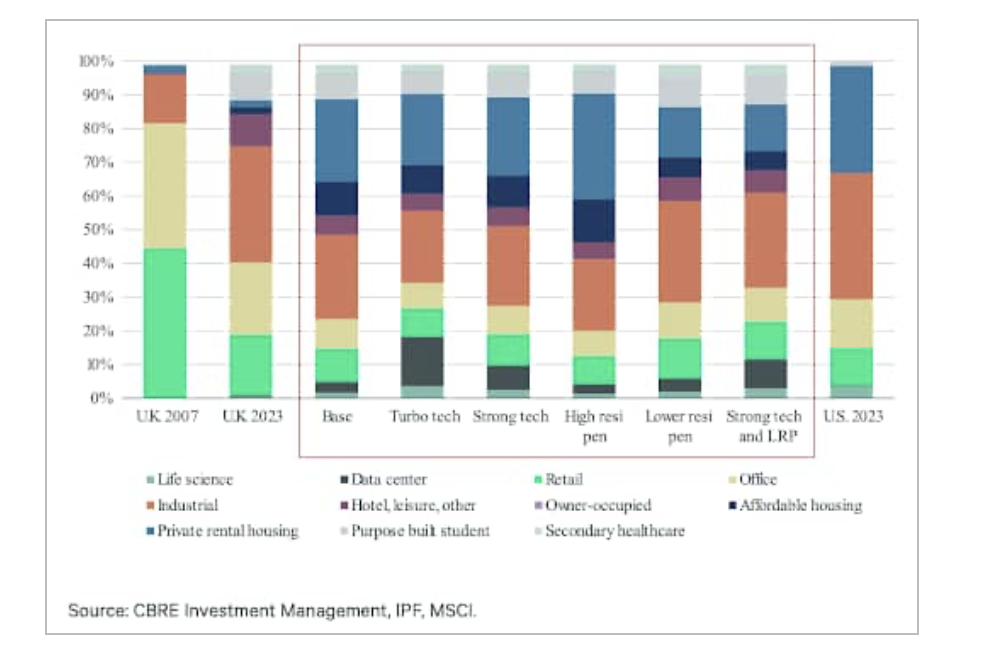
Here’s the headline picture by 2040 (base case and scenario ranges):
From “urban core” to “beds-led” universe
Today’s universe is still dominated by the urban legacy:
Urban (offices + retail): ~ 49% of the investment universe
Industrial (“sheds”): ~ 34%
Residential (“beds”): ~ 16%
Tech (data centres + life sciences): ~ 1%
By 2040, across all scenarios:
Beds become the largest theme:
From 16% today to 32–54% of the universe
46% in the base case
Sheds shrink in share, but not in value:
From 34% today to 21–30% in 2040
Total value of industrial stock actually grows by ~ 47% - just more slowly than other sectors
Urban (offices + retail) halves in share:
From 49% today to 21–30% in 2040
Versus over 80% pre-GFC
Tech grows fastest but remains the smallest:
From ~ 1% today to 4–18% in 2040
5% in the base case; up to 12% in their “strong tech + lower resi penetration” scenario, and 18% in a “turbo tech” world
Two important details:
There is no scenario where beds are not the largest theme.
There is no scenario where tech is not the smallest.
Enormous Growth Potential in Residential
CBRE are very explicit about the drivers:
For beds, the constraint is investor appetite, not underlying demand.
Residential is an enormous underlying stock; only a small slice is currently institutional.
Today, they estimate only 1.5% of affordable and 4% of private rental stock is in the investment universe. But by 2040, they see ranges of 3.8–11.3% (affordable) and 7.5–22.5% (private rental).
Tech Needs Power!
For tech, the constraint is physical capacity - especially grid and water:
They assume 10–20% p.a. floorspace growth for data centres and 5–10% p.a. for life sciences, but note that power and planning constraints will decide where we land in those bands.
Overseas capital passes 50%
Finally, they project the ownership of the universe:
Overseas ownership has already moved from 15% (2003) → 25% (2013) → 40% (2023). They expect it to pass 50% around 2038.
A note on overseas ownership: The projected majority overseas ownership by 2038 is politically incendiary whatever its economic merits. Rationally, capital origin doesn't matter—Canadian pension funds and British insurers pursue identical strategies; regulatory architecture determines outcomes, not ownership nationality (see Singapore, Netherlands).
But politics isn't always rational. "Foreign landlords" triggers reflexes that constrain policy options even when the economic critique applies equally to domestic institutions. This makes Autopilot UK harder to defend politically whilst making Rewired UK's regulatory framework more urgent—it must be built before ownership shifts, not retrofitted during a backlash.
We need institutional capital at scale; origin is economically irrelevant. The question is whether we establish strong regulatory frameworks whilst we have political latitude, or wait until ownership patterns trigger nationalist politics that foreclose more sophisticated approaches.
Setting that political complexity aside for a moment, what does the base case actually project?
By 2040…
So by 2040, in their base case, we have:
A beds-dominated universe (46%),
Followed by sheds (25%) and urban (24%),
With a small tech theme (5%),
And a majority owned by overseas capital.
On its own terms, that’s a reasonable, internally consistent forecast.
But it clearly isn’t just a real estate story.
Whither the UK Economy?
Narrow your eyes and this is just sector rotation. Open them and it’s a sketch of the UK’s future economy. Read these numbers as if they were a macro scenarios document, not an allocation note.
You get something like this:
The UK becomes a ‘beds, meds and bytes’ economy:
Investing heavily in housing and social infrastructure (beds),
Keeping a strong base of logistics and industrial (sheds),
Building a niche but constrained tech infra layer (data centres and labs).
The historic role of CBD offices and high street retail as the capital market core never returns.
Urban’s share halves and stays there.
A large chunk of the built environment, especially mid-quality offices and secondary retail, looks destined for economic obsolescence unless something radical is done.
The whole system is increasingly owned by overseas capital, collecting rent on life’s essentials.
That equilibrium has characteristics:
Strong, defensive income streams for investors,
A real estate industry that wins by serving needs, not wants - housing, health, student beds, infra, logistics,
A consumption-led, low productivity economic model where a lot of value is captured through rents on non-tradable necessities.
In other words: you can absolutely read this as the architecture of a mature rentier economy.
And for the industry, that’s… not necessarily bad.
THE LOW ROAD
Autopilot UK: the easy path to a rentier future
Let’s be blunt.
If we do nothing more than let today’s incentives run, the CBRE picture is the Autopilot outcome:
Beds institutionalise
Housing, affordable, PBSA, senior living, healthcare become the main ballast of institutional portfolios.
The sector delivers exactly what investors want: long income, low volatility, demand that doesn’t go away in a downturn.
Sheds support consumption:
Logistics and industrial space primarily serve e-commerce, parcel delivery, and supply chains for imported goods. They are productive in an operational sense, but mainly as a distribution layer for a consumption-heavy economy.
Tech stays infra-only
Data centres and labs grow, but are treated as yielding boxes with power and cooling, not as anchors for new tech ecosystems. Our ability to host compute capacity is capped by the grid; our ambition for what to build on top of it remains limited.
Urban obsolescence accumulates quietly
Prime offices are refurbished, amenitised, and re-rated. A transitional band of stock is nursed along with capex and ESG upgrades. A large tail of 1980s–2000s offices in secondary locations slowly grind down in value, but rarely get a clean reset. And the same for secondary and tertiary retail.
From a real estate industry standpoint, this might look very attractive:
You end up holding assets people need, not assets you have to persuade them to want. Demand for beds, care, and basic infra is deeply inelastic, and you have repeatable, scalable platforms that match institutional mandates perfectly.
The losers are:
Owners of obsolete space, especially leveraged office and retail holders who will, eventually, be left “holding the baby”,
Places whose historic office/retail cores no longer have a clear purpose,
And, ultimately, households and workers, who see a rising share of their income channelled into rent and basic services, with limited productivity upside.
Layer on the foreign ownership point, and Autopilot UK looks like this:
A country where the dominant investment play is to securitise housing, care and infrastructure; a growing portion of the associated income flows offshore; and much of the remaining commercial stock decays in place.
That is not a forecast of collapse. It’s worse in some ways: a forecast of managed stagnation.
THE HIGH ROAD
There is another route: using the same assets as a modernisation programme.
None of the above is inevitable.
The really interesting thing about CBRE’s work is that the asset mix itself doesn’t have to change for the story to be different.
You can still have:
Beds at 32–54% of the universe,
Sheds and urban sharing 40–50% between them,
Tech at 4–18%,
Overseas owning more than half the lot,
…and yet end up with a radically different economic and social outcome.
Rewired UK
Call this alternative Rewired UK.
Rewired UK: same pie chart, different country
In Rewired UK, we use the “beds + sheds + tech + stranded offices” mix as a national modernisation programme:
Beds as social infrastructure, not just rent streams
Institutional capital still flows into PRS, affordable, PBSA, senior and healthcare. Beds are still the biggest theme. But those platforms are structured and regulated as social infrastructure:
Stable, predictable rent regimes;
Strong quality and energy standards;
Long-term, mission-driven operating partners: linkage to health, education, and labour-market outcomes.
The same capital that would otherwise fuel a pure rentier model is now paying for decency, efficiency and resilience in the living fabric of the country.
Sheds as a re-industrialisation platform
Logistics and industrial are no longer just “e-commerce plumbing”. Selected corridors and hubs are actively positioned as advanced manufacturing + logistics ecosystems: For robotics and heavy automation, connected to ports and energy assets, and tied into skills programmes and R&D.
The same 21–30% allocation to sheds becomes a platform for tradable production, not just parcel throughput.
Tech as anchor, not footnote
Data centres and labs are treated as anchors for innovation districts, not isolated boxes:
Co-located with AI and cloud engineering teams,
Adjacent to universities and FE colleges,
Surrounded by flexible offices, labs and maker space.
Grid upgrades and planning consents are conditional on local ecosystem commitments, not just rent rolls.
Stranded offices as a national retrofitting and repurposing fund
Instead of leaving obsolete offices to quietly depreciate, we treat them as raw material:
Some become housing, care, PBSA;
Some become creative and startup space;
Some become civic, health or education hubs;
Some are demolished to fix bad street grids and open up new mixed-use plots.
AI, modular construction and standardised pattern books could dramatically lower the transaction and design costs of these transformations and is something the industry is barely beginning to exploit.
Exactly the same asset themes - beds, sheds, tech, urban - suddenly support a very different national story:
Higher productivity, because the space we provide is a complement to high-value work, not a drag on it.
Better social outcomes, because housing and care are treated as infrastructure, not pure yield.
Healthier regional economies, because stranded stock is repurposed deliberately, not left to rot.
The difference is not the content in the CBRE spreadsheet. It is what we choose to do with it.
This really is a choice – and doing nothing IS a decision
What bothers me about the CBRE report is not the analysis itself. On its own terms, it’s thoughtful, careful, and methodologically transparent.
What bothers me is how easy it would be for the industry and the policy world to treat it as ‘just how things are’:
To optimise portfolios for the ‘Autopilot UK’ scenario,
To quietly accept that a residential-dominated, foreign-owned universe is an unalloyed good for the sector,
To wave away the obsolescence problem as someone else’s write-down, some time later.
But that isn’t a neutral stance. It’s a choice.
We are, implicitly, choosing between two futures built on the same basic building blocks:
Autopilot UK
Real estate as a machine for turning housing, care and infra scarcity into income streams,
A slow-motion write-off of obsolete offices and retail,
A consumption-heavy, low-productivity economy,
A majority of “life infrastructure” owned by overseas capital.
Rewired UK
Real estate as the backbone of a social and industrial modernisation programme,
Systematic retrofit and repurposing of stranded stock,
Housing, health, logistics and tech infra treated as platforms for human capital and productive firms,
A robust, investible universe that still works for its ultimate users.
The CBRE report doesn’t, and can’t, tell us which of those futures we should pick.
But it does something valuable: it removes the illusion that we are dealing in short-term market noise. The composition of the investment universe is slow-moving, path-dependent, and incredibly hard to reverse once set.
Which means the next decade is not just about:
“Do we like beds and sheds more than offices?”
or
“How many data centres can the grid handle?”
It is about what kind of country those bets add up to.
CONCLUSION
The unsettling conclusion is this:
Sleepwalking into a rentier future is not a forecast. It’s a policy, just not one we’ve admitted to.
And the hopeful one is:
We still have time to decide that we want something else – and to use the very same “beds + sheds + tech + stranded offices” mix to build it.
This is a choice WE, as a society, and very specifically, as a real estate industry, have to make. And the window for making it with full political latitude, before ownership patterns and asset lock-in constrain our options, is narrower than we think.
Human+Machine Organisational Architecture

A Framework for Sustaining Competitive Advantage in the Age of Capable AI
I’d like to propose a new organisational architecture for knowledge-intensive firms operating in an environment where artificial intelligence can execute most routine cognitive work at near-zero marginal cost. It’s a framework which addresses a critical paradox: AI automation creates immediate productivity gains but threatens long-term organisational capability by eliminating the traditional talent development pathway.
This introduces a framework I'll develop across several newsletters. We urgently need this, or something like it. How we run ‘knowledge’ companies IS going to be profoundly reshaped by the abundance of cheap intelligence AI will deliver us. We cannot go on as we are, and we absolutely must avoid becoming mere ‘slaves to the machine’. We need something better: I’d like to think what follows outlines what is possible, should we wish to take up the challenge.
THE GOAL
The foundational spirit of this organisational transformation is to treat AI as infrastructure for human capability development, and not merely a tool to reduce labour costs. Its purpose is to automate routine cognitive execution, so humans can direct their cognitive powers toward high-judgement work, creativity, design intelligence, and strategic thinking.
If the end point is not humans operating at a level above where they are today, doing work that did not exist before, and creating dramatically more productive companies, then it will have failed.
THE BROKEN PYRAMID
Efficiency Alone Leads to Collapse
Traditionally knowledge-intensive organisations have relied on a Pyramid Structure: a large base of junior staff executing routine work, an experienced middle layer, and a small top layer providing strategic judgment.
This structure served a dual function. First ‘Economic', where inexpensive junior labour effectively subsidised expensive senior expertise. And secondly ‘Developmental’ where juniors would learn by doing over a period of 8-12 years.
Capable AI fundamentally breaks this model by eliminating the economic justification for junior roles. Let’s look at this through the lens of a 30 person CRE investment company (or division).
AI can now perform tasks like data extraction and synthesis, first-draft document creation, and quantitative modelling at a cost of £2–10K annually, vastly undercutting the traditional junior analyst cost of £50–70K. So who needs juniors?
Delayed Catastrophe
This though sets us up for a paradoxical failure: The obvious optimisation (replacing juniors with AI) creates a delayed catastrophe: By removing said juniors and replacing them with AI, productivity surges in years 0–3, but after that we start to see a hidden erosion - no junior cohorts developing expertise. By years 8–12, a capability crisis hits as senior talent retires without qualified internal replacements. Feast then famine. Fine if you’re in the generation feasting, not so great for everyone else.
The Strategic Response
So we need a strategic response. If economically we don’t need, and benefit from, not having to employ juniors, but this in turn eventually kills us, maybe we need to be thinking of a better alternative.
A quick caveat here: many companies will luxuriate in dumping employees over the next few years. Because most of the C-Suite isn’t that bothered about what happens a decade out; their bonuses depend on results in the here and now. Shareholders might want to think hard about realigning incentives for this new actuality. And employees would do well to understand the time horizons of their bosses, and act accordingly.
Many is not all though, and this framework is for those types.
The Core Hypothesis
Here is the core hypothesis; organisations that deliberately design their operating model for human+machine collaboration, rather than substitution, will achieve 2–3x productivity improvements and 50% faster talent development (4–6 years vs 8–10).
These companies will have a new objective.
The traditional model focused on humans doing routine work while capability development was a side effect (learn by doing over time); the new model focuses on capability development as the primary objective, using AI to handle routine execution.
And this will require three fundamental shifts:
1. From execution to judgment: Junior roles need to shift from being about completing tasks, to supervised capability development. The role is no longer about ‘sucking up the grunt work’ but being rapidly developing talent. We’re trying to crack Bloom's 2 sigma problem: the educational phenomenon whereby the average student tutored one-to-one using mastery learning techniques can perform two standard deviations better than students educated in a classroom environment. We’re just substituting a place of work for the classroom.
2. From tacit to explicit: Senior expertise must become externalised organisational knowledge. The organisation needs to become the learning ‘organism’, collectively, and for the benefit of all. And suppliers of tacit knowledge need to be encouraged, and compensated, for spreading it around.
3. From time-based to competency-based progression: Advancement is driven by demonstrated capability, not tenure. It should no longer be a function of how long you’ve been in a job representing your career progression. If you’re good enough, you’re good enough.
A Three Layer ARCHITECTURE
The ‘Three-Layer Architecture’ proposed here very deliberately inverts the traditional pyramid model to focus on building and protecting human judgment and creativity.
Layer 1: Execution Engine (AI-Native): This layer automates systematisable, low-learning-value work (e.g., routine data analysis, compliance checking). It must be transparent, showing reasoning to preserve learning opportunities. That which is ‘structured, repeatable, predictable’ should be automated. But it is still important for the ‘Humans’ to understand what is being done.
Layer 2: Judgment Development (Human-Centric): Humans at all levels focus on non-routine work: strategic decision-making, creative problem-solving, quality assessment, and identifying edge cases where automation fails. The critical difference here (from a traditional model) is that everyone focuses on non-routine work. Juniors aren’t corralled into only dealing with ‘grunt’ work - from the start they are pushing their human-centric capabilities.
Layer 3: System Stewardship (Human+Machine): This is the meta-layer where humans design AI workflows, externalise expert knowledge, and continuously improve the system itself. All these systems are going to be iterative. The initial design, the creation, requires strong technical and domain-specific knowledge, but curation is going to be a major ongoing feature of work. Part of the point is that human+machine is a creative modality, not a write once then leave way of thinking. Competitive advantage will accrue through creation, but last through curation.
Redefining Organisational Roles
New Talent Structure: From Analyst to Learner and Architect
This organisational architecture will require new roles. We’re looking through the lens of an ‘Investor’ but variations on this can be developed for any type of knowledge work.
The New Roles
Resident Learners (Years 0–2): This role replaces traditional junior analysts. They will validate and review AI outputs (developing quality judgment) and practice judgment in simulations, focusing on documenting patterns and edge cases rather than routine data processing.
This is personalised learning at work: The AI will be doing the processing, but the humans will be learning how to recognise good from bad, and building their critical thinking capabilities. By also working with ‘simulations’, they will be exposed to a far greater variety of deals/problems/processes than is traditionally the case.
Critically the aim is that they will progress significantly faster, potentially reaching the next stage in just 3–4 years.
Autonomous Investors (Years 2–5): These will replace traditional associates. They will execute complex transactions, make independent decisions within limits, and mentor Resident Learners (teaching solidifies expertise and provides an extra flywheel for knowledge accumulation). All their cognitive powers are focussed on human-centric strengths. Being the ‘human in the loop’ is their purpose.
System Architects (Years 5–8): This new discipline doesn't traditionally exist. They are half knowledge engineer, half domain expert, focused on designing and refining AI workflows and capturing senior expertise into reusable frameworks, multiplying the organisation's effectiveness.
Strategic Leaders (Years 8+): Their work shifts from execution oversight to teaching, knowledge externalisation, portfolio strategy, and genuinely strategic problem-solving.
The Creative Dividend and Strategic Advantage
The New Moat: Institutional Intelligence and Imagination
The ultimate output of this architecture is that each layer of automation must return usable cognitive capacity to humans and generate a creative dividend.
Sustainable outperformance requires combining disciplined allocation of capital with distinctive creative capability (taste, imagination, narrative).
Key advantages are that this framework ensures sustained competitive advantage through institutional knowledge capture (less dependent on individuals) and greater resilience. The economic model will provides higher margins and faster growth because of AI augmentation and a reliable, accelerated talent pipeline. Talent density will increase, and that will spur far greater momentum than is traditionally seen. This is a commercial learning machine with a very human core.
Conclusion
A Hypothesis for Transformation
To reiterate: this transformation is critical because the alternative (short-term efficiency optimisation) will/would inevitably lead to a capability crisis.
Technology, paradoxically, is going to be the easy part; the transformation requires leadership conviction, patient capital, and cultural change.
In future newsletters we will cover the detailed Capability Development System (simulation and mentorship) and the Transition Roadmap.
An analogy to finish with
Think of the traditional knowledge firm as a clockmaker’s workshop: apprentices start by polishing gears (routine work) for years, slowly learning the art of clock assembly (judgment) from the master. When AI arrives, it can polish every gear instantly and perfectly. If the workshop eliminates the polishing job, it loses the training pathway, and future generations never learn how to assemble a clock.
The Human+Machine Architecture transforms the workshop into a flight simulator: AI handles the routine mechanics, freeing the apprentices to immediately practice complex landings (judgment) under the master's close guidance, reaching mastery in half the time, ensuring the firm always has expert pilots ready for novel missions.
The Great PropTech Flywheel: How To Achieve It

The System We Need (But Don't Have)
Picture the ideal state: Sensors detect HVAC degradation. AI predicts failure 47 days out. The system auto-generates a work order, routes it to a pre-qualified contractor, schedules intervention during low occupancy, and logs the prevented failure in the ESG ledger. The documented improvement feeds into green loan pricing, triggering a margin step-down. Total time from detection to resolution: 36 hours. Human intervention: one approval click.
THE SIX LAYERS
This isn't science fiction. Every component to make it happen exists. In 6 layers. Within these are the entire ecosystem of products and services we need to ‘build a better built environment’.
Layer 1: Data Collection: IoT sensors, BMS integration, digital twins capturing real-time performance.
Layer 2: Optimisation: AI analytics predicting failures, optimising HVAC, lighting, space utilisation.
Layer 3: Execution: Modular retrofits, automated FM workflows, augmented maintenance teams.
Layer 4: Governance: ESG platforms, carbon accounting, continuous performance verification.
Layer 5: Finance: Green debt priced on verified operational data, not BREEAM certificates.
Layer 6: Human Layer: Occupant analytics linking environment to productivity, retention, wellbeing.
As components in an ecosystem they would each act as flywheels for each other: Better data → smarter optimisation → validated execution → credible ESG → cheaper capital → funds improvements → generates more data.
The problem is that despite everything existing, and the existence of ‘Smart’ buildings from London to Singapore, we have components, not systems. Nowhere is this flywheel in motion. It is a ‘known known’ that this is what we need, but to date we’ve just not managed to make it happen.
Why the Flywheel Doesn't Spin
There are multiple reasons why the flywheel doesn’t spin:
1. Fragmented Ownership
Each layer has different buyers making independent decisions:
- Layer 1: Procurement teams optimising sensor unit costs
- Layer 2: Engineering teams proving AI ROI
- Layer 4: Sustainability officers meeting compliance deadlines
- Layer 5: CFOs negotiating debt terms
- Layer 6: HR measuring employee satisfaction
No single decision-maker sees the compounding value. The procurement team buying sensors doesn't benefit from reduced debt costs three layers later. The CFO accessing green finance never sees occupant retention data that justified the improvements. They work together, but apart.
2. The Adoption Trap
Layer 2 (AI) needs data from Layer 1 (sensors) - but sensor deployment won't scale until AI proves ROI. Layer 5 (finance) needs verified data from Layer 4 (governance) - but governance platforms struggle until they unlock cheaper capital. Layer 3 (execution) needs proven savings from Layer 2 before landlords commit retrofit budgets.
Each layer faces adoption friction individually. Network effects only materialise at system scale - but no rational actor deploys the full stack speculatively.
3. Capital Structure Mismatch
The layers require incompatible funding:
- Layer 1 (sensors): Hardware capex, slow payback, 10-15% margins → VC won't fund
- Layer 3 (execution): Services business, 5-12% margins → PE finds unattractive
- Layer 5 (finance): Regulatory-heavy, capital-intensive → Requires institutional capital
- Layers 2, 4, 6 (software): High-margin, scalable → This is what VC wants
But the flywheel only spins across all six layers. You can't fund it with capital that only wants three spokes.
The Sovereign Solution (That We Don't Have)
There's a straightforward solution, in theory. And one that I had high hopes to see emanate from the Gulf.
Sovereign-scale orchestration could solve all three problems. A Gulf sovereign wealth fund committing £5-10bn to create companies across all six layers, with guaranteed government procurement, mandated interoperability, and 30-50 year capital horizons.
The Gulf has executed this playbook before: Emirates catalysed ground handling, catering, training into a £100bn+ ecosystem. Ma'aden seeded downstream aluminium, phosphates, industrial clusters. When you control both supply and demand, you solve chicken-and-egg problems by mandate.
Unfortunately it seems the guiding force in the Gulf real estate sector remains a short-term, build-to-flip model, incentivised by a need to project rapid, noteworthy ‘progress’, a desire for ‘capital velocity’ and a reliance on real estate as a major component of GDP and employment.
With energy and water subsidies removing price signals and the preference for importing proven solutions, all incentives are towards being rationally irrational and not building for the future. Everything needs to be done today, or tomorrow at the latest.
In fact the Middle East is solving the wrong problem superbly. World-class at rapid deployment, capital mobilisation, iconic architecture whilst not addressing durability, adaptability, resource efficiency or knowledge creation.
So sovereign-scale orchestration is unlikely to move from theory to reality.
In western markets we certainly can't make it happen. We don't have sovereign entities that can mandate integration across thousands of private landlords or force technology interoperability.
British Land can't compel Landsec to use the same protocols.
Which means the West needs market-driven orchestration, not sovereign coordination.
The Failed Paths Forward
The PropTech Unicorn
Brilliant predictive maintenance AI forecasts HVAC failures with 94% accuracy. It generates an alert: "Chiller 3 will fail in 47 days."
Then what? Without Layer 3 (execution) integration, the alert goes to an inbox. Gets forwarded. Quote requested. Finance approves three weeks later. Scheduled for next maintenance window, six weeks out. By then the chiller has failed.
Without Layer 4 (governance), even if repair happens, there's no ESG logging. Without Layer 5 (finance), accumulated improvements never feed into debt pricing.
The AI was correct. The technology worked. But the *system* didn't activate.
Venture-backed PropTech optimises individual layers superbly. But venture structures - 7-year duration, software margin requirements - prevent ecosystem orchestration.
The Landlord Builds It Internally
Landlords have the right incentives (often 20-50 year holds) and captive testing grounds (millions of square feet/metres). But building enterprise software requires completely different DNA: agile development, product management, technical talent retention.
And the talent economics work against them, especially now AI is such a key technology. Machine Learning engineers are likely to be considerably more expensive than asset managers, which won’t go down well. And the best technical people will likely leave, or be poached, within 18 months.
Historical precedent is harsh: Tesco built supply chain technology, which they never managed to sell externally and eventually outsourced. Sainsbury's built a whole banking arm but ended up selling that to NatWest. These were structural mismatches between core competency and market requirements.
Exceptions do exist. Ocado spun out fulfilment technology as a genuinely separate entity - distinct governance, compensation, leadership. But this requires admitting your competitive advantage should become someone else's business.
The Incumbent Platform Extends
Yardi could acquire point solutions across all six layers and force integration through ownership.
But they’d face acute innovator's dilemma:
- Architectural legacy: Decades-old COBOL (not all but much). Adding AI is effectively limited to either greenfield rebuild (politically impossible) or wrapper strategy (orchestrating *around* the platform).
- Business model conflict: Yardi makes money from seat licenses. The flywheel model is outcome-based (which we’ll come to): "We reduce OPEX 20%, take 30% of savings." This cannibalises their revenue.
- Channel conflict: Routing work orders to specific contractors competes with customers' FM teams and vendor relationships.
Repositioning from administrative infrastructure to strategic partner would alienate their current user base - often the people whose jobs the flywheel would automate.
Private Equity Roll-Up
PE can consolidate supply (buy 8-10 PropTech companies), but not demand (thousands of independent landlords with different priorities).
Combining high-margin software (Layers 2, 4, 6) with low-margin hardware and services (Layers 1, 3) destroys the blended margin profile PE requires. And who buys an integrated PropTech conglomerate? Too large for strategic acquisition, too operationally complex for public markets.
What Actually Works: The Orchestrator Model
What actually would work is a new entity designed for orchestration, not ownership.
Think Uber: doesn't own cars or manufacture GPS, but orchestrates the system and captures coordination value. Think Stripe: doesn't own banks, but orchestrates developer access to payment infrastructure.
The orchestrator's function:
- Ingests data from *any* Layer 1 source (sensor-agnostic)
- Runs optimisation models (proprietary or wrapping best APIs)
- Routes execution via Layer 3 partners (FM platforms, contractor networks)
- Feeds governance/ESG reporting automatically
- Provides verified performance data to finance
- Surfaces insights to occupants through existing workplace apps
Why This Becomes Viable Now
Five years ago, integration required armies of engineers building bespoke connectors. Today, three shifts change the economics:
1. LLM-Based Integration
LLMs interpret unstructured data - maintenance logs, sensor feeds in proprietary formats, PDF contracts, email complaints - and route information across systems without bespoke APIs.
Example: Predictive alert → LLM queries BMS history (any vendor format) → checks warranty terms (reads PDF) → identifies contractors → generates work order → routes to approval → updates ESG ledger → notifies occupants → logs for loan calculation.
Every step previously required dedicated integration. Now the LLM handles interpretation and routing. The integration complexity changes fundamentally.
2. API-First Modern PropTech
The 2015-2023 PropTech wave produced hundreds of API-first point solutions, unlike legacy systems. Modern ESG platforms expose RESTful APIs. Sensor networks use standard protocols. Even legacy systems now have third-party connectors.
3. Vertical AI Agents
Facilities maintenance and procurement involve multi-step workflows with conditional logic and exceptions. This previously required manual execution or brittle workflow engines.
Now AI agents manage these dynamically, adapting to context, interpreting policies, handling exceptions without explicit programming for every edge case.
The Business Model That Changes Everything
The orchestrator uses ‘Outcome-Based Pricing’.
I.e ”We reduce operational costs 15-25%. We take 30% of verified savings for five years."
This is radically different from SaaS subscriptions:
For landlords:
- Zero upfront cost (eliminates budget approval friction)
- Zero implementation risk (only pay if it works)
- Aligned incentives (orchestrator only profits from actual savings)
For the orchestrator:
- Captures value from ‘integration’ across layers
- Revenue scales with customer value, not seat count
- 18-24 month revenue lag (requires patient capital, creates moat once cash flows)
Why this was impossible before: Outcome-based pricing requires verified measurement, attribution clarity, and continuous monitoring - all require the integrated stack. Point solutions can't verify outcomes in isolation.
Three Emergence Scenarios
Scenario A: Landlord Spin-Out
A forward-thinking European landlord (British Land, Derwent, Scandinavian institutional owner) builds an integrated stack, internally driven by regulatory pressure and sustainability commitments.
After 18-24 months: It works (18-22% OPEX reduction verified). But they can't run a software business. Other landlords want the capability. They spin out as separate entity with distinct governance, competitive compensation, autonomous leadership, external capital.
Challenge: Requires admitting competitive advantage should become someone else's product. As with Ocado above.
Scenario B: Big 4 Managed Service
Deloitte/PwC/EY/KPMG recognise they have Layer 4 (ESG practices), audit credibility (Layer 5), client relationships, and capital to acquire point solutions.
Build "Building Performance as a Service” - outcome-based managed service combining tools + advisory + ongoing verification.
Precedent: Accenture's acquisitions building hybrid consulting + technology practices.
Challenge: Consultancies struggle with product thinking and technical talent retention. Would likely acquire PropTech company for technology core, wrap in consulting delivery.
Scenario C: Purpose-Built New Entrant
Founding team from real estate + technology raises growth equity (not VC) to build orchestrator from scratch.
Team profile:
- CEO: Former COO of major landlord (customer credibility)
- CTO: From industrial IoT/energy management (technical execution)
- Chief Commercial: From Big 4 sustainability practice (customer relationships, audit credibility)
Capital: £50-100m from growth equity comfortable with outcome-based revenue lag.
Timeline:
- Year 1-2: Partner with anchor customer, deploy across 50-100 buildings, validate 15-20% OPEX reduction with Big 4 audit
- Year 3-4: Expand to 5-10 landlords, achieve £10-30m revenue, begin selective acquisitions
- Year 5-7: Prove model across building types, reach £100-200m revenue, path to IPO or strategic exit
Precedent: Palantir (integration and analytics layer for industrial and government systems, ~$60bn market cap) - think ‘Palantir for the Built Environment.’.
Why this path is most credible: Specifically designed to solve the market failure - patient capital, outcome-based pricing, orchestration model, real estate DNA, technology credibility.
Conclusion
Nobody predicted Stripe in 2010. Payments were “solved”, PayPal existed, banks existed. What Stripe did was articulate the structural logic: developer experience in payments is broken, here's where value should flow. Then they built it.
This newsletter isn't predicting the PropTech orchestrator. It's articulating the structural logic: data assembly, agent orchestration, and verification are where value flows in an AI-mediated real estate world. The exact implementation, who builds it, which path they take, what it's called, matters less than understanding that logic.
Because when the Stripe moment arrives in PropTech (and it will, even if it looks different than described here), you'll want to have been thinking about data, orchestration, and trust for the past 18 months.
The CRE AI Formula - Learning From Student Housing

Sometimes a niche reveals the whole system
I’ve just given a keynote entitled ‘AI or Die? The Silent Revolution Coming for Residential Living’, and I discovered whilst working on it that the future of AI in the PBSA sector provides a blueprint for most real estate asset classes.
The future is not as uncertain as we think.
We already know most of what we need to know about AI in real estate:
What works now
What’s likely possible within five years
The barriers and strategic risks
The implications for skills, technology, and human capability
The need for a staged roadmap
And, above all, that Human is the New Luxury.
What we don’t yet know:
Whether organisations can execute on the available capabilities
How long real transformation will take - timing is a fools errand!
Whether “fewer but better” employees will generate additional revenue
And whether the market will ultimately value “Human as Luxury” the way we think it will.
The Technological Flywheel
So let’s map this out. What do we know about the future of AI?
First, even if all AI progress was to stop today much of what is likely to occur by 2030 will happen anyway. In fact, there is probably ten years of optimising, fine tuning and ‘tweaking’ to be done on the frontier models as they stand today. OpenAI’s ChatGPT, Google’s Gemini and Anthropic’s Claude are already extraordinarily ‘intelligent’.
And before anyone jumps up and screams ‘But they’re not intelligent’, we all know they are not ‘intelligent’ in a human sense, but if they can reach the same destinations as much of human intelligence, frankly who cares. They’re intelligent.
Jensen Huang, CEO of Nvidia (whose chips power 80%-95% of AI output) a year ago stated that their power had increased by 1000X in just 8 years. And that currently they are improving at ‘Moore’s Law Squared’. And the highly regarded research company Epoch AI recently wrote that leading AI models are likely to grow another 1,000x between now and 2030, assuming current scaling trends continue.
A total of 5 current and former employees of Google and DeepMind have won AI-related Nobel Prizes in the last two years (2024 and 2025).
Both Google (specifically their AI research lab DeepMind) and OpenAI have achieved gold medal-level performance in the 2025 International Mathematical Olympiad (IMO), which is widely recognised as one of the most prestigious mathematics competitions in the world.
Mostly people do not realise just how far AI has already progressed or how fast it is continuing to develop.
So we already have enormously powerful AI to work with, and we know it is going to only get better, fast. Which underpins why change in real estate will accelerate. Guaranteed.
The Kernel Shift
Andrej Karpathy was one of the founders of OpenAI and head of AI for Tesla for many years. He is in the pantheon of AI researchers, and when he talks, everyone listens.
One of his signature ideas from late 2023 was that LLMs, Large Language Models, would develop to be the kernels of a new computer operating system.
Increasingly we would interact with computers using natural language (he quipped that ‘the hottest new programming language is English’), and the LLM would understand our requirements and pull in any extra tools needed to fulfil them.
Maybe a web browser, or a calculator, or Python coding terminal. The point being that the Language Model acted as our interface to any digital service we needed.
This is coming to pass at incredible speed. Far faster than was presumed two years ago.
Many of these ‘Agentic’ systems, as they are known, are already available to us within the frontier models (have you tried ChatGPT in ‘Agent’ mode?), and a whole industry of specialist engineers is developing, building domain specific ‘Agents’ and the ‘Orchestration’ layer needed to operate them.
Orchestration is best described as a way to synchronise the activities of multiple agents according to a desired plan. Like those drone displays becoming commonplace in replacement for fireworks.
And in this environment the individual tools become less important than the creation and curation of the workflows we want them to perform. This orchestration becomes the strategic battleground. Who has the best ‘orchestra’?
The PBSA Playbook
There is a ‘Low Regret’ AI playbook within the PBSA sector. Not pervasive today, but those using AI to date are mostly following it. It involves doing what we know works! Adopting applications mature enough to be tried and tested (many from other sectors such as multi-family).
These include utilising dynamic pricing (used in hospitality for a long time), predictive maintenance, and energy optimisation. With the latter two being enabled by ubiquitous connectivity and cheap yet powerful IoT sensors.
Simply put, you can’t really go wrong with these: they have been around a while, been heavily stress tested, and are available from multiple credible suppliers. Dynamic pricing ‘should’ provide 3-5% revenue uplift, preventive maintenance ends expensive ‘panic fixes’, and energy optimisation is perhaps the lowest hanging fruit with 10-20% savings being pretty easy pickings in most assets, and more in others.
As in PBSA, many other CRE asset classes should be utilising these as table stakes. It’s really quite delinquent if one is not.
The Future Frontier
Rapidly we should be moving to the next phase where the tech we use moves from being discrete apps to integrated systems, with AI becoming the “digital nervous system” of assets.
Within PBSA there are five obvious use cases, each of which, once again, are applicable across multiple CRE asset types.
1. Agentic Operations & Digital Twins
Integrated AI "agents" will orchestrate complex decisions simultaneously across entire portfolios, optimising pricing, maintenance, and energy usage based on real-time data and simulations run on digital twins. Leading to holistic, automated asset management.
Keep your eyes on the Finance sector for early instances of this, or the likes of Walmart.
2. AI-Assisted ESG & Grid Flexibility
PBSA buildings will evolve into smart energy nodes. AI energy managers will decide when to store, consume, or sell excess power back to the grid, enabling participation in virtual power plants (VPPs) and creating new ancillary revenue streams.
Look at what Octopus Energy are already doing with their vehicle-to-grid (V2G) technology.
3. Automated Inspections & Computer Vision
Drones or computer vision systems (analysing CCTV feeds) will perform regular inspections of roofs, façades, and communal areas to detect defects, monitor cleanliness, and automatically generate work orders.
Drones improve in line with AI, so they are getting to be very powerful tools, very quickly.
4. Hyper-Personalised Engagement
AI systems will act as proactive digital concierges, learning student preferences (e.g., study habits, event attendance) to provide tailored suggestions for study groups, events, or services.
Watch for the growth in AI model ‘memory’. Frontier models are growing in their ability to remember - so they can ‘get to know you’ in quite some detail.
5. Advanced Data-Driven Student Welfare
AI may analyse non-intrusive data (such as access card usage or facility logs) to identify students at risk of distress, dropping out, or loneliness, allowing staff to conduct proactive welfare checks. This application, however, faces significant privacy barriers.
Watch though for AI therapists with robust guardrails. Many bad actors want to sell personal AI, but so do many good actors. Regulation is likely to favour the latter over time, albeit probably not arriving until someone ‘misbehaves’ badly.
All of the above are nascent technologies but developing fast. They are complicated to get right but not rocket science. And every time the power of ‘natural language computing’ increases the easier it will be to implement them. Science fiction they are not.
The Human Dimension
An absolute certainty is that successful AI rollouts within CRE (as across all sectors) will be as much about ‘Change Management’ as technology. The brutal truth is that if AI can execute a task faster, smarter, and cheaper, that task is no longer for humans. And CRE is full of manual processes that should be automated away. And will be.
So all of us are going to be going through a process of upskilling and raising the quality of the jobs we can offer. And for a given unit of output we will definitely be needing fewer people.
I see this as a feature, not a bug. We want humans to be doing what humans are uniquely good at, and computers are not. It is pointless to be looking for anything else. This is ‘don’t bring a knife to a gunfight’ territory. We humans have to raise our game, maintain agency over ‘the machines’, and focus on where we add value.
#HumanIstheNewLuxury
I believe #HumanIstheNewLuxury, as a mindset, needs to be our default setting. We have to learn new ways of working, where we automate what we can, use technology to augment us wherever possible, and deeply appreciate where only 100% human will do.
Within PBSA the entire game is going to be about reducing costs through technology, but reinvesting in much higher levels of pastoral care, customer support, and fostering a sense of safety, connection, and belonging. AI cannot replicate the empathy, lived experience, cultural sensitivity, emotional intelligence, or gut instinct required for true wellbeing support. And providing that is what is going to safeguard excellent returns.
The critical factor offsetting staff displacement is the ability of these new, human-centric roles to directly influence revenue (RevPAB) and asset value in ways that transactional staff could not.
And is this going to be any different across other CRE asset classes? I don’t think so. My hunch is that the technology is going to develop faster than we imagine, but that once here, we’ll all get bored with it. It will be amazing for a while, but sooner or later no more exciting than turning a light switch on, or loading the dishwasher.
And then we’ll all be craving more humanity. And seeing as we spend 90% of our time indoors, maybe the real estate industry is in a good place to provide it?
Three Horizons for AI in Real Estate
PBSA and the rest of the industry will likely follow these timings:
Now (2025–2026): Low-regret moves: dynamic pricing, conversational leasing, energy optimisation.
Next (2027–2028): Integrated systems: AI agents orchestrating decisions across assets.
Beyond (2029–2030): AI-native portfolios: designed from day one to generate and govern their own data. And run themselves.
Conclusion
This blueprint for PBSA feels like a roadmap for much of the industry. Of course, none of it will be possible unless the industry gets its data in order, but I’m assuming, even if through gritted teeth, we’ll get there. Because we have no choice.
Once you’ve got near or real-time data, in a data lake rather than in silos, everything becomes possible. And it really is not that complicated. All of the above could be done today, with some difficulty. In 3-5 years it will become child’s play.
As stated at the top though, the things we don’t know are whether the industry can get to grips with all of this (surely it can), how long it will take, how the revenue/cost aspect of fewer but ‘better’ employees will pan out, and ultimately whether society develops to really value #Human, or we get subsumed under a technological tsunami.
Personally I am feeling very positive about all of this. I suspect a lot of the industry will mess it up, but they’ll fade out of existence and the future will belong to those who go ‘all in’.
OVER TO YOU
Where do you stand with embracing the future? Ready? Willing? Able? If you don’t believe in this vision, what are you counterfactuals? If we don’t move forward in this way, where’s our moat? As always, would love to hear your feedback.
Cognitive Sovereignty - Use It Or Lose It

We’ve already arrived in the era of ‘Workslop’, and need to decide if this is just an amusing meme, or something much more perilous.
The adoption of Generative AI within businesses represents the most fundamental change to cognitive work since the Internet. And it presents us with a real paradox; it simultaneously has the potential to deaden our minds or energise them. Your cognitive capabilities (which is what you are paid for) are either going to atrophy or be augmented. And which it is is entirely down to you.
Executive Summary
Generative AI presents knowledge workers with a stark binary: cognitive atrophy or augmentation. Research shows that 40% of professionals now receive “workslop” (AI-generated content that appears substantive but lacks genuine insight) and those who produce it suffer significant reputational damage (50% are viewed as less capable, 42% as less trustworthy).
The risk isn't hypothetical. Unlike calculators or GPS - occasional tools for discrete tasks - AI is being embedded into the core daily work of nearly every knowledge professional. Persistent cognitive offloading leads to documented degradation: erosion of critical judgement, memory atrophy, automation bias, and loss of problem-solving capability.
But the same technology can augment rather than replace thinking. This requires intentional engagement: using AI as a cognitive scaffold for routine tasks while maintaining "strategic friction" to preserve deep thinking capabilities. This newsletter presents a five-pillar Intentional Intelligence Framework grounded in cognitive science:
Generative Primacy: attempt problems independently before consulting AI.
Strategic Friction: time-box AI access - schedule deep work without it.
Metacognitive Monitoring: maintain awareness of your thinking processes.
Contemplative Presence: use micro-pauses to interrupt autopilot behaviour.
Weekly Practice: commit to analog problem-solving and digital sabbaths.
The choice between atrophy and augmentation isn't made by your employer or the technology. It's made in dozens of small decisions daily about how you engage with AI. The consequences, for your cognitive capability and professional value, are now well documented.
“Workslop”
This hideously ugly word was recently coined in a Harvard Business Review article - ‘AI-Generated “Workslop” Is Destroying Productivity’.
The authors define it as ‘AI generated work content that masquerades as good work, but lacks the substance to meaningfully advance a given task.’ And they say that 40% of the 1,150 US based participants in the study received ‘workslop’ in the last month and that 15.4% of the content they receive at work qualifies.
It seems to be having a corrosive effect on the workplace.
“Approximately half of the people we surveyed viewed colleagues who sent workslop as less creative, capable, and reliable than they did before receiving the output. Forty-two percent saw them as less trustworthy, and 37% saw that colleague as less intelligent.”
To be clear, AI didn't invent shallow work. Many corporate incentive structures have long rewarded visible activity over genuine insight. What has changed is that AI has now made the production of this plausible-sounding 'slop' nearly instantaneous and infinitely scalable, turning a chronic issue into an acute crisis for productivity and trust.
None of which is good. In fact this is a flashing red sign of something likely to get very much worse unless steps are taken to mitigate it. After all these are high numbers considering the still very low day to day usage of Generative AI in business. So what is going on?
Setting the Scene: The Competitive Edge
What is happening is a consequence of the fundamental purpose of AI systems. They are designed to try and remove friction and generate efficiencies. The aim is to eliminate effort and difficulty. That is their job.
Unfortunately us humans are naturally lazy and when given the opportunity to take the path of least resistance we do that. In a work environment the option to delegate thinking and accept the easy, immediate answer is too much for many to resist. And they don’t, which leads to what researchers call ‘metacognitive laziness’. And business people call loss of ‘competitive edge’
Actions Have Consequences
This has consequences that are well known, and have been seen before many times. With the rise of calculators we lost the ability to perform mental arithmetic, when GPS became competent we lost the ability to read maps, and when Google came out we reconfigured our memory to remember where we can find facts rather than remember the facts themselves (known as the “Google” effect). All of this is supported by extensive academic research, as well as being something we can all relate to.
What is happening with AI though is more pervasive and more dangerous. We all have easy access to calculators, seldom need to read a map, and know how to ‘Google’. So having diminished cognitive function in these areas has little downside.
The threat from AI is of a different magnitude entirely. Calculators automate a single, discrete task. GPS is used only when navigating unfamiliar territory. These are edge cases. Generative AI, however, is being integrated into the core daily workflow of nearly every knowledge worker. It's not an occasional tool for a minor task; it's a constant partner for our most important work: writing, analysing, strategising, and creating. The cognitive offloading isn't occasional and peripheral; it's becoming constant and central.
The trouble is that with AI, as a general purpose technology, rapidly acquiring higher level knowledge skills, if we lose our ability to think then our intrinsic value trends downwards very rapidly. Pushing out ‘workslop’ is like having a sign above your head saying ‘I’m not needed’.
The Atrophy Thesis
The actual consequences of ‘cognitive offloading’ are broad, and frankly scary. They are academically noted as the ‘atrophy thesis’ and in headline terms are:
Erosion of Critical Judgement
Long-term Memory Atrophy
Loss of Problem Solving Capability
Automation Bias (accepting AI results unconditionally)
Reduced Trust in Own Judgement
Reduced Capacity for Sustained, Deep Work.
Reduced Ability at Self-Monitoring and Critical Self-evaluation
Loss of Divergent Thinking and Creative Confidence
Which is a lot of downside in return for a spot of laziness, but overwhelmingly supported by converging evidence. Consistently offload your thinking to an AI and this will be you.
How to Do It Right: Augmentation as Strategy
There is though another way. The same technology that will deaden your brain if you let it can also be leveraged as a catalyst for growth. This requires pedagogical intent and a bias towards augmentation rather than automation. Using the technology as an interactive tool to support and extend thinking, rather than simply replace it.
Augmentation in Practice
1. Scaffolding and Cognitive Load Optimisation: AI should function as a "cognitive scaffold," managing the extraneous mental effort of routine, lower-level tasks. By delegating routine components, such as data formatting, compiling standard environmental disclosures, or summarising long, uncritical market reports, you release and reallocate cognitive resources. We all have limited working memory so the more we can delegate ‘admin’ type work the more we’ll have available for hard thinking.
2. Enhanced Quality and Speed: Mostly, human+AI outperforms AI alone. A 2025 study showed this conclusively - teams working with AI greatly outperformed teams working without. See ‘the Cybernetic Teammate’ study for more on this - the same applied for individuals with AI but they still lost out to teams with AI.
3. The Metacognitive Mirror: This academic term refers to using an AI as a thinking partner. By intentionally engaging with an AI it can reason back to you and help with illuminating assumptions or finding blind spots. By asking it to adopt different personas you can stress test your arguments against a range of interlocutors.
Discipline and the Power of the Pause:
The single greatest barrier to using AI as an augmentation tool is our own ingrained habit of seeking the fastest, easiest answer. The technology is designed for frictionless, immediate output, which triggers our brain's reward system.
To counteract this, we need a practical method to interrupt this automatic impulse. This is where the work of Buddhist Monk Gelong Thubten becomes surprisingly relevant to corporate strategy. He teaches a method for inserting "micro-moments of meditation” - brief moments of mindful awareness - into our daily workflow. By very consciously pausing at apposite moments we can move from reactive to reflective engagement.
The crucial factor in transforming AI use from a threat into an advantage is Intentionality. This intentionality must be cultivated through discipline, precisely because the natural impulse is towards automaticity.
Based on this thinking, a useful process might be as follows:
The Pre-Prompt Pause: Before typing a query into the AI (e.g., "Summarise this 50-page lease abstract"), take one conscious in-breath and out-breath. In that brief space, ask: "What is my intention? What do I truly seek to understand or achieve with this interaction?". This interrupts the automated, immediate impulse and introduces purpose.
The Post-Response Pause: After the AI generates the summary or draft, take another conscious breath before copying or acting on the information. Ask: "What is my critical evaluation of this output? Does it align with my professional judgment? What is the next wise action?”.
These micro-moments are not a "wellness add-on"; they are a direct form of cognitive training, building the metacognitive muscle required to resist passive delegation.
Building Cognitive Muscle Memory
Intentional engagement for us needs to be like muscle memory for athletes. Something just baked in to how we operate.
At first glance, some of these principles might seem contradictory. How can we use AI as a 'cognitive scaffold' while also practicing 'strategic friction'? This is not a contradiction; it is a necessary duality for effective augmentation. Scaffolding helps us manage cognitive load for the task at hand, while Strategic Friction ensures the long-term health of our cognitive abilities, preventing the scaffold from becoming a permanent crutch.
Here is an Intentional Intelligence Framework:
Generative Primacy
What it is: This is the core principle of maintaining the cognitive effort required for learning by always generating your own answer or work before consulting AI. This counteracts the loss of the ‘generation effect’ and ensures the cognitive work that drives durable memory and skill building is performed.
What should you do: You should attempt problems independently for a set time (e.g., a 10–30 minute "try-first" period) or draft initial responses manually before using AI for refinement or comparison.
Strategic Friction
What it is: This principle involves deliberately re-introducing productive difficulty and effort into workflows to counteract the "frictionless" design of modern AI, which otherwise leads to skill degradation. This preserves the desirable difficulties necessary for long-term retention and transfer.
What should you do: You should implement time-boxed AI access (using it only during specific windows, not continuously) and schedule deep work blocks (e.g., 90–120 minutes daily) entirely without AI to ensure core faculties are exercised.Metacognitive Monitoring
What it is: This is the practice of maintaining conscious awareness and regulation of one's own thinking, serving as the user's primary defence against automation bias and the "illusion of competence". It involves thinking about how you are thinking, assessing comprehension, and recognising habitual offloading patterns.
What should you do: You should practice pre-task intention setting by asking, "What is my intention?" before using AI, and perform post-task evaluation by asking, "What did I genuinely learn?". You should also engage in weekly pattern recognition to identify areas of over-reliance.Contemplative presence
What it is: This pillar integrates mindfulness practice to prevent the user from resorting to autopilot reactivity and habitual searching. It involves cultivating awareness of the present moment and one's internal impulses, which trains the metacognitive muscle needed for intentional AI engagement.
What should you do: You should practice the "Pre-Prompt/Post-Response Pause"—taking a conscious in-breath and out-breath before initiating or acting on AI interaction—to transform reactive impulses into conscious choices.
Weekly Practice
What is it: This component refers to structured, routine activities designed to sustain mental fitness and prevent AI from becoming a constant cognitive crutch. These practices serve as focused workouts for the most at-risk cognitive skills.
What should you do: You should commit to at least one complex, non-trivial problem-solving session weekly using only analog tools (pen and paper), and/or schedule a Digital Sabbath (a 12–24 hour technology-free period).
Conclusion
None of the above is hard. But the downsides of not doing this are definitely harsh. As we’ve seen above this really is an important choice that each of us needs to make. If we take the easy route and offload our thinking to AIs, then our brains will atrophy, and we’ll genuinely not be of much use to any employer. I suspect an awful lot of people will go this way, unaware of just how cognitively damaging their behaviour is. And the consequences for them will be bad.
The choice is now explicit. The consequences are documented. And having read this far, you don't have the excuse of ignorance. I'd guess you either aren't offloading too much anyway, or this will prompt you to adjust your behaviour.
I knew this was a big deal, but until doing the research for this newsletter I was not aware just how much research and evidence already exists around the topic.
I hope the above is enough to highlight the issue, but if you want to deep dive into this there is a mountain of material to consult.
PS. For reference I prompted Claude, Gemini and ChatGPT to each produce Deep Research reports which I then added to NotebookLM, and from there had long discussions, produced multiple reports, and three different audio overviews. In other words, not as substitutes for thinking, but as research assistants. The difference matters.
OVER TO YOU
What’s your behaviour with AI like? How are your habits? What are you going to change? How do you remain ‘the Boss’? I would love to hear.