The CRE industry has been promising to get its data in order for thirty years. The work sitting on your desk this morning needs almost none of it.
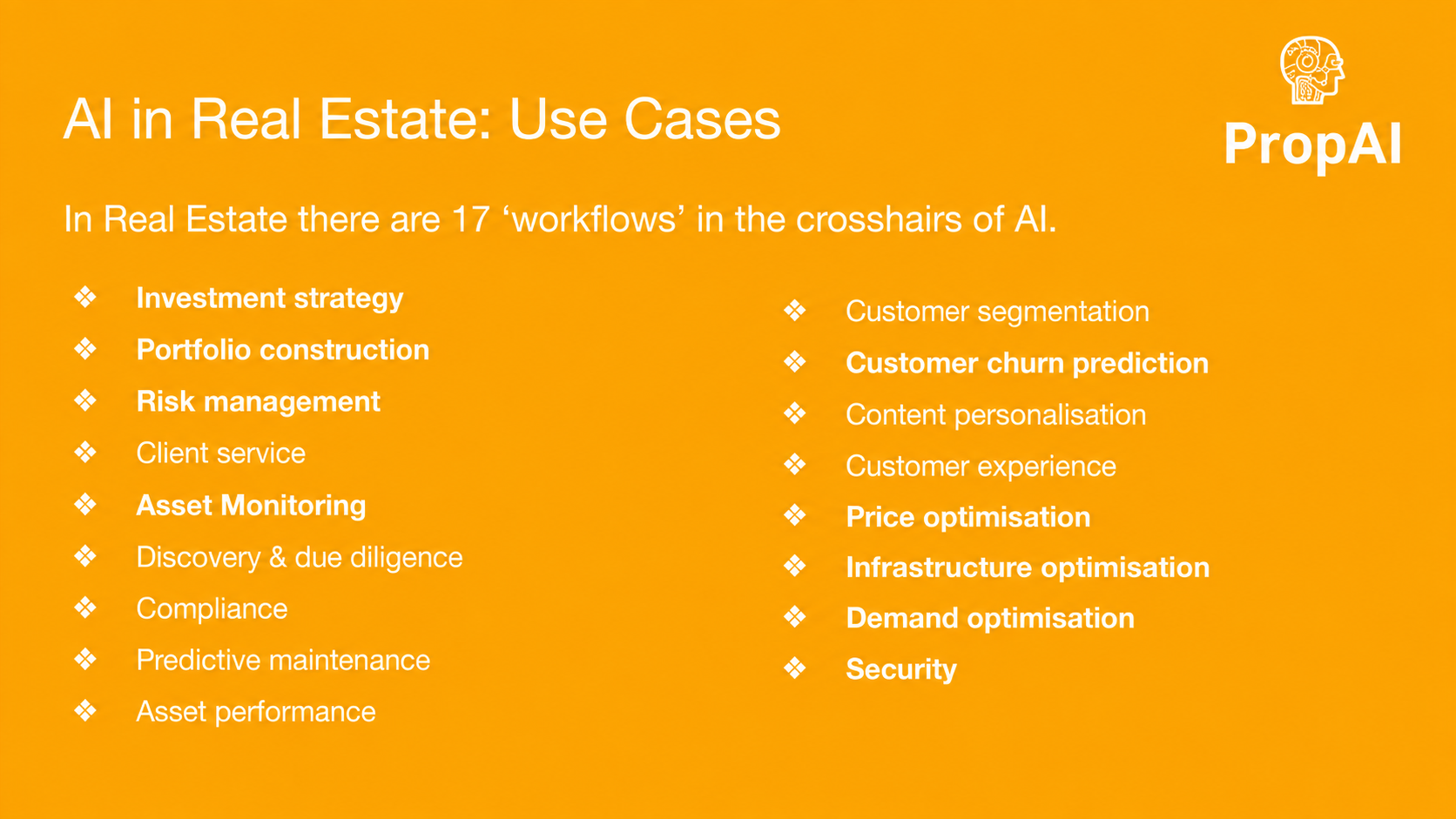
In 2018 I co-founded a company called PropAI. It went nowhere. I still have a deck I presented that year at the Future PropTech Conference, and one slide from it has been nagging at me since I ran my latest #GenerativeAIforRealEstatePeople course cohort through a collection of advanced prompting techniques.
In brief: the way I proposed tackling the 17 workflows on that slide in 2018 depended on assembling a large body of comparable records to train on. That body of records was never a by-product of how the industry works, and for most of those workflows it still has not been assembled. What has changed is who does the training. Someone else has now trained a general-purpose model, so what you supply is the material and the context for the job in front of you: a lease, a planning report, a masterplan, a situation described in a paragraph. Every firm already has those. When a panel says AI needs data, it means the corpus the industry has failed to build for thirty years, while the opportunity in front of it needs the documents they already have.
THE SLIDE I MADE IN 2018
The slide was headed ‘AI in Real Estate: Use Cases’, and underneath it I had written that there were 17 workflows in real estate in the crosshairs of AI. Investment strategy. Portfolio construction. Risk management. Discovery and due diligence. Compliance. Predictive maintenance. Asset performance. Customer churn prediction. Price optimisation. Demand optimisation. Security. And so on.
I believed every word of it. The logic seemed clean: these are workflows where patterns sit in data, machine learning finds patterns in data, so the machines are coming. We took that slide into a lot of meetings.
PropAI went nowhere.
The reason matters more than the failure. The way we proposed to attack those workflows needed a large body of comparable, labelled, longitudinal records to train on. We assumed that if the use cases were valuable enough, the data would arrive to serve them. It never did. We were selling the analytics, and the records those analytics needed had never been collected by anyone.
The industry’s answer, then and now, is the same sentence it has been repeating since long before PropAI existed. We need to get our data in order.
Eight years on, the slide is still accurate. That is the damning part.
WHAT EIGHT YEARS ACTUALLY PRODUCED
Some of the 17 did happen, and where they happened tells you why the rest did not.
Price optimisation arrived in multifamily. Churn prediction arrived alongside it. Predictive maintenance arrived in building systems. Each of those runs on a corpus that assembled itself as a by-product of ordinary operations: daily rents across hundreds of thousands of units, HVAC telemetry arriving every few seconds, tenancy records stretching back years. Making those records usable still took money and effort. What nobody had to do was invent a reason to collect them.
The multifamily pricing story is worth a moment, because of how that corpus came to exist. A vendor built a service drawing on records from competing landlords, which widened the pool any one of them could see. The US Department of Justice alleged that landlords used it to share competitively sensitive information and align their pricing. RealPage has settled with the DOJ, several landlords have settled or are settling private claims, none of them admitting wrongdoing, and legislators have started banning algorithmic rent pricing outright.
Regular readers will recognise the shape from last week. No single owner has enough data, so a third party aggregates it, and the third party ends up owning the thing everyone depends on. That is how AvalonBay’s encoded judgement ended up inside EliseAI, and it is how multifamily pricing ended up in front of the DOJ.
Now look at the other end of the list. Investment strategy. Portfolio construction. Asset performance. Discovery and due diligence. Eight years on, the obstacle in front of each of them is the one that was there in 2018, because in those workflows the corpus has to be built deliberately and at cost.
It has not been built at any scale, for reasons that have little to do with laziness. Ownership is fragmented. Assets are heterogeneous, so one building tells you little about the next. Transactions are sparse and private. Owner, manager and agent each hold a slice, and none of them is paid to hand it over. Everyone treats their own data as competitive advantage, which makes pooling it a hard sell internally.
Investment work is the hardest case of the lot, and the reason is sample size. There have been perhaps half a dozen cycles in a working lifetime. Machine learning wants thousands of comparable examples. CRE investment offers a handful of expensive, unrepeatable ones.
So when someone on a panel says AI needs better data, my question is the one in the title.
Data to help AI do what?
TWO KINDS OF DATA
The word is doing two jobs, and conflating them is why the answer to ‘are we ready?’ is always no.
Corpus data is many comparable records, labelled and longitudinal. It is what training a predictive model on your own market requires, because the patterns have to be learned from your material. It is what ‘get our data in order’ has always meant, and what this industry has mostly failed to assemble.
Artefact data is a lease. A planning report. A masterplan. A rent roll. A site photograph. A negotiating position described in a paragraph. The general capability has already been trained by somebody else, so what the artefact supplies is the subject matter: this building, this tenant, this argument.
These are two different requirements rather than two kinds of file. A shelf of leases can become a corpus. A single rent roll holds structured records. What changes is what you are asking for. One route requires a programme, a budget and years of discipline. The other requires you to open the file.
Building monitoring is the honest middle case: largely predictive and analytical AI with a generative overlay on top, and it does need a corpus. I am making no claim that artefacts cover everything.
THE QUESTIONS YOU ALREADY HAVE
Last week I took a #GenerativeAIforRealEstatePeople course cohort through a set of advanced prompting techniques, and what struck me afterwards was how much of the value sat in ordinary professional questions rather than in anything resembling a dataset.
When is exercising that break clause a strategic mistake rather than a saving?
A tenant with a break in eighteen months has a lease, a business plan, a rough view of the market and a spreadsheet that says leaving is cheaper. Working through it means arguing the other side: what the cost of moving actually includes, what the landlord is likely to do when the notice lands, what happens to the saving if the market turns while you are in the middle of a fit-out. That takes the lease, the situation and a model willing to take your position apart. It takes no corporate dataset to begin.
Where it stops is worth being precise about. Challenging the reasoning and establishing the facts are different jobs. Improving a research question takes almost nothing. Answering it credibly may take a mountain of evidence. AI can help identify the costs you left out of the break analysis. Establishing current fit-out costs takes current evidence.
What is wrong with this research brief before I commission the research?
A thousand pounds of thinking before fifty thousand pounds of work, and the input is one page.
Others came up in the same session and work the same way:
What assumption is this investment position resting on?
Where does this masterplan work against its own commercial objectives?
Does the reasoning in this planning report hold?
What is the unsupported claim in this presentation, and what will the room object to?
None of those require you to have your data in order. They require the document in front of you and a willingness to be argued with.
And keeping responsibility for a decision has never meant keeping all of the thinking. The authorised person signs. Framing, interpretation and challenge can be shared, which is a distinction the CRE industry keeps collapsing into ‘humans do the judgement’.
STILL ONLY RUNG ONE
Be clear about what this buys you. Using AI as a thinking partner makes individuals better at their jobs and leaves the organisation exactly as it found it. It is rung one of the ladder I set out last week, and the firm’s advantage still depends on redesigning the work and encoding what it learns.
Rung one is available today, on the data you already have. Which is the point.
PUT UP OR SHUT UP
Two paths are open.
Build the corpus properly. That means budget, governance, years of discipline and a hard conversation about pooling data with people you compete with. Do it, and you give the predictive applications on my 2018 slide a serious foundation. It is my belief that very few firms will choose this, and that those who do will find themselves where AvalonBay is: large enough to pay for it, and watching a vendor sell the result to everyone else.
Or work with what you have. Every professional in this industry holds thousands of documents and a head full of questions worth pressure-testing. That work needs no new data programme, and nothing you have not already been given.
The two are compatible. Keep the questions that turned out to be worth asking. Record where the machine was wrong and what the correction was. Hold on to the decision and, where you can, what happened next. Do that and individual fluency starts becoming something the firm can retain and use. That gives you the material for redesigning the work and encoding what you learn.
What is no longer available is the third option: citing the absence of data as the reason to wait, while doing nothing to assemble it. We have run that play for thirty years.
We keep telling real estate professionals that AI needs their data. We spend almost no time showing them what it can do with their questions.
Start with the questions. They are already on your desk.