A bespoke commercial real estate strategy tool, built with AI in two rounds totalling 78 minutes. And the human adds...?
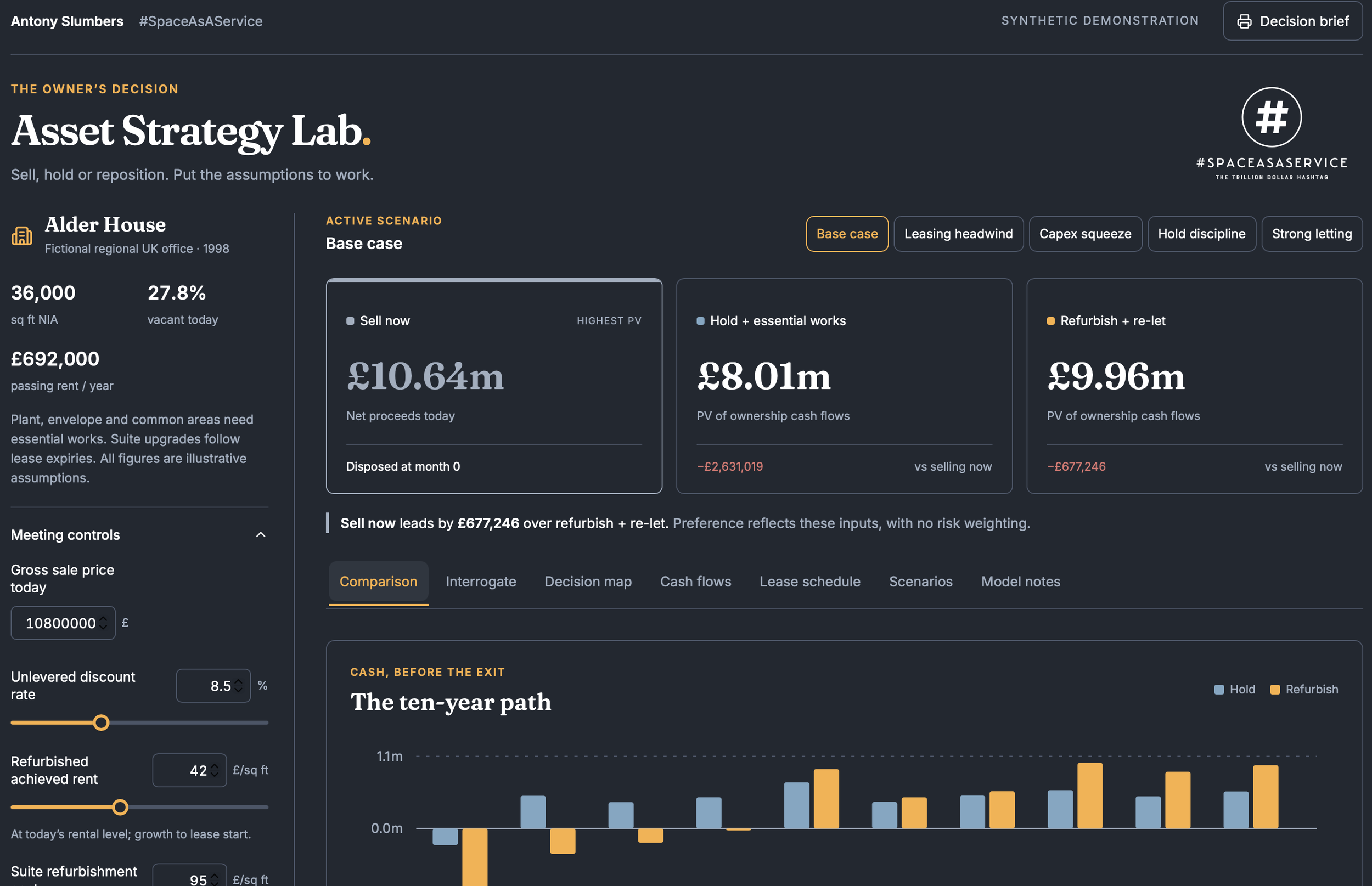
Asset Strategy Lab: a synthetic office asset, three strategies, editable assumptions and guided interrogation. Built with AI in two rounds totalling 78 minutes.
This morning I asked Codex to build a tool to help an owner compare three options for an office building: sell now, hold with essential works, or refurbish and re-let. Forty-nine minutes later, we had a working demonstration. A second round, taking another 29 minutes, added guided interrogation of the data. By then I was wondering - what, exactly, was left for the human to do?
The tool is called Asset Strategy Lab. It uses an explicitly synthetic UK multi-let office: several tenants, partial vacancy, staggered lease expiries and a refurbishment requirement.
You can change the important assumptions, compare the strategies over a common ten-year horizon, inspect the cash flows, save scenarios and explore where the preferred strategy changes as refurbishment costs, rents and letting delays vary.
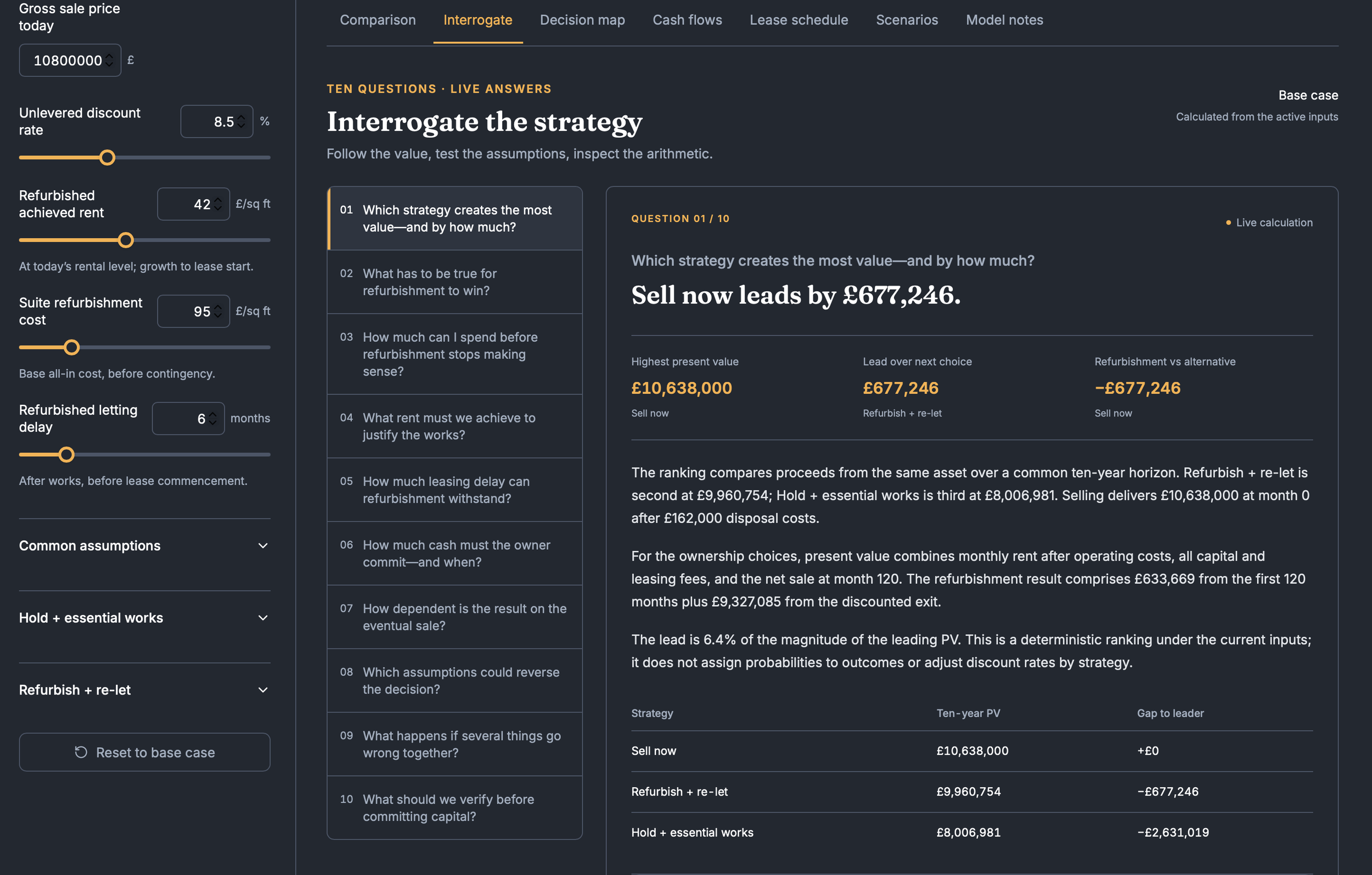
The interrogation feature was my idea. Ten questions you would naturally ask of a strategy model: what makes refurbishment worthwhile, how much funding is required, what breaks the ranking, how dependent is the answer on the exit? Select a question and get a calculated answer that updates with the assumptions.
For the busy reader: AI supplied much of the domain specification as well as the software, and subsequently helped challenge the model’s structure. Human questioning improved the work, while some of those questions could now become reusable instructions and tests. The professional opportunity is to build better analytical capability and establish where it deserves to be relied upon. The human contribution needs to be examined repeatedly as capability, evidence access and the surrounding process change.
I posted the demonstration on LinkedIn. Two early comments made sensible points. One asked about the comparable and cost evidence, and whether we had tested it against a real asset. The other emphasised understanding what breaks a ranking, particularly when several adverse assumptions combine.
Quite right.
The asset is synthetic. We checked calculations through a separate implementation within the same AI-assisted project; real-asset testing and independent professional validation remain to be done. And the tool already lets you combine weaker rents, higher costs, longer delays and other changes.
My initial response was that these comments reinforced the point. If we can build the calculations this easily, we can spend more time thinking about the inputs, investigating the property and testing the assumptions. Less spreadsheet wrangling. More attention to what changes the decision.
Which sounds like a promising division of labour.
Then I realised how much I had delegated.
I had outsourced some of the expertise too.
I am not an asset manager. I had supplied the purpose, the three strategies and the kind of experience I wanted a professional to have. Much of the detailed specification came from the AI: how lease events, income, incentives, works, operating costs and disposal proceeds would be represented.
An experienced asset manager might have briefed it better. They might have demanded renewal pathways, distinguished expiry from vacant possession, or challenged the exit convention immediately. We have yet to test what their contribution would have improved.
But the AI could already explain why these things mattered. Like it or not the model, suitably steered, would specify the product as well as any human.
The test is whether the relevant knowledge does get into the assignment, implemented appropriately and checked. Knowing an issue exists and reliably dealing with it are separate achievements. Both humans and AI can fall short.
Our next conversation therefore moved beyond the numbers entered into the tool. We started examining the model itself.
Changing only the refurbishment letting delay, while keeping the other default assumptions, produced these results:
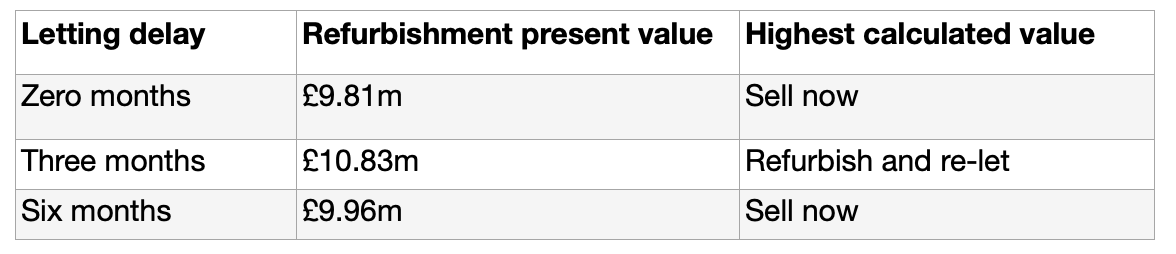
The net proceeds from selling now were £10.64m in each case. All figures are rounded outputs from the synthetic model.
Why would taking longer to let improve the refurbishment result?
The delay moves subsequent lease expiries and rent-free periods. That changes the income falling into Year 11, which the model capitalises to estimate the exit price. At three months, the higher calculated exit value more than offsets the reduction in cash received during ownership.
The arithmetic follows the chosen rules. The economic question is whether a purchaser would value that temporary income pattern in the same way, or assess the longer income stream differently. Before relying on the result for a real asset, we would want to test alternative exit treatments.
This distinction matters: correct calculation, adequate representation of the asset, and fitness for the owner’s decision are three separate requirements.
Lease pathways deserve the same scrutiny. RICS’ DCF guidance discusses breaks, renewals and new lettings, and cautions against blanket assumptions that every tenant stays or leaves without supporting evidence. Adjusting the rent cannot compensate for a consequential pathway that the model omits.
The next tempting conclusion would be that the human supplies the economic understanding. Except the AI helped identify and explain this issue too.
My contribution was to keep reopening the question.
Could the tool be better? Should the AI have identified these choices earlier? What would a sceptical professional challenge? And why was it assigning something to the human when it could apparently help do that work itself?
I could demand a better examination before I knew precisely what that examination should contain. The AI supplied much of the detail.
That is a useful form of collaboration. You can direct, challenge and persist without personally possessing every piece of expertise the task requires. It also puts a responsibility on the system: it should surface consequential questions reliably, before the user has to discover what was missed.
Repeated prodding is an imperfect process. It can produce improvements, unnecessary features or another afternoon down a rabbit hole. Better means better suited to the decision, with sufficient evidence to justify reliance. A larger tool can simply contain more ways to go wrong.
Nor can we cover every possible challenge. We can aim to handle material foreseeable cases, expose consequential assumptions and recognise when the current model is inadequate. Complexity belongs in the engine room; clarity belongs in the investment committee. The user should be able to interrogate the moving parts when it matters.
Once we discover a productive challenge, however, we can retain it. A build instruction can require scrutiny of lease pathways. A model can offer alternative exit treatments. A test can preserve the surprising delay example and demand an explanation when a new version behaves differently.
The next user benefits without repeating my questions.
Some of today’s human intervention becomes tomorrow’s process.
This is one way the boundary moves. It can happen through better instructions, access to evidence and methods of checking, alongside improvements in the underlying models. AI can help construct those improvements as well.
One distinction about the demonstration: AI built the software, while its live calculations and ten interrogation answers follow defined rules. The published app runs a model we can inspect. It does not continuously research the market or independently revise its economic structure. Those would be further capabilities to build and test.
Our conversation nevertheless went beyond what the app currently does. We used AI to question its specification and explore how it could improve. The analytical machinery and some of its criticism were supplied by the same technology.
So what is left for us humans?
For this example, I would look at four contributions.
Purpose and preferences. What does the owner want? Maximum calculated value, liquidity, limited capital exposure, or a particular portfolio outcome? AI can help reveal conflicting objectives and apply an explicit mandate. Those objectives still need an accountable source.
Evidence beyond the system’s current reach. A survey finding, a tenant’s confidential intention, a contractor’s exclusion or a negotiation happening this afternoon. AI can identify why such information matters. Obtaining it may require access, investigation or cooperation that the system currently lacks.
Challenge at the boundary. Recognising that the existing assumptions or scope no longer fit. Perhaps partial refurbishment becomes feasible, or a tenant’s intentions change the possession strategy. Both people and AI can contribute to this challenge. We should examine whether the intervention actually improves the work.
Authority and commitment. How much reliance has the system earned? What may it recommend or execute, within which limits? People and organisations can authorise bounded delegation in advance. Responsibility does not require manually selecting every action.
The distinction between information inside and outside the system’s accessible world is useful. But it leaves plenty of movement: a document connection, better records or authorised investigation can bring previously external evidence within reach.
I would expect the composition of human input to change. Claiming a smooth decline in every workflow would go beyond what we know. Expanded capability can also generate more options, assets and decisions requiring attention.
For a CRE professional, the opportunity could be substantial.
A well-tested tool could make more extensive analysis economical for owners and assets that previously could not justify it. You could examine more opportunities, revisit decisions more frequently and investigate alternatives that a conventional fee or time budget made impractical.
That is my commercial hypothesis. The prototype demonstrates capability creation; the market opportunity and decision quality still need testing.
Some remaining inputs could become more consequential. Knowing that a major tenant intends to leave may overturn the preferred strategy. A strong tool helps you establish that significance quickly and decide what to investigate next.
But information gains value through relevance, credibility and timing. Being unknown to the AI is insufficient. Whether you capture that value also depends on who else can obtain it, the service you provide and the market in which you operate.
There are three separate questions: how many human interventions does each asset require, how consequential are they, and how much work becomes economical to undertake?
Those answers can move in different directions.
And greater analytical capability does not guarantee higher fees or the same number of jobs. Clients may expect more, prices may fall, and value may concentrate elsewhere. An enthusiastic, adaptable professional can deliver excellent work while facing a tougher market.
Alarm is a reasonable response, including for people who are all-in on AI. Scalable tools also make it possible to reproduce a shared modelling weakness across many properties. Expanding coverage requires a corresponding ability to establish quality.
I keep returning to Human Judgement Has a Timestamp. This morning’s exercise gives that argument something tangible: a tool, a set of questions, a structural challenge, and a changing account of what I contributed.
When we say the human ‘wins’, we need to specify the claim.
Performance means the person produces a better analysis, prediction or decision. That needs evidence and reassessment. Preference means someone values human attention or dealing with a person. Authority means an institution assigns people responsibility for objectives and commitments.
Each can sustain human value for different reasons. None tells us how many people will be employed, or what they will be paid.
I would like to discover where humans will always win. I cannot yet give you a defensible list. Creativity, judgement and relationships contain many activities, each requiring examination. Declaring the whole category permanently human would end the investigation just as it becomes useful.
Nor can I attach a credible expiry date to expertise. We can identify what sustains a particular contribution: better demonstrated performance, inaccessible evidence, client preference, institutional authority or a process nobody has redesigned. Then ask what would justify changing the allocation.
For you, three capabilities increasingly belong together: building useful tools, establishing their fitness, and reconsidering where human involvement adds value. The learning includes discovering occasions when the machine needs challenge and occasions when your intervention adds little.
This morning’s experiment has made the question more concrete.
We can now build tools that perform substantial analytical work, answer consequential questions and help us challenge their own assumptions. We can improve them through a conversation, even when we cannot initially specify everything that improvement requires.
Some of our contributions will become part of the software. Others will remain valuable because they bring evidence the system cannot obtain, express the interests it should serve, or secure the cooperation needed to act. We need to keep examining which is which.
That uncertainty is unsettling, including for those of us enthusiastic about AI.
But we can investigate it through the work itself: build, challenge, test against reality, and reconsider the allocation. Human judgement has a timestamp. Our understanding of what we can accomplish with these systems needs one too.