What AI-first work means for the workplace, the building and the business model.
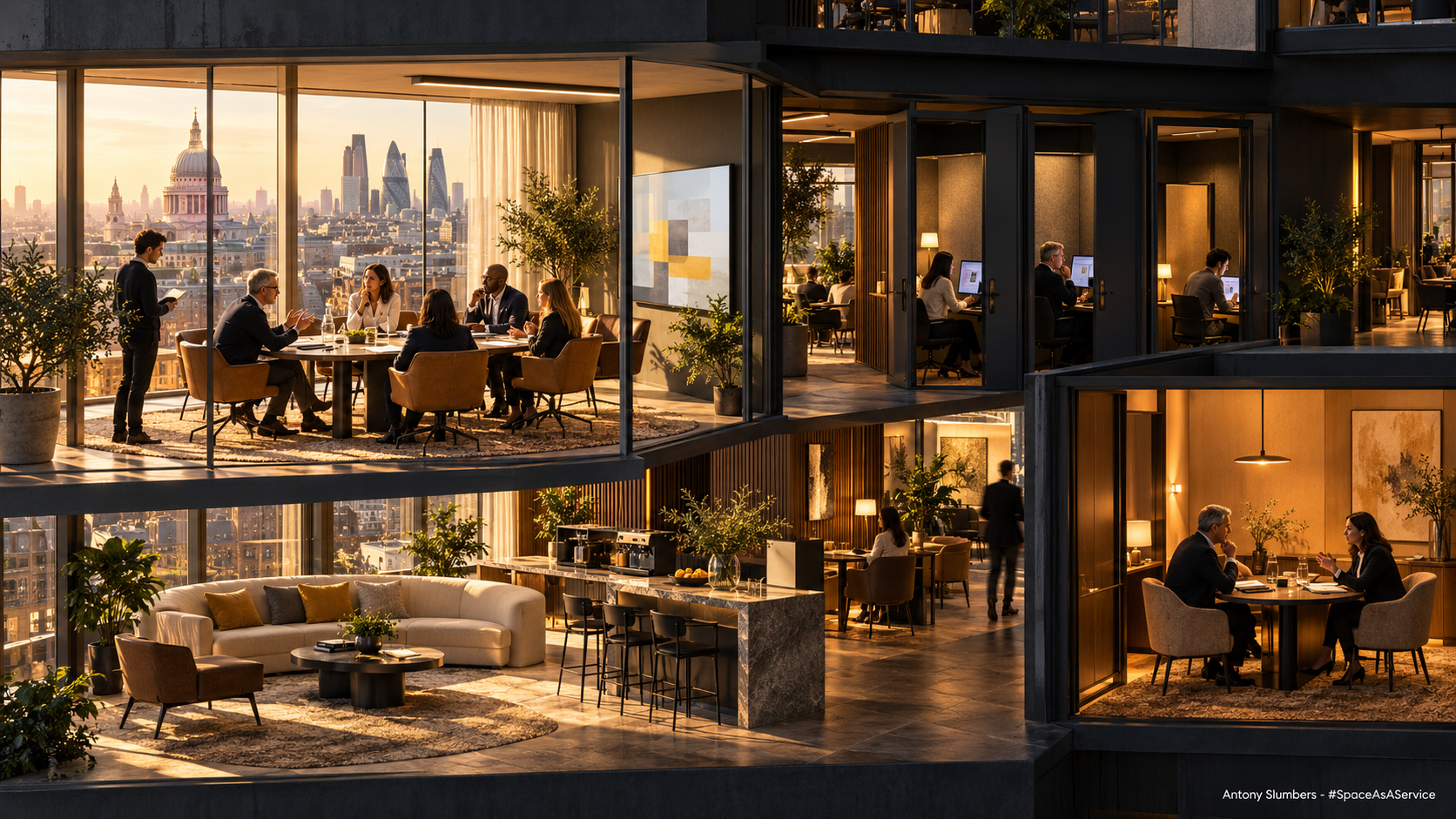
A friend asked in a WhatsApp group recently whether anyone was thinking about the physical office in the age of AI. My recent slides talked about smaller, more purposeful teams, and he wanted to know how those teams would actually use the space. It’s the right question, and it deserves a proper answer, because most of what gets written on it starts with trivia, the furniture. So this is my answer. It’s also a chance to look back at a piece I wrote two years ago, Real Estate as Maven, which argued that buildings themselves should actively help the people in them, and to consider what I got right and wrong.
Executive summary
AI is going to change why you go to the office, and the layouts should, and will, follow from that. Most of the tasks offices were built for, and much of what we call judgement, can now be done anywhere, increasingly by AI. What stays valuable in person is social (but more specific than the nebulous term ‘collaboration’): making commitments to each other, agreeing what a group wants, bringing on junior staff, and meeting people who think differently. Design for those moments and you get fewer desks, many more rooms for meeting and hosting, some rooms where everything is recorded and some where nothing is, and small private rooms for working with AI in between. For most companies, rooms like that would sit empty much of the week. So at the top of the market the answer is a building shared by many companies and many uses, run like a hotel by people whose job is to book, prepare and host them.
START AT THE RIGHT END
Most of what gets written about the office in the age of AI starts with the kit: which screens go in which meeting rooms, which sensors in which ceilings. That’s the wrong end. The layout should follow from why people come in at all, and AI changes that answer more than anything else.
A quick word on terms, because in real estate ‘agents’ means something else entirely. When I say agents here, I mean AI agents: software that carries out a piece of work on your behalf, such as reconciling a rent roll, drafting a report or running a set of scenarios, and comes back to you with the result.
Those agents can do the work anywhere. Drafting, analysing, modelling, summarising, checking: the tasks offices were built to house travel perfectly. And more and more of your time will go on supervising that work.
We’re already partway there. In the week to 28 September 2026, US office attendance averaged 54.7% of pre-2020 levels and peaked on the Tuesday at 65.3% (Kastle), and Mondays and Fridays typically run at around half the midweek peak (Analysis Atlas). The UK tells a similar story: Remit Consulting’s tracking hit a record 44.1% of office capacity in late January 2026, against a pre-pandemic norm of 60–80% (Remit Consulting). People already come in on particular days, for particular reasons. AI will sharpen that. What are those reasons?
The usual answer is that we’ll come together for judgement. I’d be careful with that. In Human Judgement Has A Timestamp I broke judgement into three parts: prediction (working out what’s likely to happen), preference (deciding what we want) and commitment (binding ourselves to a course of action). Prediction is the part AI is getting good at, and fast. Build your office strategy on that part of judgement and you’re building on the part that’s leaving. The other two are where the office’s future lies.
So what’s left?

WHY WE’LL STILL TURN UP
What keeps its value is social by nature. I see four reasons to come in. Three of them will last, because AI can’t do them at all. The fourth depends on how AI develops.
Commitment. In the late seventeenth century, merchants and ship owners met in Edward Lloyd’s coffee house to size each other up and put their names to risks. The principle still holds. AI can forecast, but nobody can hold it to a promise. Deals, mandates, investment committees and client relationships all rest on people binding themselves to each other. And as fake voices and video get cheap and convincing, turning up in person becomes the one signal that can’t be faked.
Presence is proof.
It proves who was there, and that they said it to each other’s faces. Whether they keep their word is another matter, but that’s true of any promise.
Deciding what we want. An AI can rank your options against a goal. It has no standing to set the goals for a group of people. Strategy, standards and the trade-offs between colleagues get negotiated, sometimes politically and often emotionally, and people only accept the outcome if they took part in reaching it. You’ll know that from any team you’ve ever run.
Formation. This is how juniors become professionals. They build trust, shared standards and a sense of who they are by being around the people they’ll work with. When Microsoft studied its own staff after the switch to remote work, people’s working networks became more static and siloed, with fewer links between groups (Yang et al., Nature Human Behaviour). That’s a problem we cannot ignore.
Variety. People who think differently, from different firms and disciplines, come up with ideas a single team won’t. This is the reason that depends on AI. Ask the leading AI tools the same open question and, on the evidence so far, you increasingly get similar answers. That makes real difference between people scarcer, and so more valuable. If the models become more varied, this reason weakens. The other three still stand.
That does not mean any of these four still need a physical space to convene. You already agree mandates, settle strategy and keep in touch with colleagues over video, and plenty of commitments between people who already trust each other will carry on that way. Being in the room earns the journey in particular situations:
- when the other side is unfamiliar
- when the decision is contested
- when the stakes are high and trust is thin
- when someone is learning by watching.
Those are the moments that need presence. Everything else can travel.
Two other popular reasons are weaker than they look. The first is pooling expertise: getting the people who know different things into one room. AI already does much of that. In a 776-person experiment at Procter & Gamble, individuals working with AI did as well as teams working without it on product-development tasks (Dell’Acqua et al., The Cybernetic Teammate). The second is building and managing AI agents, which is mostly solo work at a screen. The part that needs a room is agreeing, as a team, what good work looks like, which takes us back to deciding what we want.
A DAY IN THE AI-FIRST OFFICE
My friend’s real question was what all this means for the people who work there. So let me make it concrete with an illustrative day, around 2030, for an asset manager at a real estate investment firm. It’s made up, but every part of it follows from the four reasons above.
She comes in on Tuesday because three things that need her in a room are happening on Tuesday. Overnight, her AI agents have reconciled the rent roll, drafted the quarterly investor update and run three scenarios on a refinancing.
At nine, her team of six meets in their own room, around a large shared screen. They go through what the agents produced, agree what’s good enough and what isn’t, and change the instructions for next time. That’s the team deciding what it wants. A graduate sits in on all of it.
At half past ten she spends an hour in a small private room with a door, talking her agents through a different structure for the refinancing. She mostly works with them by voice now, and the numbers are confidential, so an open-plan desk is no use to her.
At half twelve she has lunch with a possible joint-venture partner from another firm, on a floor shared by all the companies in the building. The building’s management team introduced them, because they knew both firms were looking at the same kind of asset.
At two she meets the lender in a room where nothing is recorded: no microphones, no transcripts, phones left outside. They agree heads of terms. Before anyone leaves, they write the terms out by hand, read them back and both initial the page. Then they shake on it.
At half three she takes the graduate through how the negotiation went: what she conceded, why, and how she read the other side.
She leaves at half four. The follow-ups agreed at the nine o’clock meeting have already gone to the right people and their agents. On Wednesday she works from home.
Now picture your own week, and the days you genuinely need to be in. Those are the days this office is for.
THE BRIEF
Turn her Tuesday into a design brief and you get something very different from today’s office.
Fewer desks, far more rooms for meeting. Rooms for small teams, proper rooms for deals and clients, and spaces you’d be proud to host people in.
Large shared screens where a team reviews what its agents have produced and agrees what good looks like. The agents do the work; the room is where people check it and set the standard.
Small private rooms for working with agents, next to the team rooms. People will bunch their in-person moments into one day, and in between they’ll work with their agents, mostly by talking to them. That needs a door, not a desk.
Good sound insulation everywhere. Once people talk to their agents all day, open plan stops working for anything confidential.
Rooms that are either fully on or fully off. Some capture everything said; some capture nothing. More on this in a moment.
Rooms that prepare themselves. Before a meeting, the room’s systems pull together the relevant emails, documents and notes from last time. During it, they take notes and capture who agreed to do what. Afterwards, the follow-ups go to the right people and their agents. Most of the pieces exist already: Microsoft’s Copilot prepares a pre-meeting briefing from related emails, documents and past meeting notes (Microsoft), and its Facilitator agent takes notes and captures action points in physical meeting rooms (Microsoft). What’s missing is joining them up and making them standard.
Space for juniors where they can see and hear how seniors work, plus training the building can run for graduates from all its occupiers, such as sessions and mentoring with senior people from other firms, the kind of programme a ten-person company could never run on its own.
Shared floors where people from different companies meet, with dining, events and introductions made on purpose by the people running the building.
Everything bookable and easy to rearrange. You come in for the things that need a room. Nobody needs another bank of hot desks sitting empty on a Friday.
If you run a single company, look down that list and ask how many of those rooms you could keep busy. The shared floors need people from outside your firm by definition. The learning works better with them. And unless you’re very large, most of those rooms would sit empty much of the week. That’s where the property argument starts, after two more design points.
ON AND OFF
One design rule deserves its own section, because I think it’ll become the most distinctive feature of the AI-age office. Every room should be either fully on or fully off, and everyone in it should know which.
A fully on room captures the conversation. AI is listening, what’s said is transcribed, the room is prepared before people arrive and the follow-ups go out as they leave. It’s where teams work with their agents and review what they’ve produced.
A fully off room captures nothing that’s said. No microphones, no cameras, phones left outside. It’s where deals are negotiated, investment committees deliberate, decisions about people get made, and anything that needs candour happens.
Off still means documented. Before anyone leaves, the people in the room write down what they agreed, by hand, read it back and initial it: heads of terms, a committee’s decision and its reasons, an agreed next step. The rule is simple. Nothing said leaves the room, only what the people in it choose to write down together. That’s how deals were recorded for centuries, and writing the terms out together is itself part of making the commitment.
The real problem is the half-on room, which is where most offices are drifting. Transcription and AI assistants are optional, used inconsistently and sometimes quietly running. Nobody’s sure what’s being kept, so nobody quite says what they think. You’ve probably sat in that meeting already.
I expect the off room to become something people pay for, for three reasons:
Scarcity. When every meeting is transcribed by default, a room guaranteed to record nothing becomes the rare thing.
Candour. People say different things when nothing is kept, and candour is what real commitments are built on.
Proof. With voices and video easy to fake, being in the room together is the strongest evidence of who agreed to what.
The guarantee has to be real: equipment that physically can’t record, a clear sign on the door, and someone everyone trusts to make sure. In a building shared by several companies, that someone is whoever runs the building.
WHAT SITS NEXT TO WHAT
A layout is about proportions, and about what sits next to what: who walks past whom, and how long it takes to get from one room to the next. Four principles follow from her day.
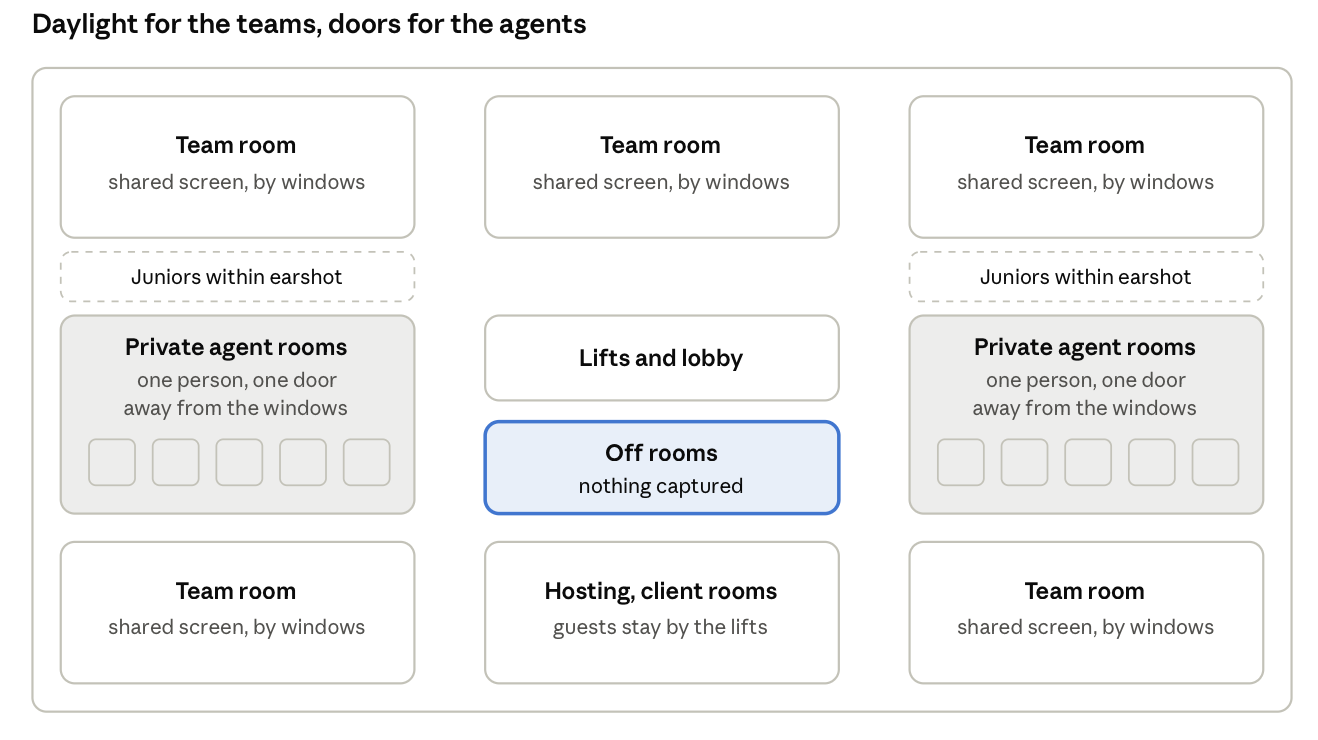
Daylight for the teams, doors for the agents. Team rooms and hosting space should take the windows, because that’s where people spend time together. The small private rooms for working with agents can go in the middle of the floor. People use them in short, focused stretches, on their own, so a door and good sound insulation matter far more than a view. For once, a deep floor with lots of space far from the windows is an asset. If you own one, that’s good news.
Private rooms right next to the team rooms. Her day ran: review with the team, work alone with her agents, review again. The walk between the two should take seconds, so the private rooms should cluster around each team room. A quiet zone at the far end of the floor is too far away.
Off rooms and hosting by the lifts. Guests should be able to arrive, negotiate and leave without walking through anyone’s team space. Putting the off rooms by the lifts also makes them neutral ground, which matters when the person across the table works for another company.
Juniors within earshot. People learn their profession partly by overhearing it. Junior seats belong on the edge of the team rooms and on the route between team rooms and private rooms, where they see and hear how decisions get made. Tucking the graduates away at the far end of the floor defeats the point.
This is a diagram of what sits next to what, so it leaves out circulation and access. Team rooms and hosting take the windows, private rooms for working with agents sit in the middle beside the team rooms, juniors sit between the two, and the off rooms sit by the lifts.
The same logic works for the whole building. Shared floors, hosting and the busiest meeting rooms go low down, near the entrance, where people from different companies cross paths. Each company’s own floors go above. And the software and agents that run the building day to day stay out of sight.
WHAT I GOT RIGHT, AND WRONG
Two years ago I tried to describe some of this in Real Estate as Maven. A maven is an expert who guides you to what you need. The idea was that buildings should do the same: actively help the people in them to work, learn and connect, going well beyond providing space. The usual criticism was that it asked far too much of a building. So how has it held up?
What I got right. The direction. The best of the market is moving from space as a product to space as a service, judged on what it does for the people using it. I also argued that people and AI would end up working intertwined, with no neat split where people do some tasks and machines do others. That’s how teams and their agents now work. And building learning into the building, and running it more like a hotel, both look more right now than they did then.
The worry that has grown. Maven warned that AI would pull people’s thinking towards sameness. The evidence since makes that a credible concern, if an unsettled one. A 2026 study of 68 AI models from 12 companies found their answers to open creative questions grew more alike with each new generation (Patel, Crossman, Aggarwal and Wenger), and a 2025 study of more than 70 models found a similar pattern (Jiang et al., NeurIPS 2025). A September 2026 paper argues that evidence is weaker than claimed (Schaeffer et al.). And technique helps: asking a model for several answers, each with how likely it thinks it is, brings its variety back to about two-thirds of the level it had before its final stage of training (Zhang et al.). The researchers are still arguing. But most people, in most firms, use the same handful of tools on their default settings, which is where the risk is greatest.
What I got wrong. I designed for the wrong unit. Maven imagined one company’s office delivering a long list of services just for that company. And its signature idea was a room that listened to a team and nudged it towards fresh thinking with changes of light and imagery. Looking back, I was over-egging it. If everyone in the room uses the same AI and shares the same company context, no amount of mood lighting brings in new perspectives. People from other companies do. And one company on its own could never afford that long list of services anyway.
Right direction, right worry, wrong unit.
Which brings us to the building.
WHY ONE COMPANY CAN’T FILL THE ROOMS
The economics come down to sharing. Most companies simply don’t have enough moments that need a room to keep good rooms busy. Many companies together can.
Take an illustrative deal room. If your firm needs it one day a week, you use it 20% of the working week and pay for it all week. Share it between five firms and, in principle, it’s in use most of the time. Hotels and airlines have run on this logic for decades. Offices got away with ignoring it, because daily attendance hid the waste.
There’s a catch, and it’s in her diary. She came in on a Tuesday, and so does everyone else. If five firms all want the deal room on Tuesday afternoon, sharing gives you a queue, not a full room. So sharing only pays if someone actively manages demand: charging more at the peak, giving priority to members who commit to more, running events and training on the quiet days, keeping some overflow space, and bringing in occupiers and uses with different rhythms. Managing a scarce peak is the operator’s real job, and the reason it can charge for it.
Get that right and the case for buildings shared by many companies and many uses rests on five things:
Fuller rooms. Many companies’ occasional demand, managed well, keeps the meeting floors, off rooms and learning spaces busier than any one company could.
Costs spread thin. Rooms that can’t record, hosting kitchens, room technology, training programmes and a capable team are largely fixed costs. Shared across dozens of companies, the cost to each falls to something it can justify. For a single small or mid-sized company it’s too much, which is the honest answer to the criticism of Maven.
Smaller firms, and more of them. If AI means firms can do more with fewer people, each needs less space, and a building needs more occupiers to fill it.
Different uses, busy at different times. Offices are busiest midweek, in the middle of the day. Hosting and events peak in the evening. Hotels, gyms, clinics, homes and education are busy at other times again. Mixing them is one of the main ways to spread the load beyond Tuesday.
Access to other people. Meeting people from other companies becomes part of what you’re paying for.
None of this is new in form. ‘Vertical village’ is the phrase used for towers that stack many occupiers around shared space, and London’s King’s Cross shows the same mix of occupiers and uses across a whole estate. What changes is what the shared space is for: less food hall and gym, more of the purposes in the brief.
I’ll call whoever runs it the operator: the people who book and prepare the rooms, guarantee the off rooms, host guests and make introductions. It might be the landlord, or a specialist the landlord hires. Confidentiality is handled by zone. Each company’s own floors are private, the shared floors have clear rules, and the operator guarantees the off rooms, because tenants will trust a neutral operator more than each other.
The case is strongest for small and mid-sized firms buying access to rooms and services they could never provide efficiently themselves. Very large occupiers, and firms whose security, intellectual property or brand demand it, will still want buildings of their own. The shared building sets the benchmark for the top of the market, and plenty of other models will sit alongside it.
WHO CAPTURES THE VALUE
I coined the term Space as a Service in 2013, and this is the clearest version of it I’ve seen. If you own offices, though, this is the uncomfortable bit. Showing that a building like this creates value is one thing. Saying who gets paid for it is another.
The question to ask is: who can charge for the benefit, and who has to fund delivering it? A good operator could raise your rents and keep your tenants longer while earning only modest fees. Or it could own the relationship with occupiers and take most of the margin, leaving you with steady rent and the cost of the building. Which way it goes depends on the contracts, on who carries the costs and risks, and on who occupiers would follow if they moved.
Landlords have three broad choices:
Become the operator. The biggest prize, and the hardest. Running hospitality-grade operations is a different business, with different people, and few landlords do it today.
Partner with an operator. Hotels have split ownership from operation for decades through management agreements, and the terms decide who carries the risk and who takes the upside.
Stay a long-lease landlord. Safest in the short term, and increasingly exposed as occupiers come in for particular moments and stop coming in every day.
If AI agents end up booking rooms for their teams, the booking may happen through the employer’s own systems and bypass the building’s altogether. Owning that booking moment gives you distribution. Whether it also gives you loyalty depends on who delivers the experience.
Then there’s valuation. Valuers reward long, contracted rent over income from running a building, and they’ve good reason to, because that income is less certain. The burden is on the industry to show it lasts and makes money after costs. Until it does, capital will keep favouring the buildings it already knows how to value.
TOO DEMANDING, UNTIL NOW
Maven was too demanding for one company and too early for the technology. For a building shared by many occupiers in the best locations, neither holds as strongly. Three things have moved since 2024, and three haven’t.
What has moved:
The cost of service. AI agents can increasingly handle bookings, room preparation, access and routine requests, so a building heavy on service no longer needs a payroll to match.
Rooms that prepare themselves. The building blocks exist, as the brief shows. What remains is joining them up.
Demand for the best space. Grade A vacancy in City of London towers is around 2% (Barbour ABI), and Grade A made up 92% of Central London take-up in the first quarter of 2026 (Savills). Occupiers are clearly paying for the best existing space. Whether they’ll pay for the package I’m describing is the commercial hypothesis to test.
What hasn’t:
Operator talent. Few landlords run hospitality-grade operations, and the skills are scarce.
Building data. Building systems still don’t talk to each other well, which gets in the way of running a building as one service.
Leases and valuation. Capital still prefers long, contracted income.
The timing matters. Barbour ABI expects new office construction in the UK to recover visibly from 2028, because refurbishment alone cannot meet the shortage of Grade A space. Buildings designed in 2027 and 2028 will open in the early 2030s. They’re the first that can be designed around this brief from the start, and it’s my belief that whoever gets one right sets the benchmark for the decade after.
WHAT WOULD PROVE ME WRONG
Views should come with the conditions that would break them. Some things would show this thesis is wrong. Others would only slow things down.
What would show I’m wrong:
Trusted remote presence. If tamper-proof, verified remote presence arrives and people trust it for high-stakes commitments, ‘presence is proof’ weakens. This is the signpost I watch most closely.
Nobody pays for the package. If occupiers want prime space but won’t pay for off rooms, introductions and learning programmes, the shared building is just a nicer office.
AI becoming more varied. If AI models start giving genuinely varied answers by default, the variety argument goes, and the other three reasons carry the weight alone.
What would slow it down:
Recording obligations. Some regulated firms must record certain communications, which could limit off rooms for exactly the occupiers who would pay most for them.
Confidentiality between rivals. If law and finance firms won’t share floors with competitors, the market is smaller.
Capital not adapting. If income from running buildings stays hard to value, owners will keep building what lenders and valuers already understand.
THE ROOM IS THE POINT
The office of the AI age is smaller for each company, busier in each room, and shared by far more companies. It’s run as a service, built around the moments when people commit, decide and learn from each other, and designed by people who start at the right end.
Two years ago I said real estate had to become more than real estate. It still does. The difference is that now we can see what it has to become, and why. Whether you own, design or occupy offices, that’s your brief.
Design for the moments that need a room. Let the agents have the rest.