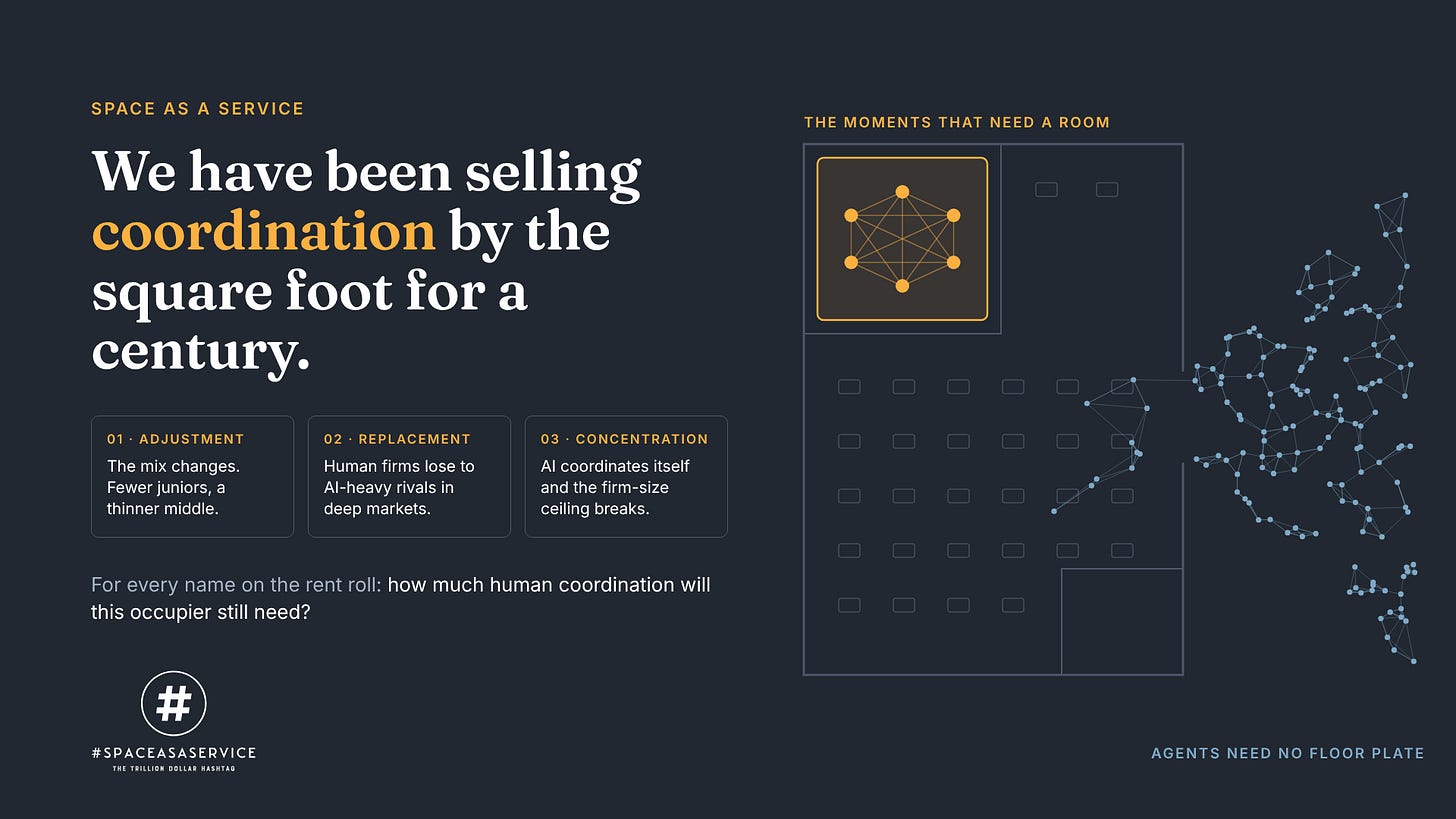
When coordination moves into software, between agents, much of the office loses its reason to exist. What remains are the moments that need a room.
Two things landed this week that belong together. Aaron Levie, co-founder and CEO of the enterprise content platform Box, posted that the gap between people working at the AI frontier and everyone else is widening, and widening fast. A day later, Alex Imas, Andrew Koh and Shane Legg published ‘Organizing Intelligence’, a theory of when AI actually transforms an economy. Levie describes the symptom. The paper offers a diagnosis. And the diagnosis turns out to be about the very thing our industry sells.
EXECUTIVE SUMMARY
AI is now superhuman at many individual tasks, yet four years after ChatGPT the economy has hardly shifted. Imas, Koh and Legg argue the reason is coordination: AI is brilliant at doing and still poor at working together, so organisations of complementary humans keep winning, and firms change who they employ rather than how big they are. Their model describes three ways change arrives (a gradual shift in the workforce mix, the sudden replacement of human firms in large standardised markets, and concentration once AI can coordinate itself), in combinations and orders that vary by activity. The office is, at root, a technology for human coordination. As AI takes over the plumbing of coordination, office demand refocuses on the moments that genuinely need a room, and whether it shrinks depends on how much human coordination each business still needs, and how many businesses there are.
THE GAP THAT KEEPS WIDENING
Levie put it about as well as anyone: “It’s almost incomprehensible how wide the distance is between someone who’s working at the frontier with AI and basically everyone else right now. The crazy thing is these lines are not converging, but only growing farther apart.” Codify your processes today, he argues, and you are behind again within months.
Anyone who uses these tools daily will recognise that. Anyone who reads the economic data will recognise something different. The studies the DeepMind paper cites find chatbot adoption has produced minimal aggregate change in earnings or hours, with only 3–7% of time saved passing through into pay (evidence that predates agentic AI). Office markets, meanwhile, are behaving like office markets.
A vertical curve or a flat line?
Both. Slow adoption is part of the story, but slow adoption on its own predicts a gap that closes as the laggards catch up. A gap that keeps widening suggests something structural, and the paper offers a candidate.
COMPETENCE AND COORDINATION
Imas, Koh and Legg (Legg co-founded DeepMind) build a theoretical model, and they are careful to call its outcomes scenarios. Its central move is to split intelligence into two capabilities.
Competence is how good an agent is at tasks: coding, writing, analysis. More of it lifts how much each worker produces.
Coordination is how well agents work together as the group grows: shared context, clean handoffs, aligned incentives. More of it changes how big an organisation can usefully get.
That second capability is what Ronald Coase was getting at in 1937 when he asked why one giant firm doesn’t employ everyone. Human coordination degrades with scale. Attention is finite, tacit knowledge loses its richness at every handoff, and incentives drift. Every organisation eventually hits a ceiling where adding people makes it worse.
Benchmarks test agents in isolation, while the economy runs on organisations. A team of jagged humans, each excellent at one thing and weak at others, can outperform an AI that beats each of them individually. The paper calls this ‘mosaic intelligence’.
And today’s AI is lopsided. On Mercor’s expert evaluations, models score 67% on one-shot tasks but 24% on multi-step workflows. Multi-agent systems fail on 41–87% of workflows through lost context, misalignment and broken verification.
Superb at doing. Poor at working together.
The paper predicts what that combination produces: smaller, flatter firms that adjust their mix of people rather than their size. The early data fit. AI-native start-ups employ about 25% fewer people than same-cohort peers. Studies cited in the paper find junior employment in AI-exposed occupations down by between 7.7% and 19%, while senior employment and pay hold steady or rise. Online freelancers, solo producers with nobody to coordinate with, have been hit hardest.
If AI coordination crosses a threshold, where adding agents keeps raising output per agent, the Coasean ceiling breaks and large markets can concentrate quickly into a handful of AI-heavy firms. The authors warn that an economy near that point could be reorganised by a coordination improvement too small to register on any benchmark.
Which also offers an explanation for Levie’s gap. The people at the frontier are, in the paper’s terms, coordinators: humans directing very capable AI. In the current regime, theirs is the value that rises.
WHO ASKS THE QUESTION
Somebody has to start things: decide what is worth doing, frame the hypothesis, choose between options that are all defensible, and carry the can when it goes wrong. Earlier this month I split judgement into prediction, preference and commitment. AI is getting very good at prediction. Preference and commitment are about what we want and what we are prepared to stand behind, and they are where authority, trust and accountability sit. Whether a machine could one day frame the question matters less than who we let decide. That is where I believe humans should keep control, and where clients, regulators and counterparties will insist on it.
Read the paper closely, though, and its ‘coordination’ is mostly something more mundane. Handoffs, shared state, routing work to the right person, keeping incentives aligned, span of control. Plumbing, in the language of my CRE Automation Matrix, applied to the organisation itself.
So it helps to split human work into three layers, in what I expect to be their order of exposure:
-
Production: bounded tasks. Being absorbed now.
-
Coordination plumbing: routing, review, status, scheduling, handoffs, a great deal of middle management. This is the paper’s threshold, and it is far closer than the third layer.
-
Preference and commitment: the question, the relationship, the decision, the signature. Last to go, and plausibly kept by choice or by regulation.
AI doesn’t need to originate anything to change the picture. To replace human firms, it needs to do the plumbing more cheaply and reliably than the people doing it now. To break the ceiling on firm size, it needs more: coordination good enough that output per agent keeps rising as the organisation grows.
For property, three questions then need keeping apart. Each firm is likely to need fewer people. Cheaper execution may well mean more firms, as more people can afford to originate businesses, projects and services. And total office demand depends on both, and on what all those people still need to be in a room together for.
THE OFFICE IS A COORDINATION TECHNOLOGY
Ask why offices exist at all. The paper’s reasons why human firms stop scaling are almost word for word the reasons we put people in the same building. Co-location is real estate’s answer to Coase’s problem. We have been selling coordination by the square foot for a century without calling it that.
Coordination moving into software can mean two quite different things for property.
Software can coordinate agents instead of people . Where AI teams do work that used to need human teams, the people go and the space goes with them. That is a straight loss of demand, and in the markets where it happens much of the office loses its reason to exist.
Software can also coordinate people better . The routing, status-chasing and handoffs leave the human day, and what remains is the work that needs presence: making commitments, agreeing what a group wants, forming younger colleagues, building trust, meeting people who think differently. That was the argument of ‘Design for the Moments That Need a Room’, and the paper gives it a mechanism. The rooms that remain matter more and may well be shared by more firms, although designing for particular moments also means sharp peaks and quiet days. Demand is already selective: Grade A took 92% of Central London take-up in Q1 2026 (Savills), though many forces besides AI sit behind that.
Most occupiers will experience both at once, in proportions that vary by activity. For any tenant, the property question becomes how much human coordination its business will still need.
There is a second-order effect. As organisational activity tilts from people to agents, it generates less demand for human workspace and more for computing infrastructure. Different budgets, different owners, different geographies: but it is one of the few places where the jobs story and the data-centre story genuinely meet.
THREE MECHANISMS
Which brings us to the portfolio question: which occupiers meet these changes first?
The paper’s three drivers are how well AI matches a firm’s core tasks, how much the work depends on teams, and how deep the market is: large and standardised, or finite and bespoke. Put together, the most exposed activities execute someone else’s question, at volume, in a digital medium where the answer can be checked. That describes a lot of office floorspace.
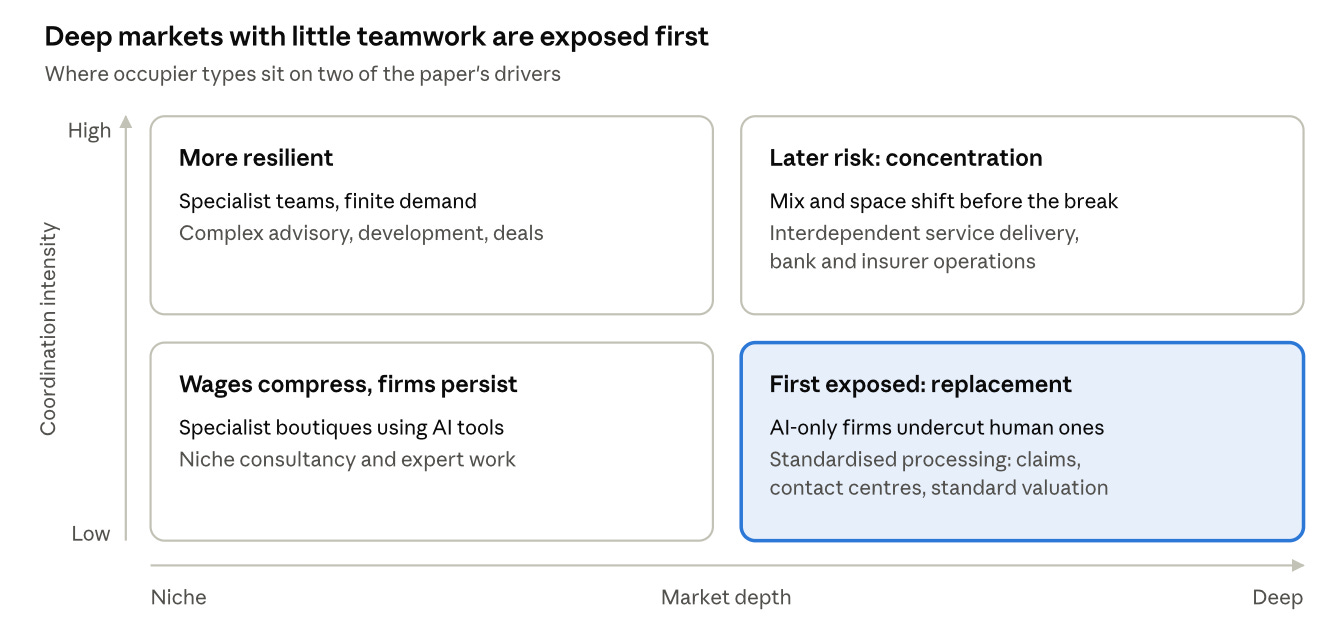
The paper’s three mechanisms are distinct, and they don’t form a queue. Competence and coordination can improve independently, so an occupier might meet them in any combination or order.
Adjustment: the mix changes. Gradual, and already under way. AI does the production, fewer juniors are hired, the middle thins and seniors carry more weight. Professional-services pyramids, IT services, software, bank and insurer middle offices and agencies show it first. India’s five largest IT services firms added a combined net 17 employees in the first nine months of FY26, a striking figure for businesses built on mass graduate hiring. In the building it shows up as fewer seats, higher specification and shorter planning horizons, mostly at lease events.
Replacement: human firms lose. Sudden. In deep markets for bounded work that needs little teamwork, an AI-heavy competitor drives unit cost below the incumbent’s and the incumbent’s market disappears. Freelancers were the early warning. Standardised processing (claims, transactions, payroll, contact centres), IT testing and maintenance, and standardised legal work such as residential conveyancing look next. The trap for landlords is that the tenant often isn’t the one deciding. An outsourcer occupies the floor, its client moves the work to an AI-native provider, the contract goes and the floor goes with it. That is credit risk arriving all at once, often in large high-density floorplates on leases sized to a single contract.
Concentration: the ceiling breaks. Sector by sector, AI takes over the coordination plumbing and deep markets consolidate into a few AI-heavy firms. Expect it first where work is entirely digital and verification is cheap: software, then digital financial operations such as payments, retail-bank servicing and insurance claims. Hiring, wages and space will move well before any wholesale reorganisation does.
The more resilient activities combine finite markets, intensive teamwork and a large share of preference and commitment: complex advisory, dealmaking, development, wet-lab science, healthcare delivery, hospitality. #HumanIsTheNewLuxury, again.
Tech is both the first sector to reorganise and the main source of the AI-native occupiers everyone wants to attract, so underwrite it in two halves. An incumbent software firm and an AI-native start-up in the same postcode are very different exposures.
WHAT THE FIRMS WILL LOOK LIKE
Each organisational shape occupies space differently. Five are worth watching for.
-
The small core with an agent fleet. A handful of people setting direction, each directing many agents. Small, premium, collaborative space, usually arriving through flex. Attractive requirements, but thin histories and volatile needs: underwrite the credit as carefully as you court the tenant.
-
The senior-heavy column. The incumbent pyramid with its base and much of its middle thinned. Redseer finds 75% of global capability centres expect a more senior-weighted workforce within five years. Expect smaller renewals at higher specification, and the formation of juniors designed in deliberately because it can no longer happen by osmosis.
-
The assurance and exception hub. What the back office becomes: fewer, more skilled people handling exceptions, regulated sign-off and the supervision of AI, at a fraction of the old seat count.
-
The platform consolidator. The concentrated winner, with a thin human governance layer, a headquarters that is small relative to revenue, and compute as its real footprint.
-
The specialist guild. Human specialists plus AI in niche markets, assembling around projects. Clustered, convening, membership-style space.
Two Coasean forces are pulling in opposite directions. Better coordination inside firms makes them bigger, favouring consolidators in deep markets. Cheaper contracting between firms makes them smaller and more networked, favouring guilds. If both play out, the occupier base polarises into a few large firms and many small ones, and the dedicated mid-sized floor becomes the requirement most at risk. Those mid-sized firms are natural customers for the shared, operator-run building I described earlier this month.
WHO YOU ARE
The same logic applies to our own industry, and it fills a gap in my own framework. The CRE Automation Matrix (plumbing versus cognition, verifiable versus hard to verify) tells you whether a task automates. It cannot tell you whether the firm doing that task survives. The paper adds two questions that help assess it: is the market deep enough for an AI-heavy firm to win all of it , and does the work depend on teams enough to make change gradual rather than sudden?
Run CRE’s functions through that and a provisional ordering appears:
-
Most exposed to replacement: secured-lending and residential valuation of standard stock, lease administration and abstraction, service charge and credit control, research, comps and market data. Deep markets, bounded work, cheap verification. A retained RICS or lender signature can coexist with heavy automation; the question is how much human work still sits behind it.
-
Heading for concentration: residential and BTR property management, and FM helpdesk and work-order coordination. Here coordination is the job. The office roles shrink; the technicians in the field stay.
-
Adjusting now: the analyst layer in investment and underwriting, cost planning, building surveying and small-lot agency. The junior squeeze.
-
More resilient, under these assumptions: prime capital markets, complex leasing, restructuring, planning promotion and complex asset management. Each still contains exposed tasks, but the core is preference, commitment and relationships in finite markets.
The Matrix’s Messy Middle (hard-to-verify plumbing) is a moveable feast. Component by component, those workflows are migrating towards verifiable plumbing or verifiable cognition as data improves and models learn to check their own work. Every component that moves right brings exposure closer. Human judgement has a timestamp, as I argued in August, and so does every classification on this list.
The CRE professions that most resemble the paper’s coordinators are project managers, development managers, FM account managers and property managers. They are gaining right now, because they direct increasingly capable AI. They are also the most exposed if AI takes over the plumbing of coordination itself. Their protection is whatever share of the role is preference and commitment: the client, the politics of planning, the liability they carry.
I should apply that to my own work too. AI fluency, which I spend much of my time teaching, buys you the coordinator’s premium today. It is a transitional premium. The durable position is deep domain expertise plus relationships in markets too bespoke for anyone to scale, with fluency as the price of entry.
WHAT TO WATCH
The paper’s most useful warning is about timing: the benchmarks won’t tell you when. Watch the behaviour of firms instead.
For each occupier, the red zone is bounded work in a deep market, cheap to verify and light on preference and commitment, on a long lease of a large secondary floorplate. The signals are public:
-
graduate intake cut or paused
-
revenue per employee rising while headcount stays flat
-
announced increases in the ratio of workers to managers
-
AI spend disclosed against payroll, the measure the paper itself proposes
-
for outsourcers, lost contracts or clients bringing work back in-house
-
requests for breaks, flex conversions or seat-density studies
At market level, watch whether output per agent starts rising as multi-agent systems grow larger, and whether firms with very large revenues and tiny headcounts appear in standardised markets.
This is a hypothesis, and some evidence over the next year or two would weaken it: outsourcers winning renewals without cutting headcount, graduate intake recovering in exposed professions, AI-native firms adding people in line with revenue once they pass a hundred or so staff, or consolidation arriving while multi-agent coordination stays poor, which would point to distribution and data as the real drivers.
THE QUESTION ON YOUR RENT ROLL
Levie is right that the frontier is pulling away. The paper explains why that hasn’t yet shown up in the economy, and why, when it does, it may arrive as a step rather than a slope.
For the office, everything hangs on how much coordination stays human. Where software coordinates people better, offices refocus on the moments that need a room, and whether total demand shrinks depends on how many people, and how many firms, still need those rooms. Where software coordinates agents instead of people, the floorplates built to house human coordination at scale lose their purpose.
So ask three questions of every name on your rent roll:
-
Is this tenant executing work someone else specified, or deciding what work to do?
- Is its market deep and standardised, or finite and bespoke?
Is its coordination done by people, or by plumbing that software is learning to run?
The answers will tell you more about your next five years than any benchmark.
Nobody is going to send you a notice when the threshold is crossed.