AI and Office Space Demand
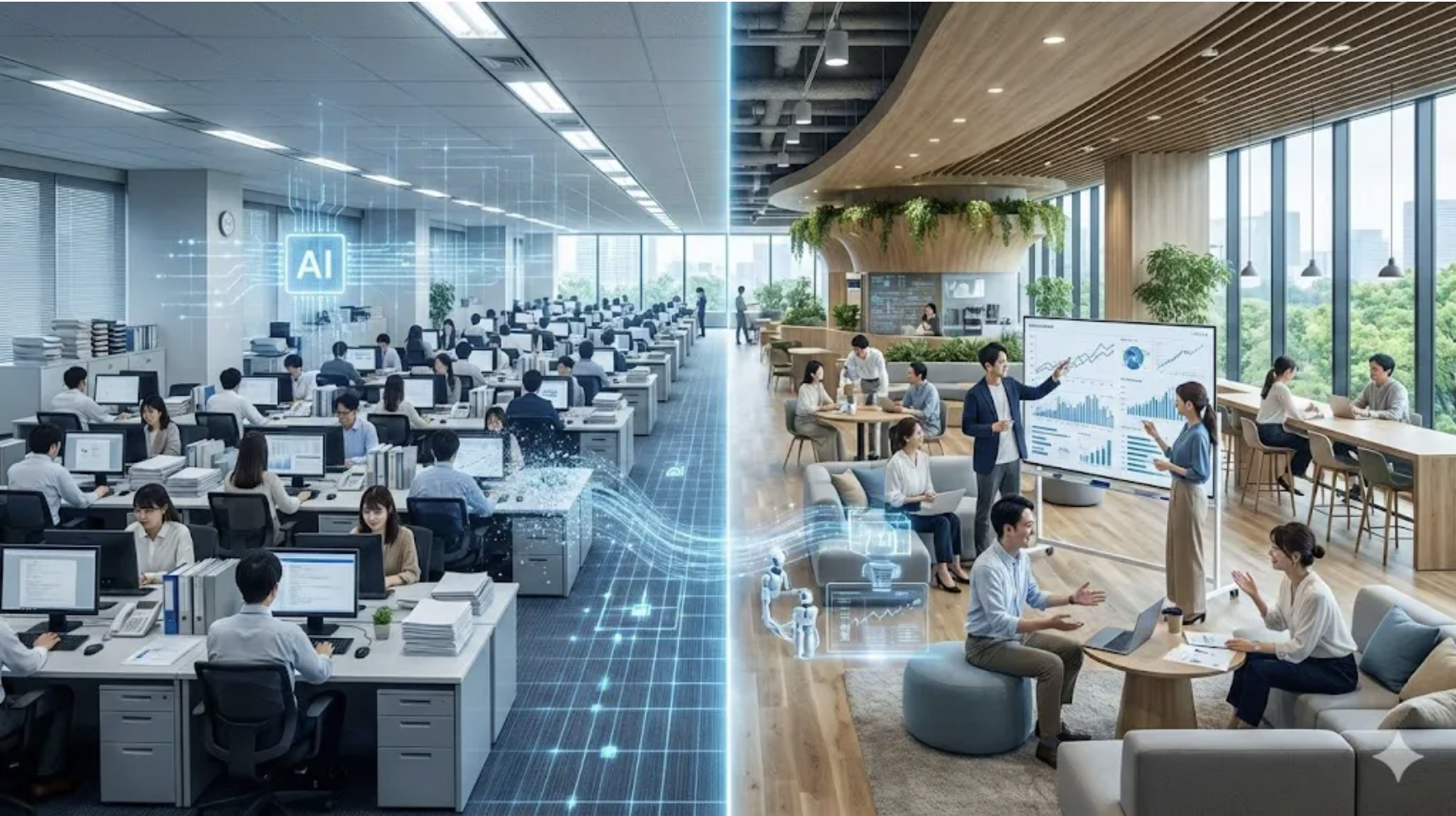
How much space will you need in 3, 5, 10 years?
A new genre of research is emerging. Call it AI-impact modelling.
The approach goes something like this. Take every occupation in the economy. Decompose each into its constituent tasks - data entry, document drafting, scheduling, analysis, negotiation, physical labour. Score each task for AI susceptibility on a scale of 0 to 1. Weight the scores by how much time each occupation spends on each task. Apply an adoption discount to reflect real-world barriers. Out comes a number: the “practical AI impact” for every job in the economy.
The methodology traces back to Eloundou et al.’s influential 2023/24 paper “GPTs are GPTs,” which assessed GPT-4’s capability against occupational tasks. Since then, the ILO, the OECD, Felten et al., and most recently the UCL/Cardiff GAISI study have all built on or extended the framework. It has become the default approach for estimating AI’s labour market impact.
And the numbers are eye-catching. Depending on whose model you look at, somewhere between 25% and 45% of the average knowledge worker’s tasks are susceptible to AI automation. Apply discount factors for adoption barriers, layer on displacement assumptions and timeline projections, and you get headline figures about millions of FTE capacity freed, hundreds of thousands of office jobs at risk, and tens of millions of square feet of space demand evaporating.
These models are proliferating because there’s a commercial appetite for them. Occupiers want to know how much space they’ll need. Investors want to know whether their assets are exposed. Consultants want to sell certainty into an uncertain market. And a multi-hundred-occupation spreadsheet with scenario matrices and regional breakdowns certainly looks like certainty.
It isn’t.
WHAT THE EVIDENCE ACTUALLY SHOWS
Before I explain why the models don’t work, let me acknowledge that something real is happening. The GAISI study (UCL, Cardiff, Oxford, Surrey - August 2025) found that job postings in AI-exposed occupations were 5.5% lower in Q2 2025 than pre-ChatGPT trends would predict - roughly 84,000 fewer postings per month. The pay premium for AI-exposed tasks fell ~12% between 2017 and 2024. Displacement effects appear, at present, to outweigh productivity-driven gains in labour demand.
But notice what this actually measures: hiring decisions. Firms choosing not to fill roles, restructuring teams, rethinking workflows. The real signal is in the aggregate behaviour of employers, not in theoretical task scores.
WHY TASK BASED MODELS DON’T WORK
Here’s the fundamental problem.
The capability scores are already stale. Every major task-exposure framework was built to assess capabilities circa 2023 - primarily GPT-4. Even GAISI, published in 2025, used GPT-4o and Gemini 2.5 Pro for its task ratings. GPT-4o was not a reasoning model, and while Gemini 2.5 Pro is more capable, both have already been superseded. Current frontier systems are qualitatively different, and in 18 months they’ll be different again. Using a 2023 capability snapshot to project 2031 or 2036 labour markets is like using a 2015 smartphone to predict what your phone would do today.
The adoption discount is a guess wearing a lab coat. These models typically apply a uniform discount - say 0.6 - to all occupations, reflecting the gap between what AI cando and what organisations will deploy. But adoption varies enormously. A fintech processing team will hit 85% AI integration years before an NHS trust reaches 30%. A flat discount applied uniformly creates false precision while masking the variation that actually matters.
The precision is theatrical. When a model tells you that a particular occupation faces a practical impact of 34.332% and will have 12.70284 hours freed per week - that level of specificity implies extraordinary confidence. The real uncertainty band is ±15 percentage points at best. Six decimal places on a qualitative assumption is not data science. It is aesthetics.
And jobs don’t work like this. This is the deepest problem. The entire framework treats occupations as fixed containers with automatable components. You take today’s task mix, score each piece, and calculate what percentage gets “freed up.” But that’s not how AI changes work. What happens in practice is that roles get redesigned, merged, split, and reinvented. A financial analyst who used to spend 40% of their time gathering data doesn’t just get that 40% back as spare capacity. The role transforms. Expectations rise. New responsibilities appear that didn’t previously exist.
The model is treating the subject as a photograph when it is actually a video.
Changing all the time.
In practice, you might as well just guess. You’d get a different number, but it wouldn’t be meaningfully less accurate. And the spreadsheet version is arguably worse than an honest guess - because the aesthetic of precision triggers all manner of anchoring biases in anyone not deeply sophisticated in their data analysis. Hand a board a number with six decimal places and they’ll treat it as a fact. That’s not a useful tool. It’s a crutch that could lead to a string of bad decisions.
THE QUESTION THESE MODELS GET WRONG
But there’s a deeper problem than imprecision, and it comes from recent work by MIT’s David Autor and Neil Thompson.
Their June 2025 paper “Expertise” argues that the standard task-based approach asks the wrong question entirely. It’s not how much of a job AI can automate that matters. It’s which parts.
The insight is this: when automation removes the low-expertise tasks from a job - the routine data gathering, the basic processing, the scheduling - the remaining work concentrates around higher-expertise activities. The job becomes harder, more specialised, and better paid. But fewer people can do it, so employment in that role falls.
When automation removes the high-expertise tasks - the complex analysis, the specialist judgement - the job gets easier. More people can do it. Employment expands, but wages drop.
Autor and Thompson document this empirically across 300+ US occupations over four decades. Their accounting clerk example is instructive: computers eliminated much of routine bookkeeping between 1980 and 2018, yet while employment fell by a third, real wages rose by nearly 40%. The remaining work - reconciliations, exception handling, judgement calls - was harder and more valuable.
Inventory clerks went the other way. Automation removed their most skilled work - technical analysis, compliance checks - leaving basic counting and stocking. The job became easier, wages fell, and employment expanded as more people could now do it.
As Neil Thompson put it: taxi drivers once relied on deep knowledge of local streets as a real differentiator. GPS automated that expertise. The result was a more commoditised service - lower wages, many more drivers.
The same task. The same “automation exposure.” Completely opposite outcomes - for wages, employment, and the kind of space those workers need.
This matters enormously for office space demand, because the task-based models produce a single number per occupation and treat it as if it tells you something about future space requirements. It doesn’t. You need to know the direction of the expertise shift.
If AI removes the grunt work from professional roles - the research, the routine drafting, the data processing - the remaining workforce is smaller, more expert, more senior, better paid, and likely needs better space. Less total square footage, but higher quality. More collaborative, more client-facing, more premium.
If AI removes the high-expertise components and commoditises the role, you get more people doing simpler work for lower pay. The space requirement shifts toward cheaper, more generic, possibly non-office settings. Same occupation. Same AI exposure score on the spreadsheet. Completely different implications for your portfolio.
WE NEED A BIGGER PIE
There’s another variable that every task-based model ignores: growth.
The bottom line is an absolute certainty: AI means we will need fewer people to achieve our current level of output.
The question is whether the pie stays the same size. If an economy grows - new products, new services, expanded demand - then productivity gains get absorbed into expansion rather than headcount reduction. Jevons paradox: when something becomes cheaper and more efficient, demand for it can increase.
But growth doesn’t always bring jobs. Bloomberg recently highlighted an unprecedented “jobless boom” in the US - GDP growing while non-farm payroll growth flatlines. The divergence has never been this persistent this far into an expansion. If AI reinforces that pattern, even economic growth won’t necessarily translate into office demand.
For a low-growth economy like the UK, the arithmetic is harder still. Productivity gains without matching demand growth translate directly into headcount reduction. This macroeconomic context is absent from every task-based model I’ve seen, and it’s arguably the most consequential variable in the system.
HOW TO ACTUALLY THINK ABOUT THIS
So if spreadsheet determinism doesn’t work, what does?
The answer is to stop pretending we can model 10 years of AI-driven change with decimal places and instead be honest about what’s knowable at different time horizons.
Three years out is an engineering problem.
Most relevant variables are already observable. Lease structures are signed. Supply is largely consented. Hybrid patterns have stabilised. AI adoption is still early for most firms.
Three-year demand is a function of things you can measure today: lease expiry profiles, observed attendance rates, sector-level employment trends, and the hiring slowdowns GAISI is already documenting. The methodology should be empirical, not modelled.
Five years is where it gets genuinely hard - but not impossible.
AI capabilities in 2031 will be radically different from today, but organisational adaptation will still be incomplete. Too far for extrapolation, too near for speculation.
The right framework here is not task decomposition. It’s two variables: productivityand growth. How much more productive will AI make your people - actually, not theoretically? And is demand for your output expanding or flat?
These interact. And they produce radically different space outcomes.
Take a company with 500 people currently occupying 60,000 sq ft. Run it through four scenarios over a five-year horizon:
Scenario 1: Low growth, high AI productivity gain Output +10%. Productivity +40%.The toughest scenario for space. Headcount drops to ~390, space requirement to ~47,000 sq ft - a 22% reduction. And per Autor/Thompson, AI has stripped out the routine work, leaving a smaller, more senior team. They don’t just need less space. They need different space - more collaborative, more client-facing. This firm is handing back a floor and upgrading what remains.
Scenario 2: Low growth, low AI productivity gain Output +10%. Productivity +15%.Nothing dramatic. Headcount drifts to ~480, space to ~57,500 sq ft - barely a 4% reduction. The firm absorbs AI gradually, trims a few roles through attrition, renews at roughly the same size. Most organisations today are probably closer to this than they’d like to admit.
Scenario 3: High growth, high AI productivity gain Output doubles (a fast-growing tech or professional services firm, say). Productivity +40%. Jevons paradox in action. Growth absorbs the productivity gain and then some. Headcount rises to ~715, space to ~86,000 sq ft - a 43% expansion. But the type of space changes dramatically: fewer individual desks, more project space, more client-facing environments.
Scenario 4: High growth, low AI productivity gain Output doubles. Productivity +15%.Growth without much AI transformation. Headcount expands to ~870, space surges past 104,000 sq ft. Scaling the old way - more people, more desks. But this may be the least likely scenario over five years, because firms growing this fast tend to invest most aggressively in AI.
The point is not that these numbers are precise - they’re napkin maths. The productivity ranges (15-40%) reflect early-adopter evidence: coding teams reporting 30-50% gains, legal and customer service operations seeing 2-3x throughput. Many firms will be lower, particularly over five years. Over ten - which is more typical of CRE investment horizons - these ranges become conservative. But they show what task-based models fundamentally miss: the same AI productivity gain can mean 22% less space or 43% more space, depending on whether a firm is growing. No occupation-level task score tells you which one you’re in. Only your own strategic context does.
These scenarios assume constant density at 120 sq ft per person. In practice, collaborative space runs larger per head than desk-based processing space - which narrows the reduction in Scenario 1 but reinforces the point about character over quantity.
And the Autor/Thompson expertise lens adds a third variable: what kind of space? In three of four scenarios, routine processing work diminishes and expert, collaborative work grows. The square footage number alone misses this. You might need less space in total but higher specification - or more space of a fundamentally different kind.
NOTE: There are other variables these scenarios don’t capture - attendance patterns, peak-load coordination, the logic of signing a five-day lease for three-day usage, whether co-location becomes more or less important as teams shift to creating and curating AI agents. These are real and consequential. But they are also deeply specific to each organisation’s culture, stage, and ways of working - and largely unknowable over a 5-10 year horizon. They reinforce the point: the answers live inside each company’s particular circumstances, not in a macro model.
Ten years is scenario territory.
Anyone offering a 10-year office demand forecast with specific numbers is selling confidence they don’t have. The honest approach is qualitative scenarios - genuinely different futures. In one, AI delivers transformative productivity and new sectors emerge. In another, productivity gains outstrip demand growth, creating structural surplus in commodity stock. In a third, the Jevons paradox catalyses broader expansion. In a fourth, the US-style jobless boom becomes structural - output growing, employment stagnant.
No spreadsheet helps you choose between these. What helps is understanding the forces, tracking the signals, and building resilience across multiple futures.
THE SUPPLY TRAP
There’s a temptation, particularly for landlords and investors, to look at the current supply picture and take comfort. There is already a well-documented shortage of the kind of space the best occupiers want - high-specification, ESG-compliant, well-located, operationally excellent. In many UK markets, occupiers are being pushed to second-best options because the best simply isn’t available.
But relying on supply constraints to fill your building is increasingly risky. AI doesn’t just change how much space firms need - it makes hybrid and distributed working progressively easier and more effective. As thetools for asynchronous collaboration, AI-synthesised meeting outputs, and rich shared context improve, the compulsion to be in a specific physical space diminishes. The occupier who accepted your second-best building because their first choice was full might, in three years’ time, decide they don’t need a central office of that size at all.
Supply constraints are a short-term tailwind. They are not a strategy.
WANT BEATS NEED
This brings us to what I think is the most important strategic question in office real estate right now - and it has nothing to do with task decomposition models.
The #SpaceAsAService era has already demonstrated that selling to someone who needs your product is fundamentally different from creating something someone actively wants. The entire trajectory of operational intensity in the office sector - the rise of flexible space, managed offices, hospitality-influenced design, amenity-rich environments - reflects this shift. Just building to spec is no longer enough.
AI accelerates this. If the processing, analysis, and document production that currently fill desks get absorbed by AI, the purpose of the office shifts further toward collaboration, client relationships, mentoring, culture-building, and the irreducibly human work that remains. Space that serves those purposes will be wanted regardless of macro demand trends. Space that’s still designed for rows of people doing information processing will not.
For developers and investors, this means every asset decision needs to start with a question that no macro model can answer: when this building is ready, what will companies want from their workspace? Not what will they need - because need is declining. What will they choose? What will they pay a premium for? What will make them pick your building over the increasingly viable alternative of not having an office at all?
You can still win big in a shrinking market if you’re building something people choose rather than something they’re forced to occupy. But it requires understanding what work is becoming - not just how much of it there is.
Relying on aggregate demand to fill your building is a bet on a macro variable you can’t control and increasingly can’t predict. Building something people actively desire is a bet on quality, experience, and understanding the future of work.
That’s a better bet.