Plumbing and Judgement: Where to Spend Your Build Budget
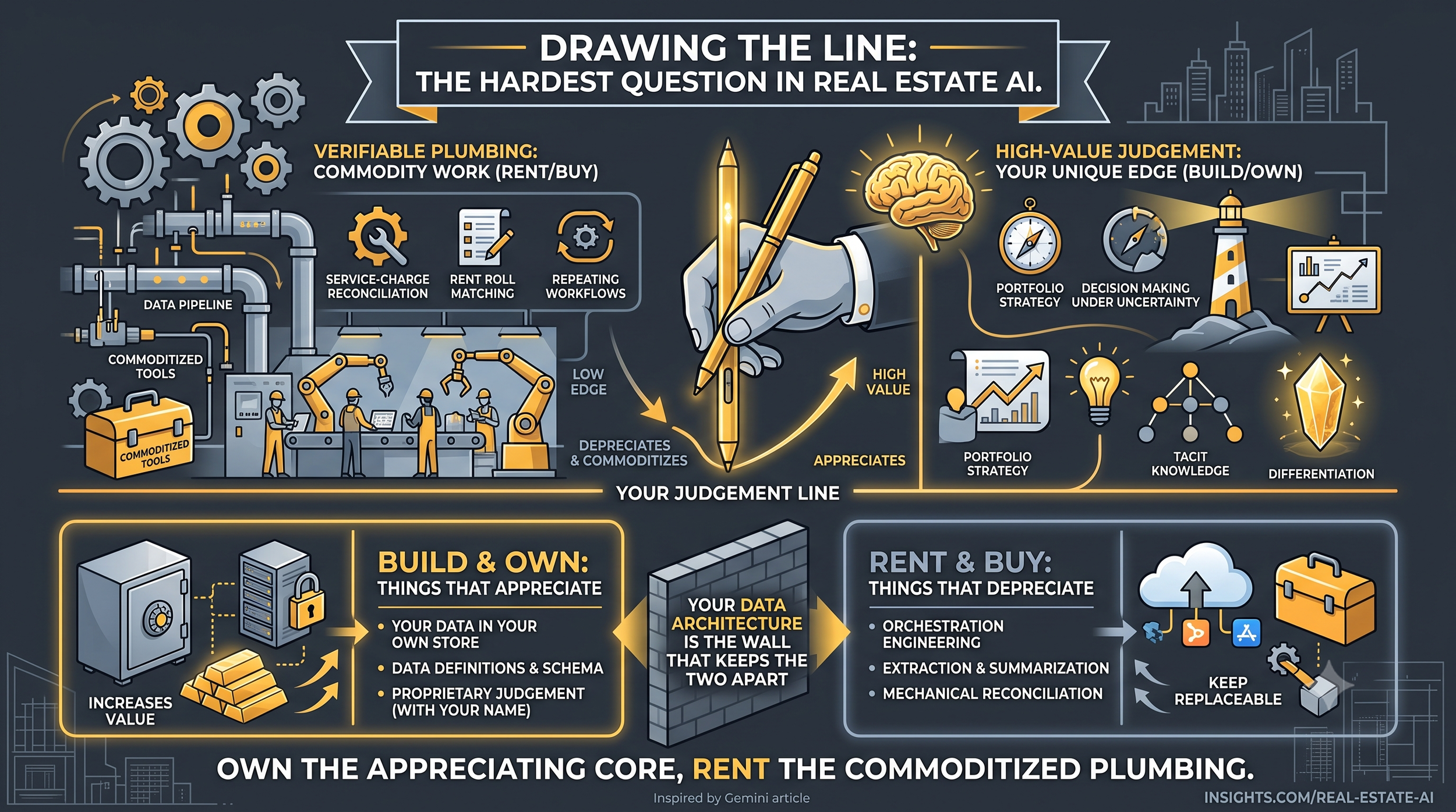
The hardest question in AI for a real estate business is not which tool to buy. It is which work to keep.
The hardest question in AI for a real estate business is not which tool to buy. It is which work to keep. Get the line right between the two and dependence becomes safe. Get it wrong and you automate away the very thing that made you worth hiring.
For years the received wisdom in real estate technology was simple: don’t build, buy. Someone else will amortise the engineering across a hundred customers and sell it to you for a fraction of what it would cost to make. That wisdom was correct for fifteen years. It has quietly stopped being correct, and the firms that have not noticed are about to make expensive mistakes in both directions: building what they should rent, renting what they should build.
Let me start with the distinction that does all the work.
Every workflow in your business breaks into two kinds of work. There is plumbing: the verifiable, mechanical work where the output either reconciles or it doesn’t. Did the service-charge reconciliation tie out? Does the rent roll match the leases? You can check the answer cheaply and mechanically, and so can anyone else. Then there is judgement: the work of deciding what to do under uncertainty, where the line falls, what a thing means. Two experienced asset managers look at the same portfolio and reach different reads, and neither can fully show their working, because the working is partly tacit and partly theirs.
Plumbing and judgement behave in opposite ways, and that is the key to the whole thing.
Plumbing commoditises. The way you reconcile a service charge is roughly the way everyone reconciles a service charge, which is exactly why a supplier can build it once and sell it to the entire market. There is no edge in it. There never was. A reconciliation done perfectly is table stakes, and being unusually good at it wins you nothing, because your competitor’s reconciliation is identical to yours.
Judgement does the reverse. As the plumbing around it gets automated and cheap, the judgement that remains becomes more valuable, because it is now the whole of your differentiation and everyone’s commodity layer looks the same. The residue concentrates. What is left when the routine 80% has been automated is a smaller share of the work and a larger share of the value.
THE TRAP DRESSED AS THE SOLUTION
This is where firms walk straight into trouble.
Working out what to automate is itself a pieece of judgement, and it is different for every firm. The decomposition of your own workflow, which parts are plumbing you should hand away and which parts are the judgement that distinguishes you, is one of the most firm-specific things you own. It is partly constituted by what you have decided your edge actually is.
So a supplier can do your plumbing for you, gladly, and you should let them. A supplier cannot do your deconstruction for you, because the answer depends on what makes your firm your firm, and they do not know that and cannot. A vendor who sells you a ready-made answer to “which parts of your work are the valuable parts” is selling the identical answer to every other customer. At which point it has stopped being judgement at all.
The vendors will not put it this way. The piitch is always the friendly one: skip the hard part, we’ll handle the structuring, you don’t need a data project. And accepting that pitch is the precise act of handing them the layer you most needed to keep. The convenience and the lock-in come in the same box. You cannot buy one without the other unless you deliberately keep the judgement work inside your own walls.
A SIMPLE MAP FOR WHERE THE BUDGET GOES
None of this means build everything. Building everything is how a real estate firm turns itself into a mediocre software company, and the cost of that is brutal. The discipline is narrower and more useful than “build” or “buy”. It is a line, drawn through your own operation, with most of the surface area on the rent side and the small valuable core on the build side.
Reach for this when you are deciding:
- Own the things that appreciate and cannot be got back. Your data, in your own store, under your own keys. The model of what your data means: the schema, the definitions, the way your messy reality resolves into structure, wherever that meaning is part of your edge. The judgement that carries your name and your balance sheet behind it. These get more valuable as the models improve, and once given away they cannot be repatriated. Build and hold them.
- Rent the things that depreciate and commoditise. The orchestration engineering. The extraction. The reconciliation. The summarising. All the verifiable plumbing that nobody’s edge ever depended on. Buy it freely, and keep it deliberately replaceable, so no single supplier can ever turn the screws.
The unifying rule is one sentence. Own what appreciates and cannot be repatriated; rent what depreciates and commoditises; and treat your data architecture as the wall that keeps the two apart.
A CAVEAT THAT MATTERS
Part of my argument for building more than you used to is that the cost of building has fallen hard. The claim is that a domain expert with these tools can now produce in days what once took a team a quarter. I believe that is directionally true. I also want to flag it as the place this argument is softest, because “I built a working version in an afternoon” and “this runs in production at institutional reliability, verified and governed” are separated by exactly the gap where most enterprise AI projects go to die. The cost of specifying the cognition has collapsed. The cost of the production engineering and the verification harness around it has barely moved. So when I say build, I mean build the valuable core and resource the unglamorous reliability work properly. The firm that hears “building is cheap now” and skips the second half will have a brilliant demo and nothing it can trust.
The decision was never really build or buy. It was always: what is plumbing, and what is judgement? Answer that honestly, for your own firm, and the rest falls out. Answer it lazily, or let a vendor answer it for you, and you will rent your judgement and build your plumbing, which is the most expensive way to get an AI strategy exactly backwards.
So draw the line yourself. Nobody can draw it for you. That, it turns out, is the first piece of judgement the whole thing depends on.