The Toll and the Amputation
Why AI lock-in is no longer about the cost of leaving, but the capability you lose when you do
Every commercial real estate firm is about to become dependent on AI suppliers it does not control. That has always been true of technology. What has changed is the kind of dependence, and the difference decides whether you keep your edge or hand it over without noticing.
I have spent a decade telling this industry that the question with technology is never whether, only how and how fast. On dependence I want to change the emphasis. The how-fast matters less than the what-kind. Because there are two kinds of lock-in, and most property people are bracing for the wrong one.
A note on form before I start. I usually write long. For the next few weeks I am doing something deliberately different: four short pieces, one idea each, on the single shift I think matters most for where this industry is heading. This is the first. They sit underneath the redesign argument I keep coming back to: that the work is to rebuild what AI makes possible, not to automate the thing you already do. Consider this the dependence corner of that map. I will break off to write about whatever the week throws up, so they will arrive as an occasional series rather than a march.
You already know the old kind. You have lived inside it for years. You pick a property management system, you pour your data into it, you train your people on it, and five years later moving to a competitor is a bet-the-operation migration that nobody wants to sign off. The cost of leaving is enormous. Everyone knows it is enormous. That knowledge is the lock-in.
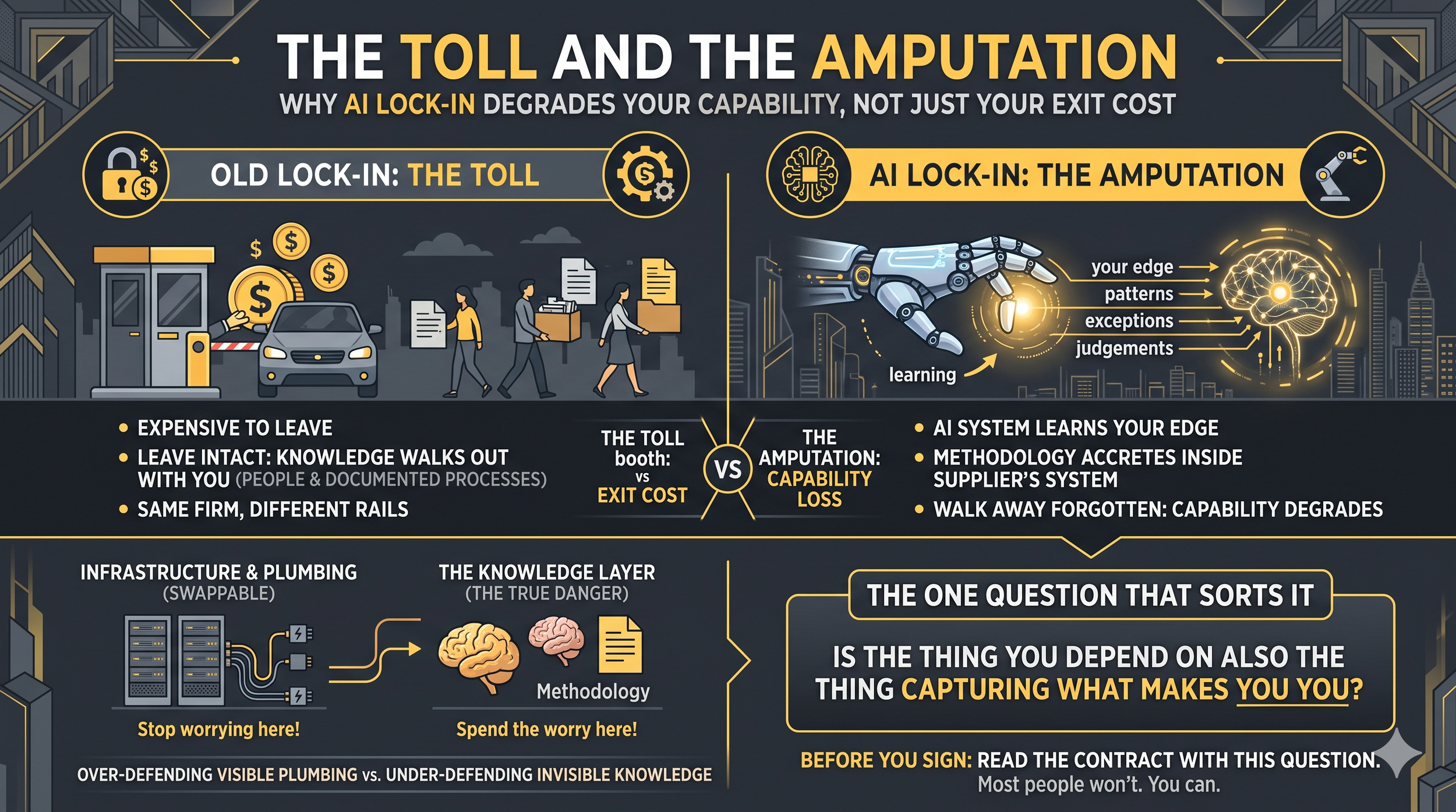
Call that the toll. It is expensive to leave, but you leave intact. Your knowledge of how to run your buildings walks out of the door with you, mostly in the heads of your people and in the processes you documented. The new system is a pain to stand up. Six months later you are running again, and you are the same firm you were before, just on different rails.
AI lock-in is a different animal, and the difference is the whole argument.
When an AI system runs a workflow for you for three years, it learns. It learns the patterns in your data, the exceptions your people make, the awkward cases and how you handle them, the thousand small judgements that constitute how your firm actually does the work. That learning accretes inside the supplier’s system. It was generated by your usage, on your data, about your portfolio. And it was never in a form you possessed.
So when you try to leave, you can take your data. You cannot take the knowledge. The knowledge was constituted somewhere else, as a by-product of you using the thing. You walk away having forgotten how to do the work, because the system did it for you and the institutional memory of how now lives in a methodology you do not own.
The toll is a cost you pay to leave. The amputation is a capability you lose by leaving.
That is the distinction, and once you see it you cannot unsee it. Old lock-in raised your exit cost. AI lock-in degrades your capability. One is a toll booth on the way out. The other removes something you needed to keep.
WHY THIS FEELS WORSE THAN IT IS, AND WORSE IN ONE PLACE THAN YOU THINK
Now let me argue against myself for a moment, because there is a twist.
In one respect the old lock-in was the more brutal of the two. Ripping out a system of record really was a multi-year nightmare, and plenty of firms started those migrations and never finished. AI dependency, by contrast, sits on top of a layer of standards and protocols that is getting cheaper and more interchangeable every quarter. The plumbing underneath is becoming more swappable over time, not less. So the instinct to fear AI dependence across the board is, in large part, misplaced. Much of it is loosening on its own.
The genuinely new danger is narrow and specific. It is the knowledge layer. It is the methodology capture that was never extractable in the first place. Everything else (the integrations, the pipes, the orchestration engineering) is commoditising, and you should treat it as replaceable infrastructure and stop worrying about it. Spend the worry where it belongs.
The mistake I see firms making is the opposite. They over-defend the plumbing, because plumbing is visible and has a price tag, and they under-defend the knowledge, because knowledge is invisible and arrives as a problem years later. They will negotiate hard on the licence fee and sign away, in the same contract and without reading it, the thing that actually matters.
THE ONE QUESTION THAT SORTS IT
You are going to be dependent. I am going to be dependent. Everyone building anything serious will depend on suppliers they do not own, and that is fine, and pretending otherwise is a fantasy. The real work is sorting the safe dependence from the dangerous kind, and there is one question that does the sorting:
Is the thing you depend on also the thing capturing what makes you you?
Where your dependence runs through commoditising infrastructure, with many suppliers, all swappable, none of them accreting your edge, depend away at any depth you like. It costs you nothing, because nobody’s competitive advantage ever lived in the plumbing. But where your dependence runs through a system that is quietly learning the judgement that distinguishes your firm, you are handing over the family silver one quarterly usage report at a time, and the invoice for that arrives late, as competitive disadvantage, long after the decision that caused it.
The toll you can always pay. The amputation you cannot undo.
So before you sign the next “do it with AI” contract, do not ask what it costs. Ask what it learns, where that learning lives, and whether you could ever get it back. If the answer is it learns your edge, it keeps it, and no you cannot, then that is no supplier at all. It is a slow transfer of the one thing you most needed to own. Read the contract with that question in hand. Most people won’t. You can.