
THE BLOG
Thoughts, Ideas, Actions for 2026… and Beyond. Part 2.

Last week we looked at ’16 Emerging CRE Tech Trends’; This week we’re going to look at ’10 Foundational Themes’ - capturing the fundamental shifts required for the next decade, and defining the high-level competitive landscape.
1. The ‘Bicycle for the Mind’ Gets an Update
In 1981 Steve Jobs talked about how a computer was like a ‘Bicycle for the Mind’, a tool to amplify our mental capabilities through elegant digital engineering. The computer, like the bicycle, isn’t just a passive tool - it’s an efficiency multiplier that dramatically extends human potential.
Bicycle though no longer feels adequate. In the last 8 years Nvidia’s GPUs (the chips that power most of ‘Planet AI’) have increased in power 1000X. According to the AI Research Company, Epoch AI, by 2030 we are likely to have 1000X the compute capacity that we have today. And R&D benchmarks in many domains are on track to be solved by 2030.
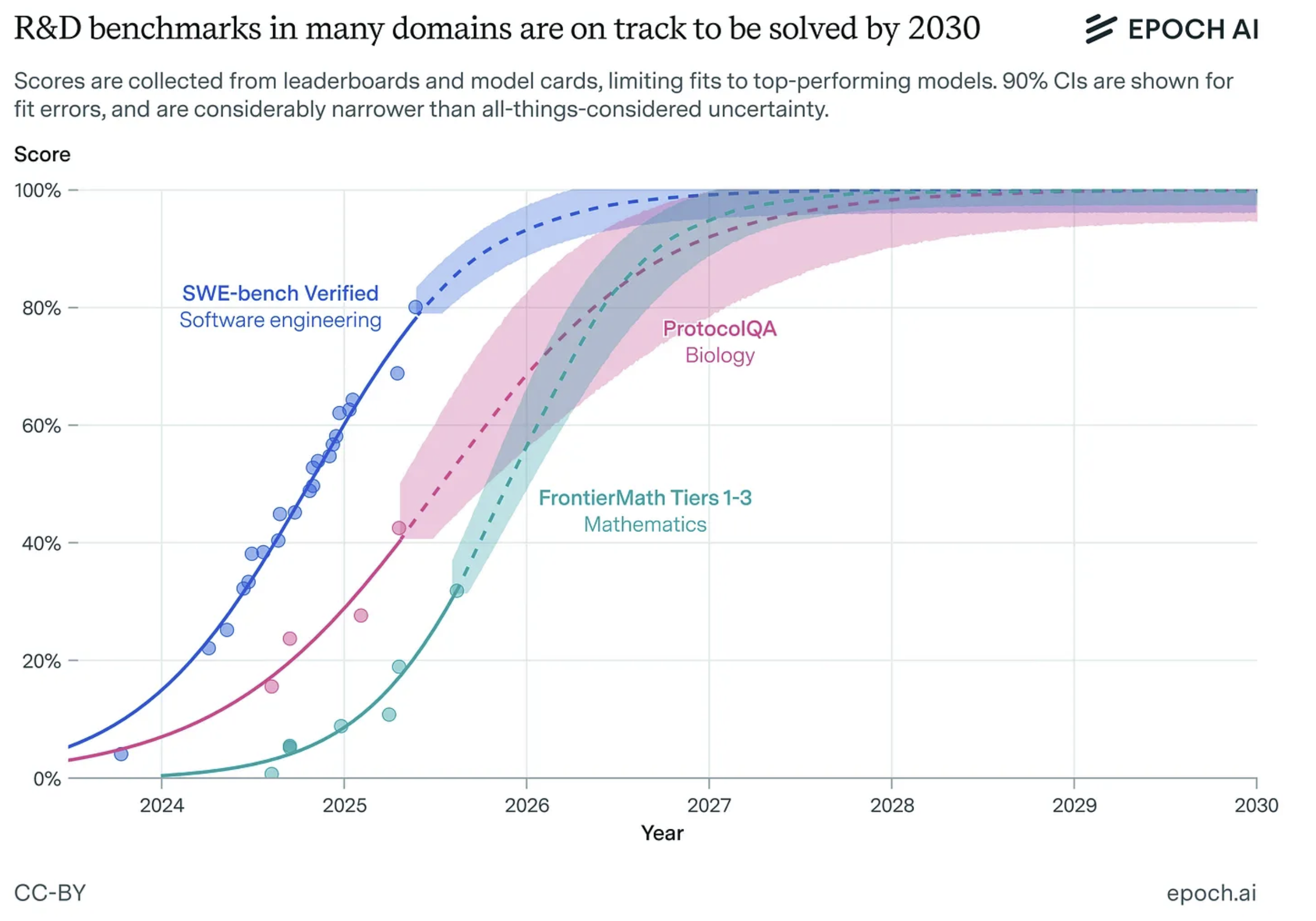
It needs to be foundational in your thinking that this scenario has a high probability of coming to pass, and therefore one must be anticipating what is likely to be possible, rather than over-indexing on current day capabilities. If one takes 9 months to develop a product/service it’s no using basing the specification on what can be done today.
What is arriving sooner than expected is the ‘LLMs as the kernel of a new operating system’ idea put forward by famed AI Research Andrej Karpathy in 2023. This is the concept that instead of needing to program a computer, increasingly one will be able to use natural language to simply ask for what we want. An LLM will be able to interpret this and pull in the necessary specialist tools as required. ‘The hottest new programming language is English’, as he says.
This is going to leave us less as individual cyclists and more as orchestrators of armies of ‘e- bikes’, which we don’t need to pedal, just steer.
Unbundling & Rebundling
There is no question that there are going to be winners and losers in an AI mediated world. Where you end up is largely going to be a function of how well you understand the way AI is going to unbundle and rebundle almost all knowledge work.
Currently each of us has a job, a role. This typically involves a series of goals that we have to achieve in order to fulfil our responsibilities. In turn each of these goals consist of a series of tasks we need to perform, or execute, to fulfil each goal. In effect, this is what every job description is specifying.
As technology develops it can perform ‘some’ of our Tasks. But Goals and Roles are still overseen by Humans.
Over time technology will enable a series of Tasks, that make up specific Goals, to be performed entirely by an ‘AI Agent’. These will be discreet mini applications that are tasked with performing X, and provided with the necessary capabilities to do so.
This means that some tasks will remain as a collection of tasks performed in part by humans, and in part by technology, whereas other goals will be possible to achieve solely through the application of technology. That goal can then be removed from the ‘job description’ and handled separately.
What might also occur is that multiple goals can be fulfilled by pulling from a repository of ‘AI Agents’ that can be combined in ways that enable them to have utility across multiple domains. Maybe with 30 ‘AI Agents’ we can deal with 50, or 100 goals.
Think of it like Lego; with the same pieces we can combine them in different ways and create a multitude of different things.
And this ‘unbundling & rebundling’ process is guaranteed. Either wilfully, or by having it imposed on us by changing circumstances.
The process is also how we will be able to fully leverage AI. One cannot simply bolt on AI to existing processes and expect transformational outcomes. Many are doing this, but already we have plenty of research showing it does not work.
We don’t need to add cream on the top of our cake - we need to bake a new one!Fast, Agile, Ultra-Productive Superteams
We are seeing the emergence of small, highly skilled teams leveraging AI augmentation to achieve exceptional productivity, challenging the size and speed of traditional large firms. Whilst the meme about ‘Single Person Unicorns’ is probably over-egging it we are already seeing various software companies, such as Midjourney, Cursor, Lovable, with dozens of employees by hundreds of millions in ARR.
Software is of course perfect for leveraging AI, more so than other industries, but there is enough evidence of quite dramatic bumps in productivity at the team level, to take this seriously.
At a corporate level achieving high productivity gains is harder and slower, due to the usual ‘Normal Technology’ …frictions: slow organisational and institutional change, the need to redesign workflows and incentives, regulatory and safety constraints, and the simple fact that deep adoption demands far more than merely making powerful tools available.
But for startups, or scale-ups, these don’t apply, and the ability of new companies to outperform incumbents is dramatically increased by AI.
Over the next two years I envisage many incumbents suddenly coming up against these new entities… and losing out.
Here’s a possible CRE example:
The “Capital Sniper” Team (Investment & Acquisitions)
The Old Way: A Head of Acquisitions manages an army of Junior Analysts. They manually read IMs, input data into Excel, and take 2 weeks to screen a deal.
The Superteam (2-3 People): One Senior Deal Maker + One Data Architect + A fleet of AI Agents.
The Workflow: AI Agents ingest every listing instantly, extracting data and running it against the firm’s investment thesis.
The Advantage: They don’t look for deals; the deals are surfaced automatically. They underwrite 500 deals a week, not 5.
Expect a few ‘Code Reds’ to be issued.Removing Friction and Enabling Discovery
Jeff Bezos said in 2021 that he thinks less about what’s going to change and more about “What’s not going to change in the next 10 years?”—because you can build a business strategy around things that are stable in time.
In commercial real estate, I’d posit that “Removing Friction and Enabling Discovery” will be forever constant. Our customers want to do what they need to do painlessly, and based on the best possible information.
But to understand why this matters now, we need to recognise a deeper shift: real estate has moved from being a Bond to being a Business.
The 25-year lease with upwards-only rent reviews is largely dead. The “lock up and leave” operating model is over. Our customers are now our users, not just our investors - and for investors to achieve the returns they want, we must put user interests first. The smart money has recognised this as opportunity, not threat: today, you can differentiate yourself like never before.
Friction has been endemic to our industry. Jargon-filled leases. Inflexible terms. Manual processes for payments, access, and visitor management. Opaque pricing. Poorly designed spaces that don’t support actual work.
Meanwhile, “enabling discovery” means making it easy for people to find what they need: seamless access to information, personalised experiences, data-driven insights, and spaces designed for serendipitous connection.
Technology, especially AI, is the key. But the level of service now required cannot be delivered economically through humans alone. Automating the “human touch” authentically, rather than robotically, is becoming a superpower for real estate operators.
The industry is at a liminal point. Removing friction and enabling discovery are the foundations upon which the winners will build.
Redefining ‘what is the best affordable option?’
In business, the quality of service we receive is directly tied to what we can afford - and the same applies to the quality we provide. Every service operates within defined price points: pay more, get more. For decades, this has created a clear divide between those who can afford premium offerings and those limited to more basic options.
Generative AI is going to upend this apple cart. It is going to redefine what is meant by ‘affordable’. In terms of the services you receive, or the services you supply. In short, it is going to massively redefine ‘the best affordable option’.
Many services that were previously ‘White Glove’ - only available to the richest and most prestigious companies - are going to be commoditised and made available to all. When financial models take 2 hours not 2 weeks to develop, when research takes 1 hour instead of 1 month, and when software apps are deliverable in 6 days instead of 6 months, the economics and dynamics of markets totally change.
This could mean services are no longer profitable to deliver, if kept as ‘White Glove’ ones, but if repositioned to be sold to a much larger market that did not exist at the old price points, the game changes entirely.
At the core, AI is going to be, in many cases, ‘the best affordable option’.
Outcomes as a Service (OaaS)
The limitations of the pure SaaS model are becoming apparent. While SaaS democratised access to powerful software, it left the burden of achieving results squarely on the client. Companies purchased subscriptions, but the responsibility for implementation, adoption, and tangible improvement remained with them.
AI changes the equation. Software alone is not enough - the operational landscape now requires software, plus data wrangling, AI implementation, analysis, and definable outcomes. Most buyers don’t want to orchestrate all of this; they just want X to perform according to A, B, and C.
Consider the difference between subscribing to an energy management platform and partnering with a provider who guarantees a specific percentage reduction in energy consumption, with fees tied to achieving that target. That’s OaaS: selling outcomes, not access.
In CRE, this might mean committing to specific tenant satisfaction scores, delivering guaranteed sustainability metrics, or ensuring space utilisation hits agreed benchmarks - with payment contingent on results.
This shift will force transformation on the supply side. PropTech companies will need new roles, such as ”Outcome Managers,” “Value Engineers”, and new pricing models: performance-based fees, risk-sharing agreements, value-based pricing tied to realised benefits.
Who’s positioned to win? Existing PropTech players have the technology but must build service capabilities. Specialised startups can focus on niche outcomes. And the large CRE services firms, JLL, CBRE, Cushman & Wakefield, have the client relationships and industry knowledge, but face the classic Innovator’s Dilemma: can they cannibalise existing revenue streams fast enough?
Increasingly, selling outcomes, not software, will be the norm.
#HumanIsTheNewLuxury
This has been my theme of the year. As the world gets ever more AI-mediated, it will actually be human skills that command premium value.
We humans tire of technology remarkably quickly. We strive to acquire the next big thing, are in thrall to it briefly, then become bored. It wasn’t long ago that maintaining a phone signal in a car was hit and miss; now we rage when 4K streaming drops at 80 mph. As Shania Twain put it: “Okay, so you’re a rocket scientist / That don’t impress me much.”
Technology will move into the background, powering much of what happens around us, but given no more thought than a light switch. What we’ll pay for is what sits on top: experiences that delight, connections that feel authentic, craftsmanship that carries the mark of human hands.
In a world of mechanical perfection, we will actively seek out imperfection. The imperfect will be unique; the perfect, a commodity. Think vinyl versus CD - the CD is technically superior, but vinyl speaks to your soul.
For real estate, this points in specific directions: high-touch concierge services where AI provides the insight but humans deliver the experience; curated spaces that reflect human judgment, not algorithmic optimisation; community-centric developments that foster genuine connection; relationship-based transactions for deals that matter.
To be clear, being a great human with great human skills won’t be enough. Each of us will need to be AI Fluent, orchestrating technology while creating and curating the intensely human experiences that constitute “work.” This is not a call for Luddism; it’s a demand for the kind of skill that makes everything look effortless.
The challenge will be making this the norm, not just a luxury.
Evolving Real Estate: Form, Purpose, Location
“We shape our buildings, and afterwards our buildings shape us.”
If we want to benefit from the themes discussed here, we need the right real estate. Churchill was explaining how our internal environment shapes us: form, purpose, and location matter. Real estate is an input to whatever output is created within it.
Technology now enables us to do “Everything Everywhere All at Once.” RTO mandates fail because they fight against the tide of technology. The world of everyone in the office, five days a week, is fundamentally a pre-internet construct - it’s just become clearer as capabilities have developed.
So what matters when pervasive AI means “the machines” are doing much of our work? I’d argue for six pillars of human-centric real estate:
- Health & Wellbeing: Environmental quality - lighting, acoustics, temperature, air quality - directly affects cognitive function. Get this right and you enable people to perform at their best.
- Ergonomics & Comfort: Physical quality designed for actual use, by actual users.
- Technology Integration: Seamless, friction-free - not ten minutes getting the AV to work before every meeting.
- Community & Connectivity: Over the next decade, this becomes THE purpose of commercial real estate. Everything else gets offloaded to machines. Why else would we commute except to do what we cannot do elsewhere?
- Flexibility & Adaptability: Sam Altman has a sign above his desk: “No one knows what happens next.” If he doesn’t know, nobody does. Billions of square feet have already outlived their product/market fit. We must create spaces people can reconfigure.
- Sustainability: Non-negotiable and foundational.
But form is only part of the story. Purpose is shifting: we don’t NEED an office to work, or a shop to shop - we have to be made to WANT them. And location is morphing: Central Business Districts are becoming Central Social Districts.
Beyond individual buildings, four broader shifts are coming:
- Decentralised hubs: The biggest agglomeration of talent is now on the internet. Distributed working is the future; real estate must supply to this demand.
- Micro-locations: Hyper-local, mixed-use developments with deep understanding of customer wants and needs.
- Transportation-responsive design: Autonomous vehicles are here - “just not evenly distributed.” When we don’t need parking, what happens to all that space?
- Fluid space allocation: A curb as delivery zone in the morning, rideshare pickup in the afternoon, restaurant seating in the evening. 24 hours in a day - use them.
- Whoever truly understands the drivers of successful spaces and places will make fortunes. And vice versa.
#SpaceasaService loves Generative AI
This grew out of a feeling that the same characteristics that make a company embrace #SpaceasaService are the ones that make them active adopters of Generative AI. Both are fundamentally creative movements, looking to enable humans and machines to work together to produce things neither could achieve alone.
And as it happens, a new study (’Employee Centricity in an AI World’) by BCG and Columbia University confirms this:
“Employee-centric organisations are 7X more likely to be AI mature compared to orgs who are beginning/emerging in employee centricity.“
And: “The same capabilities needed for successful flexible (hybrid) work arrangements—transparent communication, focusing on outcomes over activities, cross-functional coordination—are also crucial for effective AI transformation.“
The implication for real estate strategy is significant. We’re likely heading toward a market that looks like this:
- Top 15-20%: Large multinationals with in-house scale to create exceptional workplaces in exceptional buildings.
- Next 40-45%: #SpaceasaService - either through high-quality flex operators or by having operators run their buildings for them. CBRE’s acquisition of Industrious suggests this is now a core strategic bet.
- The remainder: Shrinks, goes fully distributed, or disappears. There is no future for low-to-medium quality commodity office space.
If 30-40% of existing office stock is already obsolete or heading there fast, the question becomes: which side of this divide are you positioning for?
As I’ve been saying all year—mindset matters.
We Need a Bigger Pie
You’ve heard the saying: “AI won’t take your job - someone using AI will take your job.” This is dangerously misleading. It implies 1:1 displacement - your job goes to another person who’s better with tools. This ignores the maths of leverage.
AI doesn’t just make workers better; it makes them exponentially faster. If one asset manager equipped with AI agents can perform the underwriting, market analysis, and reporting work of five junior analysts, the remaining four jobs aren’t “taken by someone using AI.” They simply evaporate.
The fundamental flaw focuses on the survivor and ignores the displaced.
In a stagnant macroeconomic environment, efficiency gains result in headcount reduction, not output expansion. The absolute certainty is this: AI means we will need fewer people to achieve our current level of output.
Which means we need a bigger pie.
But how? Not through efficiency alone - that just concentrates gains among fewer people. We need genuine expansion: new industries, new markets, new categories of value.
AI is already unlocking markets that were previously inaccessible. Language translation enables global reach; analytics reveal untapped customer segments; personalised services that once required armies of staff become viable at scale. Barriers to entrepreneurship are falling - smaller players can now compete with established enterprises through AI-powered automation.
And we need to rethink value itself. In an AI-augmented economy, intangible assets, data, knowledge, creativity, curation, take on heightened significance. Companies must move beyond efficiency gains and reimagine what constitutes value when intelligence is increasingly commoditised.
Without intentional effort, AI risks concentrating wealth among a small subset of individuals and companies. The bigger pie only matters if more people get a slice.
Surveys show that employees in the West are anxious about AI while the C-suite remains optimistic. There is a major disconnect, because employees understand the incentives. For a certain type of management, AI is a zero-sum efficiency tool. It takes a different mindset to see it as a growth catalyst.
So what’s required?
- Businesses must embrace AI for expansion, not just cost-cutting.
- Policymakers must create frameworks that encourage responsible innovation and workforce transition.
- Individuals must invest in skills that complement AI, creativity, judgment, relationship-building, and assess whether their organisation sees AI as growth engine or headcount reducer.
The next decade will determine whether AI-driven prosperity is broadly shared or narrowly concentrated. That’s a choice, not an inevitability.
Conclusion
These ten themes are not predictions to debate but a roadmap to a destination that’s largely certain. The precise route will vary, by sector, by firm, by individual circumstance, but the direction of travel is clear. AI will unbundle and rebundle knowledge work. Small teams will outcompete slow incumbents. Human skills will command premium value precisely because everything else becomes commoditised. Real estate will either serve human needs brilliantly or become obsolete.
The framework is deliberately flexible. You don’t need to act on all ten themes simultaneously. But you do need to understand how they interconnect, because they will shape the competitive landscape whether you engage with them or not.
What makes this moment different from previous technology transitions is the speed and the scope. We’re not adapting to one new tool; we’re adapting to a new substrate for all knowledge work. That’s daunting. But it’s also genuinely exciting. The organisations and individuals who approach this with curiosity rather than fear, who see growth rather than just efficiency, who invest in human capability alongside technological capability - they will thrive.
Work could be, in almost every way, better and more fulfilling in an AI-fluent world. We remain the apex species. These are super-tools, and it is for us to use them in ways that are positive and life-enhancing.
The destination is a bigger pie, more human-centric spaces, and work that plays to our distinctly human strengths. The road there is ours to choose.
Thoughts, Ideas, Actions for 2026… and Beyond. Part 1
16 Emerging CRE Tech Trends
The end of the year is a good time to look at ‘Pointers’ - ideas, thoughts, trends worth thinking about during the brief decompression over Christmas. This year, I want to use that time to make a case: the next decade will see real estate finally become what it’s always pretended to be - an industry that makes decisions based on evidence rather than intuition.
So in the next three newsletters I’m going to lay out how this transformation will unfold.
First, I’m going to look at ’16 Emerging CRE Tech Trends’ - highlighting the move towards a more data-centric, transparent and ‘assurable’ industry - categorised by immediate, mid-term, and longer-term impact.
Then I will address ’10 Foundational Themes’ - capturing the fundamental shifts required for the next decade, and defining the high-level competitive landscape.
And finally, I will address ‘Personal and Organisational Transformation’ - the required shift in skills, governance, and mindset, needed to provide us, as individuals, with the “how” for navigating these choppy waters.
So, here we go: 16 Emerging CRE Tech Trends.
You’ll notice some trends span multiple timeframes. The technology for most of these exists now; what varies is adoption. Real estate’s deep institutional inertia - fragmented ownership, long asset cycles, misaligned incentives - will slow the pace. But the direction is locked in. All of this will materialise within ten years, which means within the working life of most people reading this.
Timeline: Now – 2 Years (Already in Play/High Impact)
Operational Evidence Beats EPCs
Due diligence is shifting from static design certificates to verified in-use performance - 12-month utility logs, NABERS-style ratings, actual emissions. Buyers increasingly demand this data; smart sellers are leading with it rather than waiting to be asked. The calculation is simple: transparency signals confidence, opacity signals risk. Buildings with strong, verifiable performance will trade faster and tighter; those without face longer marketing periods and wider discounts.Provenance-Verified Documents Collapse Audit Time
When key transaction files - leases, BMS logs, utility records - can be verified as unaltered since creation, the audit burden shrinks dramatically. Buyers and their advisors currently spend weeks validating document authenticity; tamper-evident digital signatures at the point of origin could cut that to days, shortening sales cycles by 10-20%.Agentic FM Triage Cuts Cycle Time
AI agents can now autonomously handle routine facilities requests - diagnosing issues, dispatching contractors, ordering parts - provided they operate within defined spending limits. A blocked drain or faulty access reader gets resolved without human intervention; anything above the threshold escalates. Early deployments show 20-30% productivity gains for FM teams and faster resolution for occupiers. The governance model matters more than the technology: get the caps and escalation rules right, and the scope expands naturally over time.
This is the first step in a progression toward fully agent-orchestrated operations (see #8 and #13).Passkeys, Not Passwords, Drive Usage
Real estate has historically treated tenant apps as amenity theatre - nice to have, rarely used. But as flex space and service-led leasing grow, app engagement becomes a revenue line. Passkeys (biometrics, device PINs) eliminate the single biggest barrier to habitual use: the login. Every forgotten password is abandoned revenue - booking fees, service charges, retail commissions. The technology is mature; the question is whether operators recognise that UX details now have P&L consequences.Single-Loop Controls Optimisation
Targeting one major plant system - chiller, AHU, cooling tower - for AI-driven optimisation is the lowest-risk entry point to building intelligence. Deployments routinely deliver 12-15% energy savings with sub-1-year payback. The industry knows this low-hanging fruit exists; the puzzle is why so few have picked it.Lease Intelligence Crosses the Trust Threshold
AI-driven lease extraction has existed for years; what’s changing is auditability. Tools that provide clause-level source citations are finally trusted by lawyers and auditors, collapsing review time from days to hours. The implication: abstraction as a standalone service is commoditised. The value migrates to integration - connecting extracted terms directly into transaction workflows, pricing models, and due diligence systems.Privacy-Preserving Occupancy Becomes the Default
The question is no longer cameras versus sensors, it’s identifiable data versus anonymised insight. Some solutions now extract metadata from existing camera networks while discarding footage entirely; others use thermal or radar sensors that never capture identifiable data in the first place. Both approaches satisfy GDPR requirements and tenant expectations. The camera-or-sensor debate is a distraction; the real shift is that occupancy intelligence is now achievable without privacy liability. The strategic question becomes what you do with ubiquitous, anonymised movement data: dynamic pricing, automated controls, utilisation-based lease terms. Privacy-by-design approaches bypass the common HR veto, removing the main internal blocker to adoption.
Timeline: Now – Mid-Term (2–5 Years)Budget-Bounded Agents Run PM and Procurement
AI agents move from reactive triage to proactive management, anticipating maintenance needs, managing supplier relationships, handling tenant requests end-to-end. The enabling constraint is financial: agents operate within pre-approved spending thresholds, escalating only what exceeds their authority. This is the natural extension of today’s triage deployments with expanded scope and higher caps. The PM team shifts from processing transactions to setting parameters and handling exceptions.AI Workpapers Become Audit-Ready
The same provenance logic applies to AI-generated analysis. Valuations, cash flow forecasts, and risk assessments produced by AI will carry embedded records of inputs, model version, and output integrity. Auditors and risk managers increasingly expect this, not as regulatory box-ticking, but as the threshold for trusting AI outputs in board decisions and transaction sign-offs. “Assurable automation“ becomes the baseline, not the differentiator.Live Data Feeds Enter the Virtual Data Room
VDRs have always been static repositories: documents uploaded, downloaded, reviewed. The emerging model connects live API feeds directly into due diligence: real-time occupancy, energy consumption, HVAC performance, updated continuously rather than captured at a point in time. Buyers underwrite against current reality, not stale snapshots. For sellers, verified live performance data reduces uncertainty discounts and shortens negotiation cycles. The VDR becomes a window into the building, not a filing cabinet.Optimisation Becomes a CapEx Line-Item
Plant upgrades have historically been specced, installed, and commissioned, with optimisation treated as a separate, discretionary afterthought. That sequencing is reversing. Forward-thinking owners are building optimisation software and services into capital budgets from the outset, tied to M&V contracts that guarantee savings or forfeit fees. The risk shifts from owner to vendor; the savings become bankable rather than aspirational. Once single-loop optimisation (#5) proves ROI, this becomes the standard model for every major plant investment.Converged Access Unifies the User Graph
Buildings currently host a chaotic mix of employees, flex members, contractors, and delivery drivers, each managed through isolated systems that fail to communicate. This fragmentation has shifted from an administrative nuisance to an acute security vulnerability. While converged platforms exist, adoption has lagged behind capability. The tipping point arrives not via technology vendors, but through insurers and corporate tenants refusing to accept the liability of “blind spots” in building access.
Timeline: Now – Longer-Term (5–10 Years)Agent-Orchestrated O&M Becomes the Default
The progression from triage (#3) to budget-bounded management (#8) reaches its logical conclusion: AI agents orchestrate routine O&M end-to-end. They schedule preventive maintenance, dispatch contractors, adjust sequences based on occupancy and conditions, reorder consumables, all within parameters set by humans. The FM team’s role shifts fundamentally: less task execution, more parameter-setting, exception handling, and vendor strategy. Labour cost reductions of 50% or more are plausible, though the pace depends on building complexity, data readiness, and organisational appetite for change.Live Operational Data Flows into Valuations
Static annual appraisals based on comparable evidence are giving way to dynamic models fed by live operational data: occupancy rates, actual energy costs, rent collection, maintenance spend. The technology exists now; the shift is institutional. As valuation standards bodies and lenders grow comfortable with real-time inputs, appraisals become continuous rather than episodic. For REITs and large portfolio owners, this means more accurate NAV reporting; for transaction parties, faster price discovery and narrower bid-ask spreads.
Building-Level Performance Data Goes Public
Portfolio-level disclosure is becoming mandatory; the next frontier is building-level public data. Governments are moving toward requiring operational performance, energy use, emissions, potentially occupancy, to be disclosed per asset and publicly accessible. The precedents exist: NABERS in Australia, Local Law 84 in New York, the direction of travel in the EU’s EPBD recast. When every building’s performance is comparable and visible, information asymmetry collapses. Buyers see before they ask; tenants compare before they sign; investors benchmark without relying on manager self-reporting. High performers gain; poor performers can no longer hide in portfolio averages.Assurable Automation Commands a Secondary-Market Premium
The endpoint of these trends is capital value. Buildings with verifiable, well-documented, cyber-secure automation systems, where performance claims can be audited and technology infrastructure is maintainable, will command a premium in the secondary market. Buyers pay more when uncertainty is lower; lenders offer better terms when operational risk is demonstrable; insurers price for resilience. “Assurable automation“ becomes a valuation input alongside location, tenant covenant, and lease term. Buildings without it face obsolescence discounts that widen over time.
The direction here is locked in. The uncertainty is pace, not destination. The interesting questions aren’t whether these shifts will occur, but who moves first, who captures the transition premium, and who gets stuck holding assets optimised for a market that no longer exists.
Next week: 10 Foundational Themes. In the meantime—any of these you’d challenge? Any you’re already acting on?
10 Things That Matter In The Future Of Real Estate

The shift from incremental digital change to systemic AI-driven transformation
The real estate industry is moving:
From real estate as product to real estate as service
From design-intent to operational evidence
From human OR machine to human AND machine
From satisfying needs to creating desire
From providing space to enabling performance
In early 2022 I wrote a presentation, ‘10 Things that matter in the future of real estate’. Later that year ChatGPT was released, and since then AI has been the talk of the town. I’m revisiting my ’10 Things’ to see if anything has fundamentally changed.
The answer is yes and no. Some themes have been turbocharged, whilst others have been given new ‘superpowers’. In essence the shift is that today it’s less about incremental digital change and more about systemic AI-driven transformation.
The 10 Shifts at a Glance
Sustainability → Transparent, measured performance
Smart → Assurable automation
Flexibility → Adaptable + anti-fragile assets
Human + Machine → Human + Agent synergy
Productivity → Multiplication + superteams
Wellbeing → Cognitive comfort
Skills → AI fluency + judgement
Brand → Hyper-personalisation
Networks → Ecosystem orchestration
Innovation → Building a bigger economic pie
These shifts are interconnected: operational transparency enables productivity measurement; cognitive infrastructure enables human+AI performance; service delivery models capture the resulting value. Read them as a system, not a checklist.
Let’s look at these through three lenses.
PART I: THE MEASURABLE PERFORMANCE IMPERATIVE
(Why traditional real estate metrics no longer capture value)
The following three themes represent the shift from design-intent to operational evidence. They determine whether your asset survives the decade. Everything that follows determines whether it thrives.
1. Sustainability (2022) → Sustainability & Transparent Performance
Three years on from citing ‘Sustainability’ as a key theme it has become clear that green-washing got out of hand. So much virtue signalling about doing the right thing got caught out for being just that - virtue signalling. With no real heft behind it. This unfortunately gave the culture wars warriors liberty to decry the whole sustainability movement and as we’ve all seen, being ‘green’ is seen by many as a vice rather than virtue. As a result many corporate leaders have now sought to frame being unbothered by sustainability as the new reality.
But reality is reality and sustainability cannot be ignored. What is now needed is less interest in design-intent - the expected performance of a building based on its design assumptions, models and specifications, before it is occupied or operated - and a much greater focus on operational reality. We know this building ‘should’ perform in X manner - but does it? The Better Buildings Partnership has written about how ‘actual energy performance has no correlation with the EPC ratings of office buildings’
We need more NABERS style assessments:
Where you don’t get credit for promises; only for proven performance.
Where certifications shift from “predicted” to “measured”.
Where valuation models shift from EPCs to kWh/m², CO₂/m² etc
Where smart building claims must be auditable.
Where sustainability claims must be meter-verified.
Where adaptability must be demonstrated in practice, not just stated in design briefs.
And we need to shift capital and due diligence in this direction, and plan for pricing performance uncertainty at 10-20% discounts, whilst rewarding proven operational excellence. I.e we need to put our money where our mouth is. Prove it or suffer the consequences.
2. Smart (2022) → Assurable Automation (‘The New Smart Building')
The same applies to the notion of ‘Smart’. The value premium needs to shift from "having sensors" to "having auditable, cyber-secure systems that prove they deliver stated outcomes.”
We must make auditable, integrated building data platforms the new table stakes for institutional financing, treating unverifiable performance claims like missing financial statements.
Imagine a building with fully integrated, auditable data systems: every sensor, every system, every performance metric available for instant verification. Due diligence that currently takes weeks assembling data of questionable provenance becomes immediate access to cryptographically verified operational history. This is what 'assurable automation' means: not just sensors, but transparent, tamper-proof performance records that buildings can provide on demand. That's what we really need.
3. Flexibility + Resilience (2022) → Flexibility + Adaptability + Anti-Fragile
The requirement for real estate to be flexible and resilient was clear in 2022, but now, in 2025, we seem to be in a world where "No one knows what happens next." So our buildings face speedy obsolescence if they are designed for single-use and/or with limited flexibility. Adaptability is now a measurable financial asset.
So we need to explicitly value and design for structural and systems adaptability, and perhaps accept that 5-8% of additional capex will be required to protect against far greater drops in value if the future pans out in unexpected ways, which is almost inevitable.
Nassim Taleb coined the phrase ‘anti-fragile’ and it means system that becomes stronger when exposed to volatility, shocks or stressors. Not resilient, not robust, but improved by stress.
In real estate this means changing our thinking from stable, predictable, single-use and optimised for the average case, to being structurally, operationally, and economically designed to adapt. To being real estate that becomes more valuable when the world is unpredictable. So we need buildings that can be reconfigured quickly and cheaply when needs change. Think long spans, loose-fit floor plates, modular services, over-specified power & risers, demountable partitions, accessible infrastructure. Volatility becomes an opportunity (new uses, new layouts, new tenant segments), rather than a threat.
PART II: THE HUMAN PERFORMANCE MULTIPLIER
(How AI reshapes work and what buildings must enable)
These four themes address the fundamental question: what happens inside your building that couldn't happen elsewhere? As work becomes location-independent, only buildings that demonstrably enhance human+AI performance justify premium pricing.
4. Human + Machine (2022) → Human + Agent + AI Synergy
Three years in to the generative AI revolution, work is restructuring around human+AI teams. In 2022 we spoke a lot about humans and machines but mostly as separate, distinct entities. Today it’s become clearer that we’re moving to a world where humans and machines are going to work together much more holistically, more as cyborgs than centaurs. We’re entering the ‘Agent Boss’ era where each of us will have a series of virtual ‘agents’ to curate and manage.
In this world, cognitive support infrastructure becomes as important as physical infrastructure.
What does this mean? Think of it like this;
Physical infrastructure supports bodies.
Cognitive infrastructure supports minds.
Historically, offices have been optimised for desks, lighting, HVAC, lifts, meeting rooms and amenities. But in an AI-native world, what differentiates space is not its physical provision, but how well it enables thinking, decision-making, collaboration and AI-augmented workflows. This is what “cognitive support infrastructure” refers to: the spaces, systems and conditions that enhance human + AI performance.
So a building must be able to sustain exceptional environmental conditions (IAQ, high-performance acoustics, circadian lighting etc) AND provide digital/AI native infrastructure. Meaning guaranteed high-speed bandwidth, low latency, seamless device switching, local compute or edge environments for sensitive models, secure data access to building systems, integration with the BMS, tenant platforms and digital twins.
Companies ready, willing and able to pay premium rents in the future will be AI-native, so our buildings need to become the physical base-layer for these organisation’s AI operating systems.
5. Productivity (2022) → Productivity Multiplication + Superteams
Productivity is an area that has, under the radar, exploded since 2022. AI is not yet showing up in national productivity figures but we are seeing many examples of early adopters achieving very significant individual productivity gains. GitHub reports 55% faster completion rates for developers using Copilot; legal document review has compressed 70-80% in early adopter firms; customer service automation shows 40-60% capacity gains at scale.
It is hard to think of unchallengeable reasons why this won’t spread more widely amongst ‘knowledge workers’.
In the same vein, recent research from Eric Brynjolfsson, Stanford Professor, suggests that entry-level knowledge work, the tasks most exposed to AI automation, is seeing measurably slower hiring growth. While macroeconomic factors complicate attribution, the pattern aligns with early displacement hypotheses.
This gives one a steer as to where all this is going. Towards two potential real estate related scenarios:
(1) Companies need radically less space,
or
(2) Companies achieve same goals with smaller teams.
Both reduce office demand.
Whilst it does seem clear that premium space for high-performers remains valuable, and in much demand, it is undoubtedly the case that for a given level of output companies will be requiring fewer employees.
Which means we should prepare for a 15-25% demand reduction in high-exposure sectors, by repositioning from space provision to productivity enhancement, developing outcome-based pricing models that charge for performance rather than area.
Selling by the square foot is going to undervalue the very best space.
6. Health + Wellbeing (2022) → Wellness + Cognitive Comfort
The above means that we need to double down on ‘Health + Wellbeing’. We’ve known for a long time that indoor environmental quality directly affects cognitive performance, but historically that hasn’t been something most occupiers were all that bothered about. But in a much more aggressively AI mediated business world ‘cognitive comfort’ is likely to represent a key factor in a businesses success, because it affects employees output much more directly than it has to date. So buildings that measurably improve focus, decision-making, and mental stamina justify premium pricing. This is no longer amenity; it's core value proposition.
7. Skills (2022) → AI Fluency + Judgment
All of which means that the focus we had in 2022 on ‘Skills’ was correct but needs tweaking in light of the rise of AI.
The real estate industry faces a skills crisis. Traditional "real estate + spreadsheets" expertise is insufficient, not least of all because much of this work will be commoditised, if not entirely automated. Going forward we need people with very strong human skills, exceptional critical thinking, an ability to work through and solve complex, novel problems, and know enough about data science to be able to create and curate the aforementioned ‘Agents’ we’ll be working with.
This requires both workforce development, training existing staff in AI-augmented workflows, and non-traditional hiring from adjacent sectors. Firms without AI-native capabilities face competitive stress within 2-3 years as early adopters achieve productivity advantages that compound over time. The talent war is shifting from 'real estate expertise' to 'real estate expertise + AI fluency + design thinking.' Firms slow to recognise this will find themselves unable to compete for either talent or mandates.
If buildings can prove performance (Part I) and enable human+AI productivity (Part II), how do they capture this value? Through service delivery models that shift from product to platform.
PART III: THE SERVICE DELIVERY MODEL
(How real estate competes when space is optional)
These three themes represent the shift from real estate as product to real estate as service. They determine customer lifetime value, which now matters more than lease length.
8. Branding / Experience (2022) → Hyper-Personalisation + Human-Centric Experience
The idea of Brand being something worth getting stuck into was relatively new in 2022. For much of my career the mantra was always ‘you cannot brand real estate’. Which always struck me as bizarre, but was pretty much taken as gospel within the industry. The rise of WeWork (irrespective of the eventual outcome) and then Covid turbo-charged remote and hybrid working finally put a nail in this coffin. Of course you could Brand real estate - and branded real estate was what people actually wanted. ‘Flight to quality’ is all about Brand.
The difference today, as a result of the capabilities of Generative AI is that branding can be hyper personalised and spaces can be customised for individuals in far more granular ways than was previously even considered. In fact as AI increasingly handles routine work, authentic human connection becomes the premium offering - what I've called #HumanIsTheNewLuxury: the irreducible value of being in the room when creativity, judgment, and serendipity matter most. Real estate companies competing on experience differentiation, not location or specification, might well be the new normal.
So we need to be allocating far more budget to curation, programming and hospitality capability that creates defensible brand differentiation.
9. Relationships, Networks, Ecosystems (2022) → Ecosystem Orchestration + Community
It was clear in 2022 that each of us working in real estate had to work hard on building relationships, networks, and an ecosystem of other people and companies we could work with to deliver the full range of products and services our customers were demanding. In 2025 and beyond this trend is widening and becoming deeper.
We will increasingly be looking for the real estate we work in, or visit, to become part of this process. As the requirement to actually be in an office five days a week becomes ever less relevant we want more out of it when we are. Who else is here, what services can be accessed, what opportunities emerge from proximity to others? In this era space activation becomes more like space orchestration.
The building, and those operating it, need to understand who they are trying to attract and how they might assist in enabling them to do things they could not do elsewhere. It’s the idea of ‘Real estate as Maven’ - the space becomes an enabler of connection. The building becomes a matchmaker.
So significant budget needs to go towards facilitating shared events, and building opportunities to actively bring people together. What are people interested in, what are their motivations, what do they need to know and who do they need to meet.
It feels like a massive ‘brand extension’ for real estate but then real estate needs to make people want to be there. They no longer need to.
10. Innovation (2022) → Innovation + ‘Building a Bigger Pie’
Finally, the need for innovation, rightly considered a key aim in 2022, has become massively more important. As mentioned earlier, for a given level of output it is a certainty that businesses will require fewer people. So we absolutely do need to be actively working towards ‘building a bigger pie’.
Without innovation and the creation of new products and services we will reach a pretty dark place, with a lot of people under or unemployed. Incremental improvement is insufficient. Industry needs genuine innovation to create new value (not just capture existing value). We need to build!
AI is a bug and a feature in all of this. It might not eradicate many jobs entirely, but it will mean every job becomes reconfigured and each individual will be able to do far more. So jobs will go. On the other hand, each of us is being given intellectual firepower beyond our wildest dreams. The cost of intelligence is trending towards zero, and this is giving all of us, potentially, superpowers. We have unprecedented tools at our disposal to innovate. Talk of single person billion dollar companies might be over-egging it but we definitely have access to capabilities that enable us to punch way above our weight.
The downside though is that we MUST punch way above our weight. The only way forward for societies in an AI mediated world is to double down on innovation and invent the world as we want it to be. Otherwise we will have a world imposed on us that we really might not like.
CONCLUSION
Three years on, the fundamentals haven't changed, but the velocity has accelerated beyond what most of the industry has internalised.
The ten themes aren't discrete trends; they form an interconnected system. Buildings that cannot prove operational performance won't survive long enough to compete on productivity enhancement. Buildings that enable human+AI performance but price by area will see tenants capture all value gains. The service delivery model only works if underpinned by measurable infrastructure.
The timeline is compressed: Operational transparency becomes table stakes by 2027. Productivity-driven space compression materialises by 2030 - 15-25% demand reduction in high-exposure sectors. Outcome-based pricing models emerge for trophy assets whilst commodity stock faces structural obsolescence.
The uncertainty is substantial, but the directionality is clear enough to warrant defensive positioning now.
The industry faces a choice: Develop the operational sophistication to capture value in an AI-transformed world, or compete as commodity providers in a shrinking market. The organisations building measurement infrastructure, outcome-based pricing models, and genuine innovation capabilities today are positioning for defensible advantage tomorrow.
These ten things matter because they map the territory between today's industry structure and tomorrow's market reality.
The decade of reckoning has begun. Position accordingly.
OVER TO YOU
Start by auditing three things: how you measure performance, how your buildings enable human+AI work, and how your business model captures the value you create.
Beds, Sheds, Bytes - And The Future Of The UK

What the future of the real estate industry tells us about our own futures
CBRE Investment Management have just released a paper with an innocuous title and a quietly explosive implication: U.K. Real Estate in 2040: The Rise of Beds and Technology.
On the surface it’s a sector allocation piece: how the UK real estate ‘investment universe’ is likely to evolve over the next 15 years.
Underneath, it’s something else entirely.
If it’s even approximately right, it’s telling us what kind of country the UK is on track to become:
A ‘beds and infrastructure’ economy, where the dominant asset class is housing and social infrastructure, supported by logistics sheds, with a ‘small but important tech layer’ (data centres and life sciences), and a ‘structurally downgraded role’ for traditional offices and retail.
More than just a capital markets footnote, it’s a sketch of our long-term economic model. And it makes me very worried.
Let’s start with the structural shifts in the real estate universe, and then zoom out to what they imply for the broader economy – and for the choices we face.
A Slow Re-wiring
What the report actually says: the slow re-wiring of the UK investment universe.
CBRE IM start from the IPF’s 2023 estimates of the UK real estate universe, then run six scenarios out to 2040. They flex assumptions about:
Net addition of floorspace
Growth in value of stock
The share of each sector that sits in the investment universe vs owner-occupied or privately held.
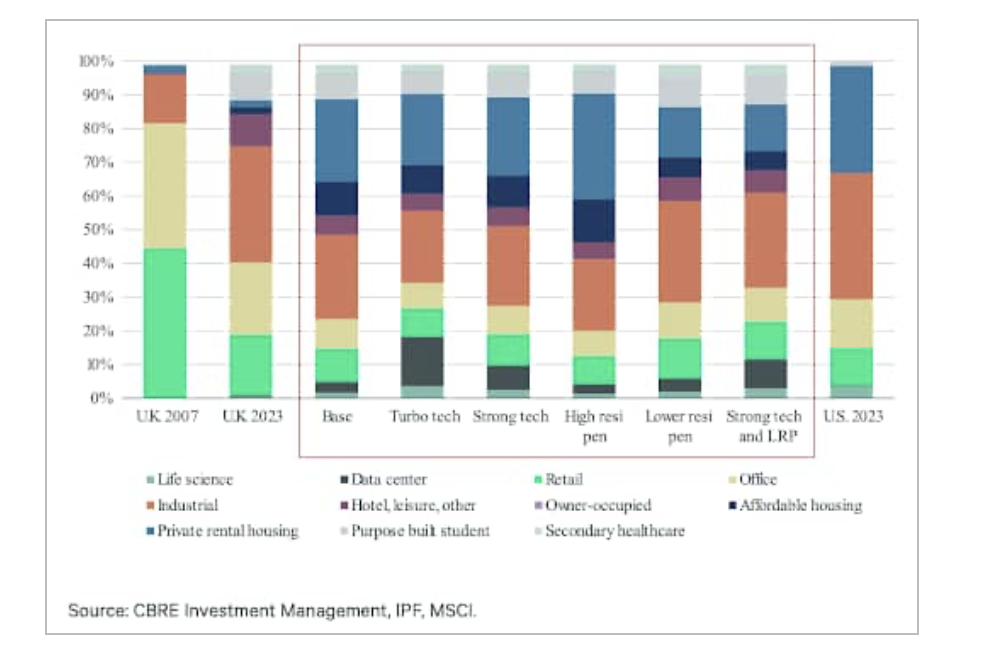
Here’s the headline picture by 2040 (base case and scenario ranges):
From “urban core” to “beds-led” universe
Today’s universe is still dominated by the urban legacy:
Urban (offices + retail): ~ 49% of the investment universe
Industrial (“sheds”): ~ 34%
Residential (“beds”): ~ 16%
Tech (data centres + life sciences): ~ 1%
By 2040, across all scenarios:
Beds become the largest theme:
From 16% today to 32–54% of the universe
46% in the base case
Sheds shrink in share, but not in value:
From 34% today to 21–30% in 2040
Total value of industrial stock actually grows by ~ 47% - just more slowly than other sectors
Urban (offices + retail) halves in share:
From 49% today to 21–30% in 2040
Versus over 80% pre-GFC
Tech grows fastest but remains the smallest:
From ~ 1% today to 4–18% in 2040
5% in the base case; up to 12% in their “strong tech + lower resi penetration” scenario, and 18% in a “turbo tech” world
Two important details:
There is no scenario where beds are not the largest theme.
There is no scenario where tech is not the smallest.
Enormous Growth Potential in Residential
CBRE are very explicit about the drivers:
For beds, the constraint is investor appetite, not underlying demand.
Residential is an enormous underlying stock; only a small slice is currently institutional.
Today, they estimate only 1.5% of affordable and 4% of private rental stock is in the investment universe. But by 2040, they see ranges of 3.8–11.3% (affordable) and 7.5–22.5% (private rental).
Tech Needs Power!
For tech, the constraint is physical capacity - especially grid and water:
They assume 10–20% p.a. floorspace growth for data centres and 5–10% p.a. for life sciences, but note that power and planning constraints will decide where we land in those bands.
Overseas capital passes 50%
Finally, they project the ownership of the universe:
Overseas ownership has already moved from 15% (2003) → 25% (2013) → 40% (2023). They expect it to pass 50% around 2038.
A note on overseas ownership: The projected majority overseas ownership by 2038 is politically incendiary whatever its economic merits. Rationally, capital origin doesn't matter—Canadian pension funds and British insurers pursue identical strategies; regulatory architecture determines outcomes, not ownership nationality (see Singapore, Netherlands).
But politics isn't always rational. "Foreign landlords" triggers reflexes that constrain policy options even when the economic critique applies equally to domestic institutions. This makes Autopilot UK harder to defend politically whilst making Rewired UK's regulatory framework more urgent—it must be built before ownership shifts, not retrofitted during a backlash.
We need institutional capital at scale; origin is economically irrelevant. The question is whether we establish strong regulatory frameworks whilst we have political latitude, or wait until ownership patterns trigger nationalist politics that foreclose more sophisticated approaches.
Setting that political complexity aside for a moment, what does the base case actually project?
By 2040…
So by 2040, in their base case, we have:
A beds-dominated universe (46%),
Followed by sheds (25%) and urban (24%),
With a small tech theme (5%),
And a majority owned by overseas capital.
On its own terms, that’s a reasonable, internally consistent forecast.
But it clearly isn’t just a real estate story.
Whither the UK Economy?
Narrow your eyes and this is just sector rotation. Open them and it’s a sketch of the UK’s future economy. Read these numbers as if they were a macro scenarios document, not an allocation note.
You get something like this:
The UK becomes a ‘beds, meds and bytes’ economy:
Investing heavily in housing and social infrastructure (beds),
Keeping a strong base of logistics and industrial (sheds),
Building a niche but constrained tech infra layer (data centres and labs).
The historic role of CBD offices and high street retail as the capital market core never returns.
Urban’s share halves and stays there.
A large chunk of the built environment, especially mid-quality offices and secondary retail, looks destined for economic obsolescence unless something radical is done.
The whole system is increasingly owned by overseas capital, collecting rent on life’s essentials.
That equilibrium has characteristics:
Strong, defensive income streams for investors,
A real estate industry that wins by serving needs, not wants - housing, health, student beds, infra, logistics,
A consumption-led, low productivity economic model where a lot of value is captured through rents on non-tradable necessities.
In other words: you can absolutely read this as the architecture of a mature rentier economy.
And for the industry, that’s… not necessarily bad.
THE LOW ROAD
Autopilot UK: the easy path to a rentier future
Let’s be blunt.
If we do nothing more than let today’s incentives run, the CBRE picture is the Autopilot outcome:
Beds institutionalise
Housing, affordable, PBSA, senior living, healthcare become the main ballast of institutional portfolios.
The sector delivers exactly what investors want: long income, low volatility, demand that doesn’t go away in a downturn.
Sheds support consumption:
Logistics and industrial space primarily serve e-commerce, parcel delivery, and supply chains for imported goods. They are productive in an operational sense, but mainly as a distribution layer for a consumption-heavy economy.
Tech stays infra-only
Data centres and labs grow, but are treated as yielding boxes with power and cooling, not as anchors for new tech ecosystems. Our ability to host compute capacity is capped by the grid; our ambition for what to build on top of it remains limited.
Urban obsolescence accumulates quietly
Prime offices are refurbished, amenitised, and re-rated. A transitional band of stock is nursed along with capex and ESG upgrades. A large tail of 1980s–2000s offices in secondary locations slowly grind down in value, but rarely get a clean reset. And the same for secondary and tertiary retail.
From a real estate industry standpoint, this might look very attractive:
You end up holding assets people need, not assets you have to persuade them to want. Demand for beds, care, and basic infra is deeply inelastic, and you have repeatable, scalable platforms that match institutional mandates perfectly.
The losers are:
Owners of obsolete space, especially leveraged office and retail holders who will, eventually, be left “holding the baby”,
Places whose historic office/retail cores no longer have a clear purpose,
And, ultimately, households and workers, who see a rising share of their income channelled into rent and basic services, with limited productivity upside.
Layer on the foreign ownership point, and Autopilot UK looks like this:
A country where the dominant investment play is to securitise housing, care and infrastructure; a growing portion of the associated income flows offshore; and much of the remaining commercial stock decays in place.
That is not a forecast of collapse. It’s worse in some ways: a forecast of managed stagnation.
THE HIGH ROAD
There is another route: using the same assets as a modernisation programme.
None of the above is inevitable.
The really interesting thing about CBRE’s work is that the asset mix itself doesn’t have to change for the story to be different.
You can still have:
Beds at 32–54% of the universe,
Sheds and urban sharing 40–50% between them,
Tech at 4–18%,
Overseas owning more than half the lot,
…and yet end up with a radically different economic and social outcome.
Rewired UK
Call this alternative Rewired UK.
Rewired UK: same pie chart, different country
In Rewired UK, we use the “beds + sheds + tech + stranded offices” mix as a national modernisation programme:
Beds as social infrastructure, not just rent streams
Institutional capital still flows into PRS, affordable, PBSA, senior and healthcare. Beds are still the biggest theme. But those platforms are structured and regulated as social infrastructure:
Stable, predictable rent regimes;
Strong quality and energy standards;
Long-term, mission-driven operating partners: linkage to health, education, and labour-market outcomes.
The same capital that would otherwise fuel a pure rentier model is now paying for decency, efficiency and resilience in the living fabric of the country.
Sheds as a re-industrialisation platform
Logistics and industrial are no longer just “e-commerce plumbing”. Selected corridors and hubs are actively positioned as advanced manufacturing + logistics ecosystems: For robotics and heavy automation, connected to ports and energy assets, and tied into skills programmes and R&D.
The same 21–30% allocation to sheds becomes a platform for tradable production, not just parcel throughput.
Tech as anchor, not footnote
Data centres and labs are treated as anchors for innovation districts, not isolated boxes:
Co-located with AI and cloud engineering teams,
Adjacent to universities and FE colleges,
Surrounded by flexible offices, labs and maker space.
Grid upgrades and planning consents are conditional on local ecosystem commitments, not just rent rolls.
Stranded offices as a national retrofitting and repurposing fund
Instead of leaving obsolete offices to quietly depreciate, we treat them as raw material:
Some become housing, care, PBSA;
Some become creative and startup space;
Some become civic, health or education hubs;
Some are demolished to fix bad street grids and open up new mixed-use plots.
AI, modular construction and standardised pattern books could dramatically lower the transaction and design costs of these transformations and is something the industry is barely beginning to exploit.
Exactly the same asset themes - beds, sheds, tech, urban - suddenly support a very different national story:
Higher productivity, because the space we provide is a complement to high-value work, not a drag on it.
Better social outcomes, because housing and care are treated as infrastructure, not pure yield.
Healthier regional economies, because stranded stock is repurposed deliberately, not left to rot.
The difference is not the content in the CBRE spreadsheet. It is what we choose to do with it.
This really is a choice – and doing nothing IS a decision
What bothers me about the CBRE report is not the analysis itself. On its own terms, it’s thoughtful, careful, and methodologically transparent.
What bothers me is how easy it would be for the industry and the policy world to treat it as ‘just how things are’:
To optimise portfolios for the ‘Autopilot UK’ scenario,
To quietly accept that a residential-dominated, foreign-owned universe is an unalloyed good for the sector,
To wave away the obsolescence problem as someone else’s write-down, some time later.
But that isn’t a neutral stance. It’s a choice.
We are, implicitly, choosing between two futures built on the same basic building blocks:
Autopilot UK
Real estate as a machine for turning housing, care and infra scarcity into income streams,
A slow-motion write-off of obsolete offices and retail,
A consumption-heavy, low-productivity economy,
A majority of “life infrastructure” owned by overseas capital.
Rewired UK
Real estate as the backbone of a social and industrial modernisation programme,
Systematic retrofit and repurposing of stranded stock,
Housing, health, logistics and tech infra treated as platforms for human capital and productive firms,
A robust, investible universe that still works for its ultimate users.
The CBRE report doesn’t, and can’t, tell us which of those futures we should pick.
But it does something valuable: it removes the illusion that we are dealing in short-term market noise. The composition of the investment universe is slow-moving, path-dependent, and incredibly hard to reverse once set.
Which means the next decade is not just about:
“Do we like beds and sheds more than offices?”
or
“How many data centres can the grid handle?”
It is about what kind of country those bets add up to.
CONCLUSION
The unsettling conclusion is this:
Sleepwalking into a rentier future is not a forecast. It’s a policy, just not one we’ve admitted to.
And the hopeful one is:
We still have time to decide that we want something else – and to use the very same “beds + sheds + tech + stranded offices” mix to build it.
This is a choice WE, as a society, and very specifically, as a real estate industry, have to make. And the window for making it with full political latitude, before ownership patterns and asset lock-in constrain our options, is narrower than we think.
Human+Machine Organisational Architecture

A Framework for Sustaining Competitive Advantage in the Age of Capable AI
I’d like to propose a new organisational architecture for knowledge-intensive firms operating in an environment where artificial intelligence can execute most routine cognitive work at near-zero marginal cost. It’s a framework which addresses a critical paradox: AI automation creates immediate productivity gains but threatens long-term organisational capability by eliminating the traditional talent development pathway.
This introduces a framework I'll develop across several newsletters. We urgently need this, or something like it. How we run ‘knowledge’ companies IS going to be profoundly reshaped by the abundance of cheap intelligence AI will deliver us. We cannot go on as we are, and we absolutely must avoid becoming mere ‘slaves to the machine’. We need something better: I’d like to think what follows outlines what is possible, should we wish to take up the challenge.
THE GOAL
The foundational spirit of this organisational transformation is to treat AI as infrastructure for human capability development, and not merely a tool to reduce labour costs. Its purpose is to automate routine cognitive execution, so humans can direct their cognitive powers toward high-judgement work, creativity, design intelligence, and strategic thinking.
If the end point is not humans operating at a level above where they are today, doing work that did not exist before, and creating dramatically more productive companies, then it will have failed.
THE BROKEN PYRAMID
Efficiency Alone Leads to Collapse
Traditionally knowledge-intensive organisations have relied on a Pyramid Structure: a large base of junior staff executing routine work, an experienced middle layer, and a small top layer providing strategic judgment.
This structure served a dual function. First ‘Economic', where inexpensive junior labour effectively subsidised expensive senior expertise. And secondly ‘Developmental’ where juniors would learn by doing over a period of 8-12 years.
Capable AI fundamentally breaks this model by eliminating the economic justification for junior roles. Let’s look at this through the lens of a 30 person CRE investment company (or division).
AI can now perform tasks like data extraction and synthesis, first-draft document creation, and quantitative modelling at a cost of £2–10K annually, vastly undercutting the traditional junior analyst cost of £50–70K. So who needs juniors?
Delayed Catastrophe
This though sets us up for a paradoxical failure: The obvious optimisation (replacing juniors with AI) creates a delayed catastrophe: By removing said juniors and replacing them with AI, productivity surges in years 0–3, but after that we start to see a hidden erosion - no junior cohorts developing expertise. By years 8–12, a capability crisis hits as senior talent retires without qualified internal replacements. Feast then famine. Fine if you’re in the generation feasting, not so great for everyone else.
The Strategic Response
So we need a strategic response. If economically we don’t need, and benefit from, not having to employ juniors, but this in turn eventually kills us, maybe we need to be thinking of a better alternative.
A quick caveat here: many companies will luxuriate in dumping employees over the next few years. Because most of the C-Suite isn’t that bothered about what happens a decade out; their bonuses depend on results in the here and now. Shareholders might want to think hard about realigning incentives for this new actuality. And employees would do well to understand the time horizons of their bosses, and act accordingly.
Many is not all though, and this framework is for those types.
The Core Hypothesis
Here is the core hypothesis; organisations that deliberately design their operating model for human+machine collaboration, rather than substitution, will achieve 2–3x productivity improvements and 50% faster talent development (4–6 years vs 8–10).
These companies will have a new objective.
The traditional model focused on humans doing routine work while capability development was a side effect (learn by doing over time); the new model focuses on capability development as the primary objective, using AI to handle routine execution.
And this will require three fundamental shifts:
1. From execution to judgment: Junior roles need to shift from being about completing tasks, to supervised capability development. The role is no longer about ‘sucking up the grunt work’ but being rapidly developing talent. We’re trying to crack Bloom's 2 sigma problem: the educational phenomenon whereby the average student tutored one-to-one using mastery learning techniques can perform two standard deviations better than students educated in a classroom environment. We’re just substituting a place of work for the classroom.
2. From tacit to explicit: Senior expertise must become externalised organisational knowledge. The organisation needs to become the learning ‘organism’, collectively, and for the benefit of all. And suppliers of tacit knowledge need to be encouraged, and compensated, for spreading it around.
3. From time-based to competency-based progression: Advancement is driven by demonstrated capability, not tenure. It should no longer be a function of how long you’ve been in a job representing your career progression. If you’re good enough, you’re good enough.
A Three Layer ARCHITECTURE
The ‘Three-Layer Architecture’ proposed here very deliberately inverts the traditional pyramid model to focus on building and protecting human judgment and creativity.
Layer 1: Execution Engine (AI-Native): This layer automates systematisable, low-learning-value work (e.g., routine data analysis, compliance checking). It must be transparent, showing reasoning to preserve learning opportunities. That which is ‘structured, repeatable, predictable’ should be automated. But it is still important for the ‘Humans’ to understand what is being done.
Layer 2: Judgment Development (Human-Centric): Humans at all levels focus on non-routine work: strategic decision-making, creative problem-solving, quality assessment, and identifying edge cases where automation fails. The critical difference here (from a traditional model) is that everyone focuses on non-routine work. Juniors aren’t corralled into only dealing with ‘grunt’ work - from the start they are pushing their human-centric capabilities.
Layer 3: System Stewardship (Human+Machine): This is the meta-layer where humans design AI workflows, externalise expert knowledge, and continuously improve the system itself. All these systems are going to be iterative. The initial design, the creation, requires strong technical and domain-specific knowledge, but curation is going to be a major ongoing feature of work. Part of the point is that human+machine is a creative modality, not a write once then leave way of thinking. Competitive advantage will accrue through creation, but last through curation.
Redefining Organisational Roles
New Talent Structure: From Analyst to Learner and Architect
This organisational architecture will require new roles. We’re looking through the lens of an ‘Investor’ but variations on this can be developed for any type of knowledge work.
The New Roles
Resident Learners (Years 0–2): This role replaces traditional junior analysts. They will validate and review AI outputs (developing quality judgment) and practice judgment in simulations, focusing on documenting patterns and edge cases rather than routine data processing.
This is personalised learning at work: The AI will be doing the processing, but the humans will be learning how to recognise good from bad, and building their critical thinking capabilities. By also working with ‘simulations’, they will be exposed to a far greater variety of deals/problems/processes than is traditionally the case.
Critically the aim is that they will progress significantly faster, potentially reaching the next stage in just 3–4 years.
Autonomous Investors (Years 2–5): These will replace traditional associates. They will execute complex transactions, make independent decisions within limits, and mentor Resident Learners (teaching solidifies expertise and provides an extra flywheel for knowledge accumulation). All their cognitive powers are focussed on human-centric strengths. Being the ‘human in the loop’ is their purpose.
System Architects (Years 5–8): This new discipline doesn't traditionally exist. They are half knowledge engineer, half domain expert, focused on designing and refining AI workflows and capturing senior expertise into reusable frameworks, multiplying the organisation's effectiveness.
Strategic Leaders (Years 8+): Their work shifts from execution oversight to teaching, knowledge externalisation, portfolio strategy, and genuinely strategic problem-solving.
The Creative Dividend and Strategic Advantage
The New Moat: Institutional Intelligence and Imagination
The ultimate output of this architecture is that each layer of automation must return usable cognitive capacity to humans and generate a creative dividend.
Sustainable outperformance requires combining disciplined allocation of capital with distinctive creative capability (taste, imagination, narrative).
Key advantages are that this framework ensures sustained competitive advantage through institutional knowledge capture (less dependent on individuals) and greater resilience. The economic model will provides higher margins and faster growth because of AI augmentation and a reliable, accelerated talent pipeline. Talent density will increase, and that will spur far greater momentum than is traditionally seen. This is a commercial learning machine with a very human core.
Conclusion
A Hypothesis for Transformation
To reiterate: this transformation is critical because the alternative (short-term efficiency optimisation) will/would inevitably lead to a capability crisis.
Technology, paradoxically, is going to be the easy part; the transformation requires leadership conviction, patient capital, and cultural change.
In future newsletters we will cover the detailed Capability Development System (simulation and mentorship) and the Transition Roadmap.
An analogy to finish with
Think of the traditional knowledge firm as a clockmaker’s workshop: apprentices start by polishing gears (routine work) for years, slowly learning the art of clock assembly (judgment) from the master. When AI arrives, it can polish every gear instantly and perfectly. If the workshop eliminates the polishing job, it loses the training pathway, and future generations never learn how to assemble a clock.
The Human+Machine Architecture transforms the workshop into a flight simulator: AI handles the routine mechanics, freeing the apprentices to immediately practice complex landings (judgment) under the master's close guidance, reaching mastery in half the time, ensuring the firm always has expert pilots ready for novel missions.