
THE BLOG
The PropTech Paradox
AI is opening a much larger market, and making the resulting value harder to capture.
This week I have been looking at two maps of the same industry. One shows the PropTech companies that have successfully reached expansion stage across Europe. The other maps the actual work of commercial real estate: the day-to-day workflows performed by investors, asset managers, valuers, brokers, operators and everyone else. Put them side by side and you can see the technological frontier moving.
For most of its history, PropTech has operated around the work of real estate. It digitised leases, organised information, administered processes, controlled buildings and gave people better evidence on which to base decisions.
AI is moving inside the work itself. It can read the lease, compare the evidence, interpret ambiguity, construct scenarios, draft the recommendation, challenge the conclusion and increasingly initiate whatever happens next.
This opens up a much larger market for technology. It also opens that market to almost everybody.
That is the PropTech paradox: more of real estate is becoming technologically addressable, while the resulting value is becoming more contested and potentially harder to capture.
THE OLD PROPTECH FRONTIER
The BUILTWORLD and PwC PropTech Map Europe 2026 includes an ‘Expansion’ category of companies that have moved beyond startup promise and established a real position in the market.
What struck me when I analysed the 26 companies in this category was how physical many of them are. Parking systems. EV charging. Building controls. Sensors. Energy infrastructure. Storage. Flexible space. Businesses embedded in the daily operation of buildings and cities.
This is a cross-section of selected survivors, so I would be wary of turning it into a neat history of European PropTech. Still, the physicality is striking.
And it matters.
These companies have installed equipment, secured sites, negotiated permissions, integrated with other systems, assembled local operating teams and built customer relationships. Each deployment makes the next one easier and the whole position harder to reproduce.
AI can optimise a charging network. The network still has to be financed, permitted, installed and operated. A frontier model can improve a parking business. It cannot conjure years of site agreements, payment integrations and local operational knowledge into existence.
Earlier PropTech often accumulated scarcity through deployment.
The physical world did some of the defensive work.
That protection has limits. A business may keep its infrastructure while another company takes control of the customer relationship, the decision layer or the most profitable intelligence sitting above it. Replicating the network is hard. Abstracting value away from it may prove easier.
Even so, many established PropTech businesses begin the AI era with something tangible that a clever product team cannot quickly copy.
WHEN SOFTWARE MOVES INSIDE THE WORK
My second map is a register of 102 canonical workflows across commercial real estate. It spans investment, asset management, leasing, valuation, operations, development, fund management, reporting, corporate workplace and rental living.
This register was built as the top of the funnel for our RIRA process. It maps the work before we ask what AI should automate, augment or leave to people.
Traditional software was good at storing, calculating, routing and enforcing. But real estate work also involves unstructured documents, incomplete evidence, conflicting objectives, local context and professional judgement. Much of that sat beyond software’s practical reach.
Generative and agentic AI move the boundary.
The 102 workflows are certainly not 102 workflows ready for end-to-end automation. Technological possibility is only the first test. Commercial attractiveness comes next. Defensible capture is harder again.
Technologically addressable. Commercially addressable. Defensibly capturable.
The field gets smaller at each stage.
Yet the expansion at the top of this funnel is profound. Technology can now tackle increasingly large portions of the work for which surveyors, asset managers, valuers, lawyers, brokers, analysts and consultants are paid.
PropTech used to compete primarily for a share of the property industry’s technology budget. AI allows it to compete for a share of the much larger economic cost of getting the work done.
The prize gets bigger.
So does the crowd.
EVERYONE CAN SEE THE PRIZE
An AI-native startup can build a specialist product around a valuable workflow.
An established technology company can extend upwards from the data, infrastructure or system of record it already controls.
A real estate principal can use the same models to create private advantage around its own workflows and institutional knowledge. It never needs to sell the resulting product; better investment decisions or lower operating costs are return enough.
Professional advisers can rebuild the services they already sell, combining AI with people, methodology, client trust and the willingness to accept liability.
And the AI labs, consultancies, systems integrators and deployment companies can all enter the same territory from outside conventional PropTech.
They are pursuing the same work with very different economics.
The startup needs recurring product revenue. The incumbent may add the capability to defend a much larger platform. The CRE firm wants an operating advantage. The adviser wants to retain the client and improve the margin on its service. The model provider may absorb a useful generic capability into the platform itself.
This is a peculiar competitive market: several players can attack the same workflow while playing entirely different games.
And they are all drawing from broadly the same pool of intelligence.
The ability to use a frontier model is widely available. Prompting is becoming commonplace. Build costs continue to fall. Today’s impressive feature has an awkward habit of becoming tomorrow’s checkbox.
AI-native startups still have important advantages. Focus matters. Domain depth matters. Incumbents move slowly, internal teams are stretched and general-purpose tools remain general. A specialist can move faster and solve the whole problem rather than adding a clever feature to part of it.
But access to intelligence provides little protection on its own.
Very nice, if you can keep it.
SCARCITY CHANGES SHAPE
My hypothesis is that the strongest AI-native PropTech companies will be those that use widely available intelligence to accumulate assets that remain scarce.
They may own proprietary context: data rights, evidence, taxonomies and institutional knowledge that materially improve the work.
They may control the system of work: the multi-step process through which a consequential decision is made, checked and acted upon.
They may possess distribution and trust: deep customer relationships, embedded integrations and permission to operate inside sensitive processes.
They may accept accountability: verification, governance, auditability, regulatory understanding and responsibility when the outcome matters.
Or they may create a genuine learning loop, where every completed workflow produces evidence that improves the next one and compounds an advantage beyond the underlying model.
The strongest will combine several of these.
Earlier PropTech often acquired scarcity as a by-product of deployment. AI-native PropTech has to construct it deliberately while scaling.
This distinction explains why a product can be useful, popular and commercially viable while remaining strategically fragile. Demand proves that somebody wants the outcome. It says much less about which supplier will own that value three years from now.
It also explains why some apparently old-fashioned PropTech companies may outlast much cleverer-looking AI products. Installations, contracts, permissions, operational capability and trusted relationships have an irritating resistance to being replicated with a prompt.
WHO OWNS THE VALUE?
For existing PropTech companies, the opportunity is to use their accumulated position as a launch pad. Infrastructure, data, workflow access and customer relationships can support a move into higher-value intelligence and action. Leave it too late and someone else will build the decision layer above you, relegating the original business to a utility.
For CRE companies, the familiar choice between buying software and carrying on as before is disappearing. They will need to decide where proprietary advantage should reside: what to buy, what to build, what to assemble and which workflows are too important to surrender entirely to a supplier.
And for founders and investors, a large total addressable market is merely the beginning. Who else can pursue this workflow? What do they already own? Why will the customer buy rather than build or compose? What becomes stronger with every use? Which part of the company remains valuable after the next major model release?
Five years from now, I am confident that far more of the knowledge work of real estate will be performed with technology. I am much less certain that standalone technology companies will capture most of the value created.
That is the tension worth watching.
So if you are building, backing or buying PropTech, ask one final question: what will this company still own when everybody’s AI can do it?
This is part four in a series.
The PropTech Paradox: AI is opening a much larger market, and making the resulting value harder to capture.
Human Judgement has a Timestamp: which judgement, doing what, verified how, and as of when?
The Company After the Pyramid: what a future CRE company needs to look like.
The Capability Spine: How to Build One: How CRE firms can build a capability spine, one workflow at a time
Thirty-One Newsletters. One Argument.
Seven extraordinary months - 31 newsletters. One core message.
This has been an incredible year so far. The seeds were sown last November when Claude Code and Opus 4.5 ushered us into a transformed AI landscape, where seeing LLMs as the natural language interface to the computing universe came alive. That breakthrough set the scene for this year.
I have been trying to synthesise the implications of all of this for CRE. Both in terms of how we should be organising and running our businesses, but also what this will all mean in terms of demand. What assets will thrive, and why?
Below I highlight the messages of 13 of those newsletters, but the theme has been the same throughout: when AI removes or diminishes the constraints a business or industry was built around, the value does not disappear, it moves. And it moves to whoever redesigns the work to maximise the leverage the technology offers.
The argument operates at four levels. At task level, AI makes production cheaper. At professional level, value moves towards judgement and accountability. At firm level, pyramids, pricing models and competitive moats begin to change. At property level, altered headcount, location and operating requirements reshape demand. The mistake is to analyse any one of these levels in isolation.
LEVEL ONE: TASK
1. Build from the bottom up, not top down.
CRE is obsessed about data. Which is remarkable seeing as it has so little, and even less that can talk to each other. But year after year the talk is about sorting our data out, and getting it in a position to apply AI. Everyone is waiting for the perfect predictive CRE systems. But there is no Jim Simons of real estate for a reason. Stop looking.
Meanwhile, from the bottom up, there are incredible things that can be done with decent, but not earth shattering, data, and a solid AI reasoning layer. So much potential is being missed because CRE companies are not grasping what is possible, off the shelf and for all employees, with frontier AI models today.
‘CRE AI Is a Layer Cake’
In September: For every task you do consider… how could AI help with this? If it involves words, images, video or audio the answer will be probably quite a lot. And as AI is now making real contributions to solving decades old mathematics problems, it can probably help you with your spreadsheet as well. Start immediately; no need to wait.
2. AI is like Real Estate - Own what appreciates. Rent what depreciates.
Business tasks can all be mapped to a matrix (our CRE Automation Matrix). Against two axes. Is the work ‘plumbing’ or ‘cognition’, and is it hard or easy to verify. Anything that is verifiable plumbing is going to be commoditised and you should rent the tools to do so. Anything involving cognition that is hard to verify is where the greatest value lies, and you must own that.
‘Plumbing and Judgement’
And beware of the power of AI lock-in. Where you cannot leave, regardless of cost. Where the workings of your business are in the model you are renting. Without the model, you have no business. And this is about much more than not having suppliers train on your data.
‘The Toll and the Amputation’
In September: Get smart about procurement. Ask what is being learnt, where that learning lives, and could you take it away with you?
3. Agentic AI is cool, but very hot in terms of cost.
Paying for your monthly licence of ChatGPT or Claude is a ridiculous bargain today. The ROI to anyone using these models proficiently is almost embarrassing. Running swarms of AI agents, in loops, continuously, in contrast, can be ruinously expensive. So far, 2026 has been the year this has become clear. Last year you couldn’t do much agentically - this year there is a wealth of tooling available that enables you to do extraordinary things. But using these tools wisely is something we all need to learn quickly. Mostly that comes down to understanding that the best use of ‘Agents’ is when they can easily verify facts, and perform valuable work at great speed.
‘The AI Employee Trap’
In September: When planning how best to use your agents ask two questions: how cheaply can it check each step, and how much do I pay someone to do this now.
LEVEL TWO: PROFESSIONAL
4. Real estate is not the single industry we presume it is.
We cannot define the defensibility of real estate as one industry. That depends on whether you need to actually interact with physical real estate, and whether your signature really matters. Analysts are much more vulnerable than surveyors who walk the building.
‘Are you in the wrong half of Real Estate?’
In September: Locate where you sit amongst the four quadrants (in the article). Then work on protecting your downside, and maximising your upside. There are choices to be made.
5. We say we have moats - but mostly they are leakier than we make out
In January we looked at six defences the CRE industry thinks it has against technological competition: brand, scale, complexity, data, regulation and relationships. The latter may be a moat for an individual, but friends still ask for ‘the best price’. Regulation requires an activity to take place, but does not determine its price. And complex deals do indeed require human judgement, but in reality, how much of what you do fits in this bucket? As an industry we’re not as immune as many seem to believe.
‘CRE: Constraints, Moats and Value’
In September: Consider what you think is your deepest moat - then ask what would need to remain true for it to still be as deep in 2030.
LEVEL THREE: FIRM
6. AI removes business constraints - and changes business models.
Sangeet Choudary has a line in his book Reshuffle which I have deeply internalised: ‘new tech collapses old constraints, and once a constraint disappears the logic of competitive advantage must be reimagined from first principles.’ It is the foundation upon which I built the RIRA framework. Within CRE, as in most businesses, we have always been constrained by a scarcity of time and limited cognitive bandwidth. AI is removing these blockers.
‘It’s Time to Get Serious’
In September: What do you charge for that AI is commoditising? How will that compress fees? What AI do you need to leverage to maintain margins, or at least limit their destruction?
7. Professional services was a pyramid - those days are gone.
AI, badly implemented, is likely to reduce the number of juniors professional services firms hire, and the Stanford Digital Economy Lab’s work on entry-level employment in AI-exposed occupations suggests it already has.
Pierson Ferdinand launched in January 2024 with over 130 partners and now has more than 270, with no associates by design. Its founders call it “AI-native” and say the model handles the first drafts juniors used to produce, though nearly half the firm’s revenue comes from partners sharing work sideways with each other, which is the more interesting half of the story. The pyramid did not vanish into the machine; it flattened into a mesh, with AI absorbing the drafting layer beneath. One may not like it, but the logic is impeccable. Professional services solved this problem once, by making training compulsory rather than commercial. AI has not broken that bargain, it has made breaking it affordable. Train no one, hire whoever your competitors were foolish enough to train. Everyone runs the same numbers, so nobody trains, and the middle ranks hollow out on someone else’s watch.
‘The Pyramid Has Already Broken’
In September: Spend time thinking about organisational structures. Within five years getting them wrong might bite you back, hard.
LEVEL FOUR: PROPERTY
Everything above happens inside businesses. This is where it shows up in the asset.
Pierson Ferdinand again. At Level 3 the AI story got the headlines; the property story is that a firm doing nine figures of revenue has no offices at all, and channels the saved overhead straight into partner compensation. That is what these four levels look like when you follow one firm all the way down. The drafting layer automates, the pyramid flattens into a mesh, the real estate line goes to zero, and the money reappears as pay.
8. A tenant with a strong balance sheet is no cause to sleep easy
Of course it is comforting to know your tenant can pay the rent. But in an AI world a thriving tenant might not want your space anyway. It might enable them to thrive, to pay more, but to fewer employees. We need to look deeper at how AI will impact different types of customers. There is no direct correlation between growth and headcount anymore.
‘The Smooth Market That Hides the Rupture’
In September: Ask your occupiers - how is AI changing how you work? Are you doing more with more, or more with less. Then connect that to the space they’ll need.
9. A new genre of research is emerging. Call it AI-impact modelling.
There is an old-school task-based way of modelling occupations for AI-exposure. Still being heavily peddled. But it’s really rather useless.
What matters is how much more productive AI makes a company, and whether that company exists in a world of growing demand. Jevons Paradox doesn’t apply in markets where demand is inelastic.
Where a firm’s output demand is elastic, productivity gains convert into more output at flat or rising headcount; where it’s inelastic, they convert directly into fewer people, and therefore less space. A regional law firm’s caseload doesn’t triple because drafting got cheap. A growing software firm’s roadmap does. Though the elasticity that matters most sits in the market you are not currently serving, which I come back to at the end.
Currently space shortages are masking underlying demand. Don’t mistake a tailwind for a strategy.
‘AI and Office Space Demand’
In September: AI is going to make demand very jagged. Underwriting against aggregate demand is a dangerous game. The criticality of having the right product in the right location has never been greater. Look ruthlessly at your own portfolio, and get weeding.
10. Jagged demand shows up in pricing before it shows up in occupancy.
There is no newsletter behind this one. It is not a separate argument, it is what items 8 and 9 imply once you follow them out to where the money actually gets committed.
The demand story becomes a pricing story. Valuation runs on expectation, not event. If the market comes to believe that a building’s occupiers will renew for less space, that belief prices in years ahead of the lease event that would prove it right.
The effect is dispersion rather than decline. Today the yield difference between prime and secondary is a gradient: wide, but continuous, and you can price your way along it. Jagged demand turns a gradient into a step. There is stock on one side and stock on the other, and progressively less in between.
Meanwhile the underwriting inputs quietly stop meaning what they used to mean. Covenant strength tells you whether a tenant can pay. It tells you nothing about whether they will want the same floorplate in 2031, which is the actual risk, and it does not appear in a credit rating. WAULT flatters you right up to the break. And LTV covenants get tested against valuations that assume reletting at market rent within a conventional void period, precisely the assumption AI puts under pressure for the wrong half of the stock.
The risk was never default. It was renewal.
In September: take your three weakest assets and stop asking whether the tenants can pay. Ask whether they will want the same quantum of space at expiry, then read what your valuation assumes about the void if they do not. If those two answers disagree, you have found your problem.
ACROSS ALL FOUR LEVELS — HOW TO FIND IT
11. Imagine harder. There are three levels of ambition. Don’t stop at the first.
Within the RIRA framework the ‘I’ stands for Imagine - imagine what AI enables. There are three horizons: H1 is the same but better, H2 is something new bolted on to what we do now, H3 is doing something in an entirely new way. Faster taxi, more comfortable taxi, Uber!
Most of what you see with AI is H1. People applying AI to some existing workflow, and proclaiming transformation. It’s not. It’s mostly just doing what everyone else could/should/will do. With a very limited time competitive advantage.
Some things have limits, and making them better/faster/cheaper is the right thing to do, but to make a difference you need to be looking to H2 or H3. This is where the new moats will be built - in places your peers simply did not look.
‘Better, Faster, Cheaper, Fewer’ and ‘The Workflow You Should Have Burned’
In September: pick a workflow that is meaningful to you, then decompose it according to the RIRA framework and work through what AI now enables that was not possible before. And map out how you could make it 10X not 10% better.
12. The Five Provocations.
In February I published ‘Five Provocations’: a framework for finding where AI creates genuinely new ventures, not just better processes. They follow a narrative arc — what becomes free → what falls apart → what gets built → who wins → who pays.
The horizons tell you how ambitious to be. The provocations tell you where to point that ambition. Start with what becomes free, because everything else follows: once a cost goes to near-zero, the business built on charging for it falls apart, and whatever gets built in its place is where the next decade’s money sits.
‘Where’s the New Business?’
In September: name one thing in your business that AI has just made free. Then walk it through all five. If you cannot get as far as “who pays”, you have found a capability rather than a business.
WHAT IS ALREADY BAKED IN
This year has seen barely believable capability development. The frontier labs are now using AI to build AI, and the exponential is being pushed harder as a result. Headline economic statistics show little of it yet. The statistics will catch up within two to three years, and in some sectors abruptly.
You do not have to predict the future. You do need to recognise what is already baked in: models will have more memory, more domain-specific intelligence, stronger reasoning, more tools, the ability to operate your computer as you do but faster — and each year they get roughly an order of magnitude cheaper to run at a given level of capability. Last year’s state of the art is a fraction of its original cost today.
At some point, perhaps one to three years off, last year’s model will be both capable enough to do everything you need doing in your business and dirt cheap. Most of what we do at work is not that complicated. Fiddly, subject to nuance, requiring varying degrees of judgement — but too hard for AI? Don’t bank on it.
That last point is the killer, and it needs a caveat. Price per token collapses; total spend does not. This is Jevons working exactly as designed. OpenAI’s CFO has talked about “useful intelligence per dollar” - what is uneconomic today becomes economic next year, so you use more of it.
But note the asymmetry. Demand for compute is elastic: cheaper tokens mean more spend, automatically, with nobody deciding anything. Demand for professional output is elastic too, but only in the market that currently cannot afford it. Among the clients already being served, cheaper production means fewer people. The bigger pie is real; I have written a whole report on where it is. But it does not bake itself. It requires someone to build the offer, price it for a customer they have never served, and accept eating their own margin to do it. Absent that, the efficiency gain lands in the labs’ revenue and in your vacancy rate.
And note where it lands even in the good case. The firms that go and serve that new market will look like Pierson Ferdinand, not like Big Law. Distributed, low-overhead, built for a price point that cannot carry a City lease. Growth in output has stopped implying growth in space. Both branches of this argument reduce conventional office demand. They just do it for opposite reasons.
WHERE I MIGHT BE WRONG
Capability is not adoption. The dynamo took thirty years to show up in productivity statistics, and the constraint was never the dynamo, it was that factories had to be redesigned around it, and the people who could not do that had to retire first. Liability and professional indemnity will keep humans signing things long after machines can produce them. If I am wrong, it will be about timing rather than direction. But timing is what you underwrite against, so that matters.
Which is why the strategy here is asymmetric rather than predictive. If this moves slowly, the cost of having built fluency early is some wasted licence fees and a few workflows you redesigned sooner than strictly necessary: workflows you were going to have to redesign anyway. If it moves fast, the cost of not having built it is that you cannot buy the capability at the moment you need it, because nobody can. Fluency is not procurable on demand.
There will be great winners and great losers, and you have more agency over which you are than the discourse suggests. Start with one workflow, in September.
Eating One’s Own Dogfood
Developing RIRA, then ignoring it, wouldn’t be good enough
Being an author on the web always assumed a bundle of things: judgement, ideation, drafting, accountability. Who typed something was a pretty good proxy for who thought it. It no longer is. As with so many business workflows the process of creation is being unbundled, and rebundled. In business writing what used to make sense, no longer does. The accepted wisdom needs a software update. In 2026, there is a better way to write.
The Manifesto Irony
In 2024 I wrote an article, ‘We need to think of LLMs as second brains‘, in which I argued that when we work with AI ‘we should be doing so in ‘cyborg’ mode, where they become part of ‘how we do stuff’. Each of us has this army of virtual interns, who know more about just about everything than we do (save for our own specialities), who we can engage with, to push us, challenge us, and generally enable us to perform at a much higher level than we could on our own.’
If I passed that article through an ‘AI Detector’, such as Pangram, which is now integrated into Substack, it would return ‘100% Human-Written’. If I passed through it an article where I had taken my own advice, and that had been written in ‘cyborg’ mode, it would be flagged as ‘100% AI-Written.’
Which tells us we’ve yet to internalise the implications, or leverage, of the AI age.
The Upfront Confession
As I said, Pangram is now integrated here on Substack, and for any article, or comment, you will see an option to enquire whether AI was involved in it.
With my articles you will mostly see them described as ‘100% AI-Written’. Given my 2024 article this is no surprise, but I want to elaborate on why. And why it is, in 2026, the wrong question to be asking.
What does the detector measure?
I’ve always liked the line often attributed, erroneously, to Ernest Hemingway that one should ‘write drunk, edit sober’, as it captures that feeling of euphoria when one is in the zone and the words, and ideas, and feelings, are flowing like a river after a storm. And those moments of ‘sober’ reflection when you’ve cooled down and, on second thoughts, decided different wording would work better. This is how humans write, with jagged edges. Some lines are better than others, some word constructions more striking than others. All but the very greatest writers ‘can’t keep it up’.
And this is what AI detectors look for - those jagged edges. Or at least, it was how detectors worked. But they found that it just wasn’t very accurate. So everything got more sophisticated still. This is Pangram’s own explanation of what they do.
“Pangram is a type of neural network called a classifier model. In the broadest sense, Pangram reads a segment of writing and – using an enormous set of learned patterns – estimates whether it is AI-generated.
Pangram learns to distinguish human and LLM writing by building a kind of map where authors with similar writing styles are placed close together, while those whose styles differ are positioned farther apart. On this map, Human-Written and AI-generated text form distinct clusters, and our research shows that Pangram can even locate major commercial language models, such as ChatGPT and Claude, in different regions.”
In essence, beyond the obvious AI tells, like ‘It’s X, not Y’, the detectors see patterns we don’t, and they can today be assumed to be very accurate. In answering the incomplete question, in my opinion. As Substack CEO Chris Best refers to in his ‘Against Claudefishing’ article:
“Note that Pangram can only detect whether AI was used to make the text, not whether great human care went into creating it, nor whether AI tools were used as a source.”
The abuses are real
It is fair to say though that ‘AI slop’ absolutely does exist, and should be called out. And it exists in four clear ways:
1. Substitution - when AI is used to simply ‘write an article about XYZ’, lightly edited, and passed off as original thinking. Here the author has offloaded their cognition almost entirely.
2. False intimacy - when the author allows the AI to manufacture anecdotes or experiences and passes them off as their own.
3. Unexamined authority - when the author uses AI to write fluently on topics they have not verified, and could not defend if questioned.
4. Industrialised output - using AI to put out endless content. The sort of thing AI influencers peddle on Linkedin - ‘use this prompt to write 30 days blogposts’.
In any of these cases AI is being used in a diminishing way - it diminishes the author’s cognitive capability and diminishes the reader’s right to not be misled.
The big problem though is non-disclosure. Now Substack is making a thing of this, let’s see who discloses what. You can disable AI-Checking of your posts in this new system, and add a disclosure notice. I won’t be doing the former, and will be doing the latter.
Working, in ‘cyborg’ mode?
It used to take me three to four hours of concentrated work to write a newsletter, in 100% human mode. Today it takes me, in cyborg mode, much the same. The difference now is my newsletters tend to be roughly twice as long, richer in context, and denser in content.
This is how I work today:
Most of the week I am reading and talking to people. Keeping up with ‘Planet AI’ is a full-time job. The fastest growing industry the world has ever seen is working on what it calls ‘the exponential’, and the sheer volume of new features, functionality, research and commentary is extraordinary. I see myself as a filter, taking in the firehose, and dribbling out what is manageable for normal people, with jobs to do, to take in.
So each week I end up with a topic that is front and centre of my mind. Often, as has been the case this year, these fit into the wider frameworks I have been working on, such as RIRA and the CRE Automation Matrix. My core is working out how real estate companies, and real estate itself, is going to change over the next 5-10 years.
Normally on a Friday, or Saturday morning, I will write up a hypothesis for that week’s newsletter. A few paragraphs of quite dense and abbreviated ideas. I will then give this to Claude, on whatever is the current highest quality setting, and ask it to critique, then flesh out these ideas. From there we will go back and forth, often arguing with each other, up and down rabbit holes, for two to three hours. Sometimes in one continuous session, but often over several. Claude can think, and rethink, very fast, but I need to let things mull over in my mind, and this requires a walk, or just a bit of noodling around.
After this time, we start to settle on ‘our position’ - me and my army of intelligences - and I ask Claude to develop a framework for the newsletter, synthesising everything we’ve discussed. And then we argue some more about that.
Then I ask Claude to write the first draft newsletter. Given that our frameworks are fully developed, quite detailed, and full of hopefully notable ideas and turns of phrase, by now this feels more like an assembly session than anything else. We have developed a recipe, refined it, bought all the ingredients, measured them out perfectly - now we just need to do the cooking.
Once a first draft is ready I copy it all, open up whatever the latest version of ChatGPT is, and ask it ‘This is my latest draft newsletter - please rate and review it’.
I then take that review and give it back to Claude and say ‘this is ChatGPT’s rating and review’. And the arguing/debate starts again. Both Claude and I will accept/reject different areas of the review. Once done, we’ll rerun the drafting and give that back, again, to ChatGPT, and repeat the process.
If debate is fractious, and the topic divisive, I will invoke my ‘Virtual Board’, which consists of five deliberately adversarial personas:
The Sceptical Practitioner
A veteran European institutional CRE asset manager/fund director to sanity test everything.
The AI Engineer
A production-focused machine-learning specialist for technical insight.
The Organisational Behaviourist
A workplace learning and change expert who asks ‘What will someone actually do differently on a Tuesday morning six months later?’
The Industry Economist
A specialist in technological disruption and professional services who examines who captures the economic value.
The Structural Contrarian
The final challenger who tests the architecture of the argument.
These are calibrated roles rather than named real-world figures. They are explicitly instructed to watch for my potential true-believer bias, implementation optimism, practitioner gap, confidence about AI capabilities, and assumption that teaching a framework leads to changed behaviour.
I don’t spar with this lot every week - but when ideas need a challenge they are awesome. And pretty mean.
At this stage we are generally done. Hours of debate, iteration, ideation, then considerable editing, by different editors. The button is pushed and a final draft is pumped out. Which incidentally is controlled by a ‘Skill’ I developed - ‘Antony’s Newsletter Voice’ which was trained on thousands of words of my earlier 100% Me-Written blog posts.
Collectively this makes my newsletters amongst the most edited writing, probably, on Substack. In this case though, my editor is my co-producer. This is genuine cyborg work - it is not ‘My ideas, AI typing’.
So who is the author?
In a world where, with extraordinary intelligence at our fingertips we’d be stupid to not use it, who then is the author?
I think five questions have to be answered:
The Accountability Test
Origination: did the central thesis come from me?
Judgement: did I decide what was true, important and worth saying?
Defensibility: could I explain and defend every substantive statement?
Authenticity: does this reflect me, is it representative of my thinking?
Accountability: if it is wrong, is it down to me, not the model?
I have been pushing a distinct worldview ever since I started blogging in 2013. Whether an AI writes the final words or not, I would defy anyone to say this is no longer true. My newsletters are co-produced but I am the author. If they weren’t my ideas, or I did not agree with them, they wouldn’t be in there.
This is unbundling / rebundling in action. The author is the same, but differently expressed.
You’ll have noticed that using AI has saved me no time. And it does not. What it does is allow me to write longer, richer, more highly researched, and better edited newsletters, in the same time span. Without AI, each would take 1-2 days, not 3-4 hours.
A note on economics
From 2013-2024 I wrote on average 20 newsletters a year, of circa 1,000-1,250 words each. In 2025 I wrote 49, totalling 94,046 words, averaging 1,919. This year I write once a week, over 2,000 words. It is up to you whether you agree or not but I think my newsletters this year are richer, deeper and form a more coherent body of work than I’ve ever produced. From an economic perspective, unless in cyborg mode, they simply would not exist. For me this is a 2+2=5 result.
This is business, not literature
My newsletter is for a business audience where what matters are the ideas. Good writing helps to make good ideas more accessible and ‘sticky’, but it is what it is. Business writing. If I was writing my memoirs, or a novel, my attitude would be very different. But I am not - I am writing to hopefully make you think, and to help us all build a better built environment. Doing that with all the tools at my disposal is, for me, the obvious way to go.
RIRA in action
This year I have been writing about, nay evangelising, my RIRA framework. The ‘I’ of which, ‘Imagine’, explicitly argues that we should be taking advantage of the constraints AI removes and looking to do things that were either economically unviable before, or simply not possible. Adding AI into a business should not be, must not be, about doing what was done before, better, faster, cheaper, but imagining what was previously not possible.
For me, in cyborg mode, I have access to nigh on unlimited intelligence, on-demand advisors and mentors, and hyper-persistent editors. As the progenitor of RIRA how could I work any other way, in 2026?
So yes, I will continue writing in this way, and will show up as ‘100% AI-Written’. Which should mean you receive me, but better.
This week, the newsletter is 100% Human-Written, but frankly that tells you precisely nothing about whether the argument is good. Just as last week’s newsletter will return as ‘AI-Written’ and that also tells you nothing.
Which is the whole point. With business writing it is the quality of argument, which someone stands behind, that counts. Not who typed it up. I intend to keep trying to warrant the time it takes to read my content - using all the help I can get.
Better, Faster, Cheaper, Fewer
Without a bigger pie, AI means fewer, better people.
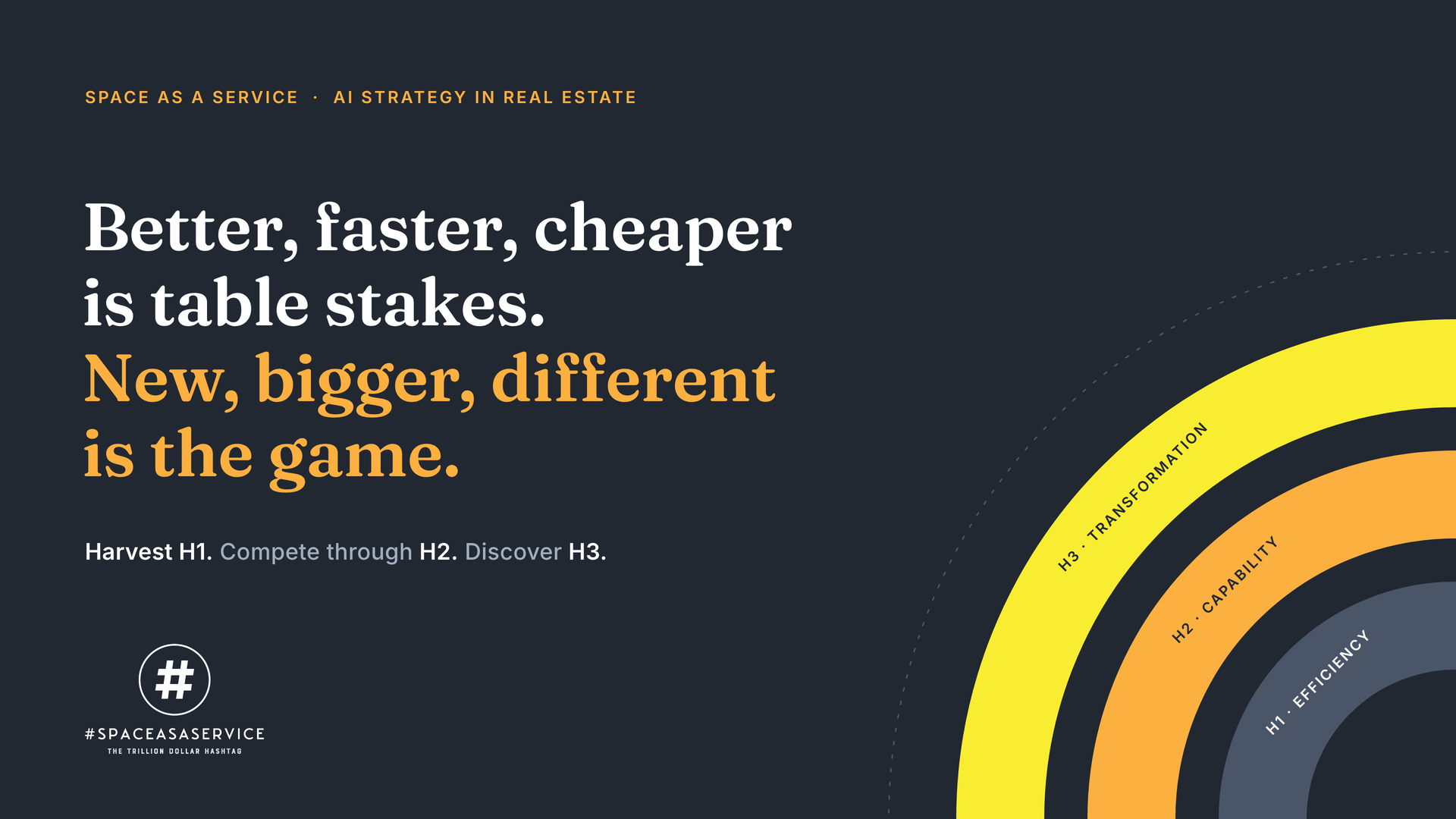
Almost every AI initiative in real estate is aimed at doing today’s work more efficiently. Widely shared efficiency is a condition of competing, but without a bigger pie it is also the road to a much smaller industry.
“New tech collapses old constraints. Once a constraint disappears, the logic of competitive advantage and business model design must be reimagined from first principles.” - Sangeet Choudary
I have spent much of this week reading about AI adoption. A major BCG survey. A thoughtful industry roundtable on change management. A widely shared letter on the future of property management. What struck me was the gap between what the evidence now says and what the conversation keeps doing with it.
Executive Summary: AI efficiency will not, by itself, produce durable advantage: as widely available tools make existing workflows cheaper, much of the gain passes to clients and technology providers, and, unless demand expands, fewer people will be required. Real advantage lies in H2: using collapsed costs to sell services and capabilities that were previously uneconomic. Harvest H1. Compete through H2. Discover H3.
THE ADOPTION REFLEX
BCG’s latest AI at Work survey, of nearly 12,000 employees, is close to my own position. Organisations using AI to reshape workflows end-to-end, or to invent new business models, have nearly doubled in a year, from 22% to 42%, and they report more value and happier people than those merely deploying tools. BCG’s advice to CEOs is to invest in redesigning work, and to stop buying more tools.
The revealing part is what happened when that finding reached the industry conversation. It was translated, almost instantly, back into the familiar language of adoption: sponsorship, guidance, governance, citizen developers, data trust, training. All necessary. All useful. And all of it answering the same question: how do we absorb AI into the business we already have? The workflow is treated as fixed. The deliverable is treated as fixed. The business model is treated as fixed. All that is up for discussion is speed.
Which is the tell.
ALMOST EVERYTHING IS H1
In my RIRA process I use three horizons. H1 is efficiency: the same work, done faster and cheaper. H2 is capability: things that were either impossible before, or possible but never economically viable. H3 is transformation: the workflow, the deliverable or the business model redesigned outright.
I should be precise about the claim, because it is easy to over-egg. Some workflows are genuinely H1-only, and I say so every time I teach. Not everything is an H3 in waiting. And nobody needs to bet the firm on full transformation this quarter.
The claim is narrower and, I think, harder to dodge: scan the industry’s actual deployments and almost everything is H1. Faster lease abstraction. Quicker IC papers. Cheaper reporting. The current workflow assumed to be absolute, with intelligence poured into it like a faster engine into the same chassis.
Timidity is the wrong diagnosis. Most people have simply not joined the dots on what comes next, and so are not managing for it. That is a failure of foresight, and foresight is a governance duty.
WHY H1 CANNOT BE THE WHOLE STRATEGY
Two dots, joined.
The first is economic. H1 done well is real work, and it can stick: proprietary data, deep integration, fast organisational learning and unusually good execution all turn generic tools into embedded capability. Toyota’s competitors could buy the same machinery. The Toyota Production System was another matter. But where the gain comes from applying a widely available tool to a standard workflow, competition redistributes it: clients take it as lower fees, model providers take it as margin, and the firm keeps it only briefly. Efficiency you share with all your competitors is a cost of staying in the game. H1 can make you competitive. It cannot tell you what to compete on.
The second dot is Choudary’s, in the quotation above. Every workflow in this industry was designed around a scarcity: documents were expensive to read, analysis was expensive to produce, expertise was expensive to access. Those constraints are the ones collapsing. And when a constraint collapses, the opportunity appears precisely in the space it used to fence off: everything that was never impossible, merely uneconomic. That space is H2, and it is enormous.
FEWER, BETTER PEOPLE
AI will make us more efficient. It will make economically viable much that never was. And it will enable things entirely new. But efficiency on its own carries a consequence the industry keeps stepping around: without a bigger pie, we will need fewer, better people.
Take that widely shared property management letter, guest-written by the CEO of a US national operating platform. It is one of the better things published on the subject this year, and it gets a great deal right: managers elevated into genuine asset managers, and a potential new market drawn from America’s 87 million owner-occupied homes, which professional management has never economically reached. That is real H2 thinking.
But its own numbers point somewhere its conclusion refuses to go. Traditional operators, it says, run roughly 100 units per person; AI-forward operators already run up to 200 per employee. If the top of that range becomes the norm, employment holds only if the number of managed units, or the depth of service provided to each one, grows at comparable speed. The letter leans on Jevons, the Victorian economist who observed that more efficient steam engines led Britain to burn more coal. But Jevons describes demand for the resource, and the resource here is management capacity, which AI now supplies. Lower costs may well unlock new demand. Somebody still has to design the service, find the customer and persuade them to buy.
Jevons is a prize, and it has to be earned.
GO ALL IN
Accept that arithmetic and the rational response writes itself: go all in. Use this technology to become a demonstrably better company than your peers. Better data, better judgement, faster learning, lower cost, and above all new things to sell.
All in on what, exactly? On the objective, and the objective is the pie. Harvest H1 to fund the work: those efficiencies are real money, just rarely durable advantage. Compete through H2, where capability is scarce and yours to shape. And let H2 experiments reveal where H3 lives, because transformation is discovered through redesign, never declared in advance.
Worst case, the pie stays flat. The market thins, and yours is one of the firms still standing, taking share from competitors who spent the decade giving the 2019 business a lick of paint. Best case, this new capability does what technology has done in wave after wave before it, and grows the pie, and you are positioned to take more than your share of a bigger market.
You do not need to forecast which future arrives.
The same strategy wins in both.
WHAT GOING ALL IN ACTUALLY MEANS
You cannot H3 by declaration, and you cannot H2 from the town hall stage either. This is a granular game: take one material workflow, unbundle it into tasks, ask which of its assumptions are scar tissue from constraints that no longer exist, then rebundle around what the customer is actually buying. Then the next workflow, and often several together, because value crosses their boundaries. This is the entire premise of RIRA: Release, Imagine, Redesign, Actualise.
And aim, at minimum, for H2. Does lease abstraction stay a cheaper abstract, or become portfolio intelligence: every obligation in every lease, continuously legible? Does underwriting stay a faster IC paper, or become underwriting everything: the whole investable universe screened as a matter of course? Does property management stay a ticket queue, or become a service valuable enough that affluent owner-occupiers, from a universe of 87 million homes, choose to buy it?
Right now, the industry is funding the first half of each of those sentences.
HOW YOU WILL KNOW
It is my belief that within five years the divergence will be visible in revenue mix. The firms that went all in will be earning meaningful income from services that did not exist in 2025. The H1 firms will be running the 2019 business at 2019 fee levels, minus the compression. If that divergence fails to appear, I will have been wrong about the size of the opportunity. I do not expect to be.
Better, faster, cheaper is table stakes. New, bigger, different is the game. And which game you are playing is entirely down to you.
The Workflow You Should Have Burned
The AI product that works is the one you should worry about.
The AI product that works is the one you should worry about. It speeds up the work you do today, shows a return on day one, asks nothing of you, and quietly removes the one thing that would have made you rebuild the work properly. The bill comes later, from a direction you are not watching.
Most of what is being sold to commercial real estate under the AI banner is the same job you already do, done faster. Abstract the lease, but quicker. Reconcile the service charge, but in seconds. Produce the variance pack, but overnight. It sells beautifully, because it slots into how you already work and you can see the saving immediately. And it is, I think, a trap with a very long fuse.
Start with what these products actually do. They take your existing workflow and compress its labour. The workflow itself is left untouched. Nobody asks why you produce that deliverable in that shape, or what the work would look like if you rebuilt it around what the machine can now do. The tool points itself at the artefact you already make and makes it cheaper.
The trouble is that the artefact you already make is a fossil.
You abstract a hundred-page lease into a two-page structured summary because no human can hold a hundred-page lease in their head. That is the constraint the abstract was invented to solve. If the machine can hold the whole lease, and answer any question you put to it directly, the two-page abstract is a buggy-whip: a beautifully made solution to a problem you no longer have. Automating its production is automating the manufacture of something a redesigned workflow might not even want. You have made the horse faster instead of buying the car.
WHY THE GOOD VERSION OF THIS IS THE DANGEROUS ONE
Now, I am not going to tell you that selling the faster horse is a con. It is not. It is often the only sale that works.
Asking a real estate firm to redesign a workflow is asking it to admit the current process is wrong, restructure who does what, swallow the disruption, and trust a supplier with how the work is done rather than just a task. That sale loses to something more urgent every single budget cycle. The “do it with AI” sale wins precisely because it demands nothing: it fits your org chart, it fits your deliverable, it pays back on day one. For the firm selling it, leading with the faster horse is frequently the correct opening move. The question that matters is what happens after the sale.
And there are two firms that make the identical pitch.
One is using speed as a wedge. It lands on “we’ll automate your reporting”, gets inside, learns your workflows, and then uses that position to drive the redesign you would never have bought cold. The other is selling speed as the whole product: bank the saving, never move, sell the same faster horse to the next firm. From the outside, on a website, you cannot tell them apart. They say the same words. The only tell is whether the company has any theory of the rebuilt workflow it is taking you towards, or merely a longer and longer list of things it can speed up. Breadth, oddly, is the giveaway: a firm with a redesign in mind goes narrow and deep on one workflow, because you cannot rethink fifty at once. A firm selling faster horses adds a new horse every quarter.
THE BILL ARRIVES FROM A DIRECTION YOU ARE NOT WATCHING
The comforting assumption is that if you buy the faster horse, you will eventually notice it was the wrong purchase and correct course. I do not think you will. The faster horse is sticky for a cruel reason: it removes the very pain that would have forced you to rethink. The analyst hours that used to hurt, the late nights on the variance pack, the cost that might one day have made you stop and ask whether the whole process was wrong, all of it gets quietly absorbed by the tool. The pain that would have triggered the redesign is gone. So the redesign conversation never happens.
You run a fossilised workflow at ten times the speed, indefinitely. You feel faster, leaner, more modern than the firms around you, and for a good while you genuinely are. You will mistake the speed for transformation, because from the inside they feel the same.
Then one day a competitor who rebuilt the workflow rather than accelerating it does something you simply cannot do at any speed. Not faster reporting: a different capability altogether, one that only exists because they burned the old process and built around what the machine made possible. Your faster horse cannot catch their car, because the race has stopped being about speed. That is when the bill arrives. Years late, from a direction you were not watching, as a capability gap rather than a cost. The faster horse never failed you. That is exactly why it was dangerous. It served you faithfully while quietly foreclosing the thing that would have mattered.
WHAT TO DO WITH THIS BEFORE YOU SIGN
None of this is an argument against buying AI. It is an argument against buying speed on a workflow you should be rebuilding. The two feel identical at the point of purchase and could not be more different five years out.
So before you sign for the next “do X with AI”, ask one question that the demo will not answer for you: is X a workflow I should be redesigning, or merely accelerating? If the honest answer is that the whole process is a relic of constraints the machine has just removed, then speeding it up is the most expensive kind of progress there is, because it feels like winning and it quietly switches off the alarm that would have told you to do the real work.
The firms that win the next decade will be the ones who had the nerve to look at a workflow they had run for thirty years and ask whether it should exist at all. Speed is the consolation prize. The real prize goes to whoever is willing to burn the workflow and build the thing the machine actually makes possible.~
Faster horses are lovely. Just remember what happened to the people who kept breeding them.