
THE BLOG
Data To Help AI Do What?
The CRE industry has been promising to get its data in order for thirty years. The work sitting on your desk this morning needs almost none of it.
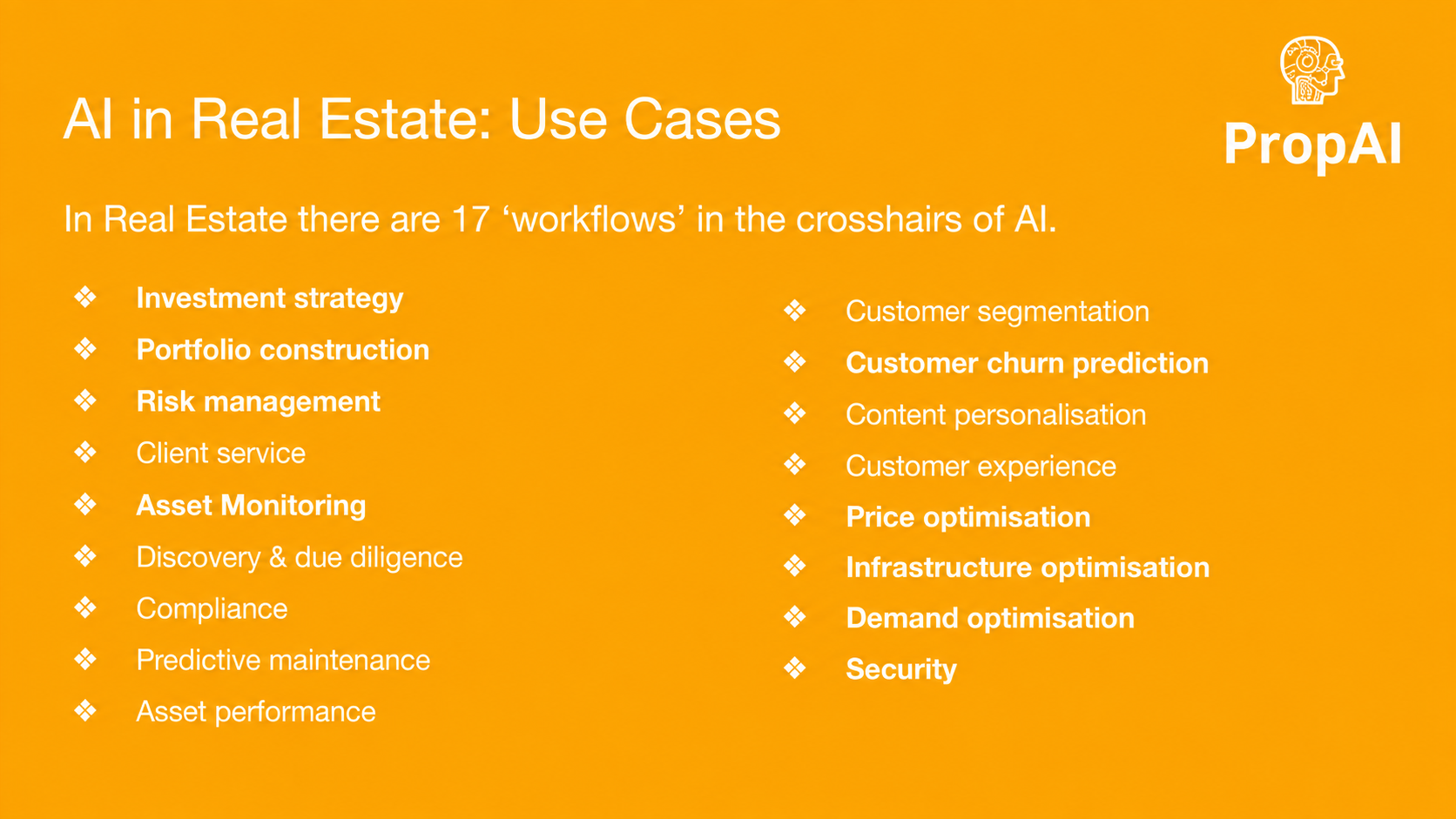
In 2018 I co-founded a company called PropAI. It went nowhere. I still have a deck I presented that year at the Future PropTech Conference, and one slide from it has been nagging at me since I ran my latest #GenerativeAIforRealEstatePeople course cohort through a collection of advanced prompting techniques.
In brief: the way I proposed tackling the 17 workflows on that slide in 2018 depended on assembling a large body of comparable records to train on. That body of records was never a by-product of how the industry works, and for most of those workflows it still has not been assembled. What has changed is who does the training. Someone else has now trained a general-purpose model, so what you supply is the material and the context for the job in front of you: a lease, a planning report, a masterplan, a situation described in a paragraph. Every firm already has those. When a panel says AI needs data, it means the corpus the industry has failed to build for thirty years, while the opportunity in front of it needs the documents they already have.
THE SLIDE I MADE IN 2018
The slide was headed ‘AI in Real Estate: Use Cases’, and underneath it I had written that there were 17 workflows in real estate in the crosshairs of AI. Investment strategy. Portfolio construction. Risk management. Discovery and due diligence. Compliance. Predictive maintenance. Asset performance. Customer churn prediction. Price optimisation. Demand optimisation. Security. And so on.
I believed every word of it. The logic seemed clean: these are workflows where patterns sit in data, machine learning finds patterns in data, so the machines are coming. We took that slide into a lot of meetings.
PropAI went nowhere.
The reason matters more than the failure. The way we proposed to attack those workflows needed a large body of comparable, labelled, longitudinal records to train on. We assumed that if the use cases were valuable enough, the data would arrive to serve them. It never did. We were selling the analytics, and the records those analytics needed had never been collected by anyone.
The industry’s answer, then and now, is the same sentence it has been repeating since long before PropAI existed. We need to get our data in order.
Eight years on, the slide is still accurate. That is the damning part.
WHAT EIGHT YEARS ACTUALLY PRODUCED
Some of the 17 did happen, and where they happened tells you why the rest did not.
Price optimisation arrived in multifamily. Churn prediction arrived alongside it. Predictive maintenance arrived in building systems. Each of those runs on a corpus that assembled itself as a by-product of ordinary operations: daily rents across hundreds of thousands of units, HVAC telemetry arriving every few seconds, tenancy records stretching back years. Making those records usable still took money and effort. What nobody had to do was invent a reason to collect them.
The multifamily pricing story is worth a moment, because of how that corpus came to exist. A vendor built a service drawing on records from competing landlords, which widened the pool any one of them could see. The US Department of Justice alleged that landlords used it to share competitively sensitive information and align their pricing. RealPage has settled with the DOJ, several landlords have settled or are settling private claims, none of them admitting wrongdoing, and legislators have started banning algorithmic rent pricing outright.
Regular readers will recognise the shape from last week. No single owner has enough data, so a third party aggregates it, and the third party ends up owning the thing everyone depends on. That is how AvalonBay’s encoded judgement ended up inside EliseAI, and it is how multifamily pricing ended up in front of the DOJ.
Now look at the other end of the list. Investment strategy. Portfolio construction. Asset performance. Discovery and due diligence. Eight years on, the obstacle in front of each of them is the one that was there in 2018, because in those workflows the corpus has to be built deliberately and at cost.
It has not been built at any scale, for reasons that have little to do with laziness. Ownership is fragmented. Assets are heterogeneous, so one building tells you little about the next. Transactions are sparse and private. Owner, manager and agent each hold a slice, and none of them is paid to hand it over. Everyone treats their own data as competitive advantage, which makes pooling it a hard sell internally.
Investment work is the hardest case of the lot, and the reason is sample size. There have been perhaps half a dozen cycles in a working lifetime. Machine learning wants thousands of comparable examples. CRE investment offers a handful of expensive, unrepeatable ones.
So when someone on a panel says AI needs better data, my question is the one in the title.
Data to help AI do what?
TWO KINDS OF DATA
The word is doing two jobs, and conflating them is why the answer to ‘are we ready?’ is always no.
Corpus data is many comparable records, labelled and longitudinal. It is what training a predictive model on your own market requires, because the patterns have to be learned from your material. It is what ‘get our data in order’ has always meant, and what this industry has mostly failed to assemble.
Artefact data is a lease. A planning report. A masterplan. A rent roll. A site photograph. A negotiating position described in a paragraph. The general capability has already been trained by somebody else, so what the artefact supplies is the subject matter: this building, this tenant, this argument.
These are two different requirements rather than two kinds of file. A shelf of leases can become a corpus. A single rent roll holds structured records. What changes is what you are asking for. One route requires a programme, a budget and years of discipline. The other requires you to open the file.
Building monitoring is the honest middle case: largely predictive and analytical AI with a generative overlay on top, and it does need a corpus. I am making no claim that artefacts cover everything.
THE QUESTIONS YOU ALREADY HAVE
Last week I took a #GenerativeAIforRealEstatePeople course cohort through a set of advanced prompting techniques, and what struck me afterwards was how much of the value sat in ordinary professional questions rather than in anything resembling a dataset.
When is exercising that break clause a strategic mistake rather than a saving?
A tenant with a break in eighteen months has a lease, a business plan, a rough view of the market and a spreadsheet that says leaving is cheaper. Working through it means arguing the other side: what the cost of moving actually includes, what the landlord is likely to do when the notice lands, what happens to the saving if the market turns while you are in the middle of a fit-out. That takes the lease, the situation and a model willing to take your position apart. It takes no corporate dataset to begin.
Where it stops is worth being precise about. Challenging the reasoning and establishing the facts are different jobs. Improving a research question takes almost nothing. Answering it credibly may take a mountain of evidence. AI can help identify the costs you left out of the break analysis. Establishing current fit-out costs takes current evidence.
What is wrong with this research brief before I commission the research?
A thousand pounds of thinking before fifty thousand pounds of work, and the input is one page.
Others came up in the same session and work the same way:
What assumption is this investment position resting on?
Where does this masterplan work against its own commercial objectives?
Does the reasoning in this planning report hold?
What is the unsupported claim in this presentation, and what will the room object to?
None of those require you to have your data in order. They require the document in front of you and a willingness to be argued with.
And keeping responsibility for a decision has never meant keeping all of the thinking. The authorised person signs. Framing, interpretation and challenge can be shared, which is a distinction the CRE industry keeps collapsing into ‘humans do the judgement’.
STILL ONLY RUNG ONE
Be clear about what this buys you. Using AI as a thinking partner makes individuals better at their jobs and leaves the organisation exactly as it found it. It is rung one of the ladder I set out last week, and the firm’s advantage still depends on redesigning the work and encoding what it learns.
Rung one is available today, on the data you already have. Which is the point.
PUT UP OR SHUT UP
Two paths are open.
Build the corpus properly. That means budget, governance, years of discipline and a hard conversation about pooling data with people you compete with. Do it, and you give the predictive applications on my 2018 slide a serious foundation. It is my belief that very few firms will choose this, and that those who do will find themselves where AvalonBay is: large enough to pay for it, and watching a vendor sell the result to everyone else.
Or work with what you have. Every professional in this industry holds thousands of documents and a head full of questions worth pressure-testing. That work needs no new data programme, and nothing you have not already been given.
The two are compatible. Keep the questions that turned out to be worth asking. Record where the machine was wrong and what the correction was. Hold on to the decision and, where you can, what happened next. Do that and individual fluency starts becoming something the firm can retain and use. That gives you the material for redesigning the work and encoding what you learn.
What is no longer available is the third option: citing the absence of data as the reason to wait, while doing nothing to assemble it. We have run that play for thirty years.
We keep telling real estate professionals that AI needs their data. We spend almost no time showing them what it can do with their questions.
Start with the questions. They are already on your desk.
Only Step One
CRE has settled on a comforting line about AI: judgement is what matters. It is true, it is safe to say on a stage, and it helps nobody.

Three times in one week I came across the same idea. A keynote slide told the room that competitive advantage lies in human wisdom applied through AI. A write-up of a conference panel concluded that the winners will be the firms with the best people who know how to use the tech. And a LinkedIn post from a PropTech builder argued that AI eats the commodity layer and fails at the judgement layer. The likes piled up. I nodded too, up to a point.
I have some sympathy. I’ve been banging the #HumanIsTheNewLuxury drum for years, and from the back of a room my version can sound much like theirs. The difference matters. Mine is a claim about where scarcity and pricing move when cognition gets cheap, and it comes with a demand that the work itself be redesigned. The version doing the rounds this week gives permission to carry on as before, with better tools.
In August I argued that ‘human judgement has a timestamp’: the boundary between what machines and people do well keeps moving, so any division of labour needs a date on it. This piece asks a different question. If the judgement line is so obviously incomplete, why does the industry keep saying it?
All three ideas are appealing, and for good reason. The grind is getting cheaper. People do decide whether any of this works. Fluency is where every firm has to start. What I would query is the ceiling the third one puts on the machine, and what all three leave out.
They stop at step one.
WHY THE LINE PERSISTS
One reason is straightforward, and it is the least cynical of them. Most people in this industry have never seen AI think with them. They have been told for three years that AI needs their data and that they supply the judgement, so they have tried extraction, summarising and first-draft reports, and rather fewer have sat down and asked a model to take their own position apart. Having never seen that, they conclude the division of labour was right all along. I’ll come back to this properly next week, because it deserves its own piece.
The other four reasons are less innocent.
The first is identity. This is an industry built on surveying, valuation and relationships, and judgement is what its professionals believe they are. Telling a room of chartered surveyors that judgement is the future amounts to telling them that they are the future. People rarely argue with that.
The second is incentive. Everything beyond step one asks the expert to make their own scarcity less scarce: to write down how they decide, precisely enough that the firm, and eventually a system, can do it without them. In a business built on billable effort and personal client relationships, that asks individuals to weaken their own bargaining position. You can’t argue people out of an incentive.
The third is what can be said on a stage. No senior figure from a large firm is going to tell a conference that their workflows need tearing up, or that a slice of their headcount exists to process information. ‘Judgement matters’ is as far as anyone can go in public, whatever they believe in private. I’ve sat on enough panels to know the pull.
The fourth is that the line is true but incomplete, which makes it awkward to challenge. Push back and you sound as if you’re dismissing expertise. And for anyone selling software into the industry, ‘AI takes the grind and leaves you the judgement’ is a very convenient message to put in front of buyers.
So the line gets repeated, and the industry stays on the first rung.
THE LADDER
Think about a restaurant kitchen. Giving the cooks better knives makes them quicker. Redesigning the menu and the kitchen around what the new equipment can do changes the economics of the place. Writing the recipes down, precisely enough that the food survives the head chef leaving, is what turns a good restaurant into a group.
CRE’s version has three rungs, and each is harder to copy than the one below it.
Fluency. Your people use the tools well, and that includes using them to think: interrogating the reasoning in a planning report, finding the objection a presentation invites, arguing the other side of a deal before the other side does. Most of the industry is still some way from this, and it is worth more than it gets credit for. It is also buyable: a competitor can hire or train its way to parity within a year. Every quotation in my opening lives here.
Redesign. The work itself changes shape. Tasks move, teams reform, and the process gets rebuilt around what AI can now do.
Encoding. The firm’s judgement becomes something it owns and runs, which survives people leaving and compounds with use. Regular readers will recognise this as the capability spine from ‘The Company After the Pyramid‘. The ladder is the way up to it.
Rung one makes individuals better at their jobs and leaves the organisation exactly as it found it. Redesign changes how the firm works. Encoding is how the firm keeps what it learns.
The best CRE example of rung two I know is AvalonBay. It mapped more than 100 tasks its onsite associates carry out and rethought how and where each one gets done: AI handles first contact, centralised teams sit behind it, and neighbourhood teams work on the ground. The company says the programme is on track for $55m of annual incremental NOI by the end of this year, against a longer-term target of $80m.
Two caveats keep this honest. Much of the model is centralisation that predates large language models (AvalonBay opened a back-office service centre in Virginia Beach in 2007), and the company doesn’t break out how much of the NOI is down to AI. Even so, this is redesign with numbers reported to investors, which is rarer than it should be.
The rung where value leaks
AvalonBay’s story has a sting in the tail. It was EliseAI’s early design partner; the founders moved to Arlington to sit with its teams and watch the work. AvalonBay invested, deployed the product across its portfolio, and together with Equity Residential now runs AI across 90% of prospect workflows, around 2.5 million customer interactions a year. On the call announcing their $69bn merger, Equity Residential’s chief executive reportedly said the platform will be sold to the wider industry and the combined company won’t own it outright. EliseAI says one in six US apartments now uses its software.
The knowledge AvalonBay helped encode has become the industry’s baseline. What AvalonBay keeps is the scale to pay for redesign, which goes a long way to explaining the merger. I made the wider argument in ‘The Toll and the Amputation‘: if your judgement gets encoded inside someone else’s product, you have helped build your competitors’ business.
WHY STEP ONE IS NO LONGER ENOUGH
Staying on the first rung was a reasonable choice while nobody was forcing the pace. Three things this summer suggest the pace is now being forced.
Capital. Prologis has agreed a £14bn takeover of SEGRO, pitched largely on SEGRO’s data centre pipeline, even though data centres currently produce around 7% of SEGRO’s net rental income (it expects more than 30% by 2035). Meanwhile OpenAI and Anthropic have each set up deployment businesses with private equity money: OpenAI with TPG, Brookfield, Advent and Bain; Anthropic with Blackstone, Hellman & Friedman and Goldman Sachs. Their purpose is to put engineers inside companies to redesign workflows around AI. Blackstone’s Jon Gray called the shortage of engineers who can implement these systems at speed one of the biggest bottlenecks to adoption. Two of the world’s largest real estate investors are backing firms whose whole job is rung two.
Clients. At the start of September the Financial Times reported that Goldman Sachs, Morgan Stanley and Citi are pressing their law firms to pass on AI savings. Goldman has asked firms what AI is saving them. Citi now asks firms bidding for its work to disclose the figure. Morgan Stanley plans to put most of its outside legal work out to competitive bid by the end of the year, with fixed fees on the table, and its general counsel called the associate-heavy model ‘extraordinarily unstable’.
Morgan Stanley also said it will still pay serious money for judgement. The panellists are right about that. What the bank is refusing to keep funding is the pyramid of junior hours underneath the judgement, and that pyramid is what law firm economics rest on.
CRE has its own pyramids: valuation teams, due diligence, lease administration, research, the management layer of outsourced FM. Which leads to the test I would put in front of any CRE business this autumn.
How are you paid?
A broker on commission keeps any productivity gain: if AI lets them do more deals, the fee per deal stays the same. Work whose price is anchored to effort has no such protection. Once the client knows the effort has shrunk, the price follows. The banks have just shown exactly how that conversation starts.
Talent. The person who can take a firm to rung two combines real CRE domain knowledge with real technical skill, and the labs are hiring that profile as fast as they can find it. Most CRE firms will rent one from a deployment business, and that engineer will encode your judgement inside a system you don’t own. The alternative is to grow your own, which starts with the people already on your payroll who have got good at rung one.
SO, WHICH RUNG?
It is my belief that the judgement line will be heard for a while yet, because it is the only version of the argument that is comfortable to say out loud. It survives partly because we keep telling real estate professionals that AI needs their data, and spend almost no time showing them what it can do with their questions. More on that next week.
One prediction to hold me to: within two years, a major UK institutional client will require its valuers or agents to disclose AI savings in fee tenders. Morgan Stanley has already written the letter. Someone in CRE will copy it.
Judgement will still be paid for when that happens. The question is whether your firm has built anything above it.
Rung one keeps you in the game. Rung two changes your margins. Rung three decides who owns the answer.
Which rung are you on, and who is climbing the next one for you?
The Capability Spine: How to Build One
How CRE firms can build a capability spine, one workflow at a time

Last week I argued that the capability spine is the company.
By that I meant the combination of context, instructions, Skills, connections, workflows, evaluations, decision history and relationship memory through which a company gets work done and improves how it does it.
Easy to say.
But how does a CRE company actually build one?
First though, a question worth asking ourselves: how much genuinely distinctive capability does the average CRE company possess?
Because if the answer is “very little”, the implications are rather more serious than simply deciding whether to buy or build some new AI tools.
THE SHORT VERSION
A CRE company does not need a vast new technology platform before it can begin assembling its capability spine.
It can begin with one useful workflow. Write down how the work should be done. Connect the systems and documents it needs. Add the minimum context required to interpret and verify the evidence. Test it properly. Deploy it within clear decision boundaries. Record what happens.
That produces a Skill.
Build more Skills, allow them to share trusted context and feed the evidence from completed work back into them, and a capability spine starts to form.
This can happen now.
The harder question is deciding which capabilities are worth owning when PropTech vendors will increasingly offer pre-built versions of the same workflows.
A CRE company should buy capabilities that are becoming generic, while retaining control of the methods, evidence and learning through which it could genuinely become better than its competitors.
CLAUDEFORCE AND THE DISAPPEARING INTERFACE
The Claudeforce announcement on 26 August gives us an early view of how this architecture may work.
Salesforce and Anthropic (developers of Claude) are bringing Salesforce data, workflows, permissions and business rules into Claude. The first product, currently available to selected pilot customers with an open beta planned for September 2026, is a plugin containing 37 pre-built sales Skills.
These cover activities such as pipeline reviews, stakeholder mapping, account planning, call preparation and win-loss analysis.
The user can ask Claude what needs attention, request an account plan or investigate a struggling deal. Claude reaches into Salesforce, Slack, and other connected sources, then acts within the permissions and business rules already established by Salesforce.
Salesforce calls the architecture behind this AIForce. Its data, applications, workflows and governance are exposed as capabilities that an AI can call directly through MCP, the Model Context Protocol. The plugin bridges the probabilistic model (Claude) with the deterministic business logic (Salesforce), and inherits the existing role-based access control.
The user no longer has to navigate the traditional Salesforce interface. It becomes a governed utility.
This has prompted a good deal of commentary that Salesforce has effectively surrendered the user interface to Claude.
In the short term, this looks like astute defensive work. If users increasingly want to operate through an AI, Salesforce needs to make sure its data, workflows and business rules remain essential wherever that AI happens to sit.
Over time, though, one can imagine Salesforce becoming less visible: an extraordinarily valuable data, rules and permissions utility operating behind somebody else’s interface.
That does not necessarily make Salesforce weaker. Infrastructure can be both invisible and extremely powerful. But it does change where the relationship with the user sits and which part of the technology stack appears to be doing the work.
There is a second tension.
Claudeforce provides the infrastructure through which companies could assemble their own capabilities. Salesforce and Anthropic have also done the assembly for them by supplying 37 Skills out of the box.
The window is opening and closing at the same time.
It has become much easier for a company to make its own methods executable. It has also become much easier for vendors to turn common methods into products available to every customer.
Pipeline reviews and account planning may once have felt like company capabilities. They have now become entries in a vendor’s Skill library.
CRE should assume the same thing is coming.
HAVE CRE COMPANIES GOT ANYTHING DECISIVE?
Property companies often talk about their proprietary processes, investment discipline and unique ability to spot value. How different are they really?
Most companies screen acquisitions, select comparables, construct cash flows, review leases, monitor covenants, prepare asset plans and report to investors. The templates vary. The approval thresholds vary. The language and presentation certainly vary. Much of the underlying work is remarkably similar.
Specialist PropTech vendors are already productising important parts of real-assets investment and asset management, connecting fragmented systems and information to support acquisitions, portfolio analysis, reporting and decision-making. A capable vendor may build many of these workflows faster and better than an individual CRE company could.
So why build anything internally? There are two possible answers.
The first is that CRE companies possess rather less proprietary capability than they believe. As vendors absorb more of the analysis and workflow, a larger share of the value will accrue to those vendors. The real-estate company may still possess capital, assets, licences, relationships, local execution capability and access to transactions. Those remain significant sources of advantage. But claims of superior analytical or operating capability will become harder to sustain when every competitor is using much the same system.
The second answer is that companies need to create more differentiation.
Building an internal version of a generic workflow will not achieve that. If two firms encode the same method, use the same models and draw on the same market data, both have merely constructed their own commodity.
The opportunity lies in making the company’s judgement explicit, testing whether it is actually any good and connecting decisions to outcomes so the method improves. The starting Skill may not be distinctive. The learning loop around it could become so.
A company with no distinctive method cannot manufacture one by writing a Skill. But a company that never makes its method explicit may soon be unable to tell whether it has one.
WHAT IS A SKILL?
A Skill is a reusable, version-controlled description of how a particular piece of work should be performed.
It goes well beyond a prompt.
Depending on the workflow, it might define:
The objective and required output
The sequence of analysis
The data and documents to retrieve
The tools and systems it is authorised to use
The company’s definitions, assumptions and methodology
The tests and validation rules to apply
Permissions and approval boundaries
Circumstances requiring human escalation
Examples of good and unacceptable work
The evaluations used to measure performance
Take lease analysis. “Summarise this lease” is a prompt.
A lease-analysis Skill defines which clauses to extract, how the company describes them, which calculations to perform, how side letters and deeds of variation should be handled, what must reconcile with the rent roll and which inconsistencies require human review.
The Skill contains the method, not merely the request.
Related Skills could cover lease abstraction, rent-roll reconciliation, covenant checking, break-option analysis, comparable selection, asset-plan preparation and investment-committee reporting.
They could sit inside a plugin that provides controlled access to the documents, databases and tools required to do the work.
This is a very different form of internal development from the one most CRE companies remember. No eighteen-month roadmap. No attempt to replace every existing system. No vast requirements document followed by an application that is obsolete by the time it arrives. The company is encoding a method, connecting existing components and controlling how the work is performed.
THE TWENTIETH-FLOOR PROBLEM
A common argument says that using AI without first fixing the data foundation is like trying to build the twentieth floor of a building before constructing the nineteen floors below it. It is a neat metaphor. It is also increasingly unhelpful.
Of course a company needs trusted data, permissions, definitions and systems. An AI cannot reliably analyse a lease it cannot access, reconcile records that use incompatible identifiers or determine which of three conflicting figures is authoritative. But it does not follow that the entire enterprise foundation must be completed before anything useful can happen.
Build vertically.
Choose one worthwhile workflow. Give it the minimum complete foundation it needs: the relevant documents, identifiers, permissions, definitions, connections, evidence rules and evaluations.
The first working Skill creates value and lays a small piece of foundation. The next Skill reuses some of that foundation and extends it. This is slower than magic and dramatically faster than waiting for a perfect enterprise data architecture that may never arrive. You do need foundations. You can build them through the work.
THE MISSING LAYER IS CONTEXT AND EVIDENCE
Access to data is not enough.
A system might find a property called Riverside House, a tenant called Acme Ltd, a figure of £750,000 and a date of 14 March 2028.
What do those facts mean?
Does Acme occupy the entire building or one unit? Is £750,000 the passing rent, estimated rental value or annual service charge? Is 14 March 2028 a break, expiry or rent-review date? Did the information come from an executed lease, an old valuation report or somebody’s assumption?
The Skill needs a shared vocabulary and an evidence standard. It must know what an asset, unit, lease and counterparty are; where each fact came from; when it was true; whether it has been superseded; and which source takes precedence when records conflict.
That context might be held in a relational schema, structured files, an ontology, a validation layer or a knowledge graph. The technology is an implementation choice.
Knowledge graphs become particularly useful when the relationship is central to the question. Which assets are exposed to tenants owned by the same parent company? Which funds, loans and covenants are affected by a particular lease event? Which deed supersedes which provision in the original lease? How does one counterparty connect to multiple properties and obligations?
For a Skill dealing with those questions, a small task-specific or “baby” graph might be exactly the right answer. It only needs to model the entities, relationships and verification requirements relevant to that workflow. Other Skills will not need one at all. The architecture should fit the work.
HOW TO BUILD THE FIRST SKILL
1. Start with a decision or outcome
Do not begin with “we need an AI strategy”. Choose one piece of recurring work where quality matters and where the company can recognise a good result.
Lease-event verification for one portfolio might work. So might acquisition screening within one sector, covenant monitoring for one fund or quarterly investor reporting.
Avoid starting with the most complicated workflow in the business. Equally, avoid a trivial use case whose success would make no difference. The first Skill should be small enough to build and test quickly, but important enough for people to care whether it works.
2. Make the method explicit
Ask the people who currently perform the work:
What are you trying to establish? Which sources do you trust? What calculations do you perform? Which assumptions are allowed? What makes you suspicious? When do you escalate? What does a good output contain?
This may be uncomfortable. The company may discover that the method is not written down, varies between teams or relies heavily on individual habit. There may be four definitions of what should have been one common term.
That discovery is part of the value. You cannot make a method executable until you know what it is.
3. Connect only what the Skill needs
The Skill may need documents from SharePoint, records from Yardi, a rent roll from Excel, market data from an external provider and approval rights held in another system. Connect those sources. Do not begin by migrating every record into a new master platform. Existing applications can remain systems of record. APIs, connectors and MCP servers increasingly allow the Skill to retrieve or act on information where it already sits.
Permissions should travel with the connection. A Skill should see only what the user is authorised to see and take only the actions it has been authorised to take.
4. Add the minimum context required for trust
Define the relevant entities, relationships, terminology, source hierarchy, dates and validation rules. For a simple workflow, structured documents and a clear schema may be enough. For a relationship-heavy workflow, build a small graph. The objective is not to model the company. It is to prevent the Skill from guessing about the part of the company relevant to the work.
5. Evaluate it properly
A Skill is not a company capability because it worked impressively in a demonstration. It needs to be tested against representative work for which the correct answers are already known.
A lease Skill should be evaluated on ordinary leases, difficult leases, side letters, deeds of variation, inconsistent rent rolls and the jurisdictions in which it will operate. The evaluation must test extraction, calculation, reconciliation, source selection and escalation, and be performed by the people who own the work, not external consultants.
Failures need to be classified. Did the model misread the document? Did the Skill contain a poor instruction? Was the source data wrong? Did the validation rule fail? Was the task outside the authorised boundary?
Changes to the Skill, model, connected system or underlying data should trigger re-evaluation. Without verification there is no automation.
6. Give it bounded decision rights
The first version should probably assist a human rather than act independently. As its performance becomes better understood, its authority can expand. It might move from extracting evidence, to recommending an action, to executing a routine action subject to defined conditions. The boundary should depend on evidence, consequence and reversibility.
A wrong internal draft is irritating. A wrong valuation assumption, lease notice or external communication can be expensive.
7. Record what happened
The Skill produces an immediate output. The company should also record the decision, important assumptions, evidence used, human changes and eventual outcome.
Did the tenant renew? Was the acquisition thesis right? Did the comparable prove representative? Did the proposed capital expenditure generate the expected improvement?
That evidence becomes the capability-spine update. It changes the instructions, evaluations, source weightings, escalation rules or decision boundaries applied next time. This is the point at which repeated work begins to compound into institutional capability.
In CRE though, the feedback loop between an underwriting thesis and the final outcome (e.g. 5-year lease renewal, exit yield, refurbishment ROI) is notoriously long and noisy. So design learning loops that not only track multi-year macro outcomes, but also short-cycle proxy outcomes (e.g. IC question friction, broker response rates, tenant concession delta, audit reconciliation speed).
FROM ONE SKILL TO A CAPABILITY SPINE
One useful Skill is still only one useful Skill. The spine emerges as Skills begin to share common infrastructure:
Canonical identifiers for assets, funds, leases, units and counterparties
Agreed definitions of important business terms
Permission and access controls
Provenance and evidence standards
Effective dates and version histories
Interfaces through which Skills exchange validated information
Decision records and outcome histories
Evaluations and governance
This common core might be quite small but putting it together can be difficult. Master data, definitions and permissions are hard. The difference lies in sequencing. Each deployed Skill extends the shared core. It does not route around it, and the company does not wait for the entire core to be completed before deploying the first Skill.
Someone needs authority over this architecture. Otherwise each team will create its own identifiers, definitions and local version of the truth. That is the System Architect role I described last week: part domain expert, part technologist, able to translate how the company works into executable and testable systems while maintaining coherence across them. This is an emerging translation role in our industry, but one we need to acquire.
BUILD, BUY OR CONNECT?
Most CRE companies should continue buying most of their technology. They should buy generic software that every comparable company needs. They should connect to authoritative systems of record and specialist external data. They should use vendors with deeper technical capability where those vendors can build and operate the workflow better.
The decision becomes harder where the workflow touches the company’s competitive position.
A useful test is:
Buy where the method is broadly common and the vendor can perform it better or more cheaply.
Connect where somebody else owns the authoritative system, data or specialist component.
Build and own where the Skill captures judgement, evidence or learning that materially affects how the company competes.
Then ask:
How long is this likely to remain distinctive? The boundary will move. Today’s proprietary workflow may become next year’s pre-built Skill. Nor does “build” necessarily mean employing an internal software team. A PropTech company or specialist developer could build the Skill with you.
The important questions concern ownership and control. Can the company inspect and change the method? Does it own the evaluation set? Can it export its instructions, decision history and outcome data? Can it change models or providers? Is the vendor improving a capability belonging to the client, or using the client’s work to improve a product sold across the market?
Who writes the code is a secondary question. Who accumulates the learning is not.
THE ORGANISATIONAL IMPLICATION
None of this requires a five-person team to sit permanently around every workflow. Think of the requirements as hats, not headcount.
The first Skill might involve one CRE professional who owns the outcome, one crossover person able to turn the method into a working system, and a sponsor with enough authority to unlock access and approve the boundaries.
Data, integration, security, risk and legal expertise can be brought in where needed. The domain expert remains responsible for what good work looks like. The system builder makes that method executable and measurable. The sponsor prevents the experiment from dying somewhere between IT, compliance and a committee.
As the capability becomes more consequential, the governance around it should become stronger.
THE COMPANY AFTER APPLICATIONS
The emerging model is organised around the work, not the software. When the interface disappears into the agent, the company’s only remaining tech asset is the fidelity of its instructions and the integrity of its feedback loop.
The AI environment is where the user expresses the intent. Skills encode how the company performs the task. Plugins and protocols connect the required systems. Schemas, rules and selective knowledge graphs provide context and verification. Existing applications continue to supply records, transactions and specialist components.
Some vendors will adapt successfully, as Salesforce is attempting to do. They may become extremely valuable infrastructure operating behind the AI interface.
Others will build complete Skills and workflows for CRE customers. In many cases, buying those capabilities will be entirely sensible. But every CRE company will need to understand what remains inside the firm when the vendor provides the method, performs the analysis and learns from the results.
Capital, assets, relationships and execution capability may be sufficient.
Claims of superior judgement will need stronger evidence.
START NOW
A company does not need to wait for years of data remediation before beginning.
Choose one recurring task small enough to complete in a morning. Map the inputs, method, evidence, decision boundaries, good and bad outputs, live-system connections and success criteria.
Build the smallest complete version.
Test it against real work.
Record what goes wrong.
Improve it.
Then decide whether the capability is generic enough to buy, important enough to own, or dependent on a vendor whose incentives and rights need to be understood.
The first Skill will probably be copied.
The outcome-labelled history of how the company improves it will be much harder to copy.
Last week I said the capability spine is the company. This is how one begins:
One workflow. An explicit method. Connected evidence. Proper evaluation. A recorded outcome.
Then again.
————————————
This is part four in a series.
The PropTech Paradox: AI is opening a much larger market, and making the resulting value harder to capture.
Human Judgement has a Timestamp: which judgement, doing what, verified how, and as of when?
The Company After the Pyramid: what a future CRE company needs to look like.
The Capability Spine: How to Build One: How CRE firms can build a capability spine, one workflow at a time
The Company After the Pyramid
What a future CRE company needs to look like
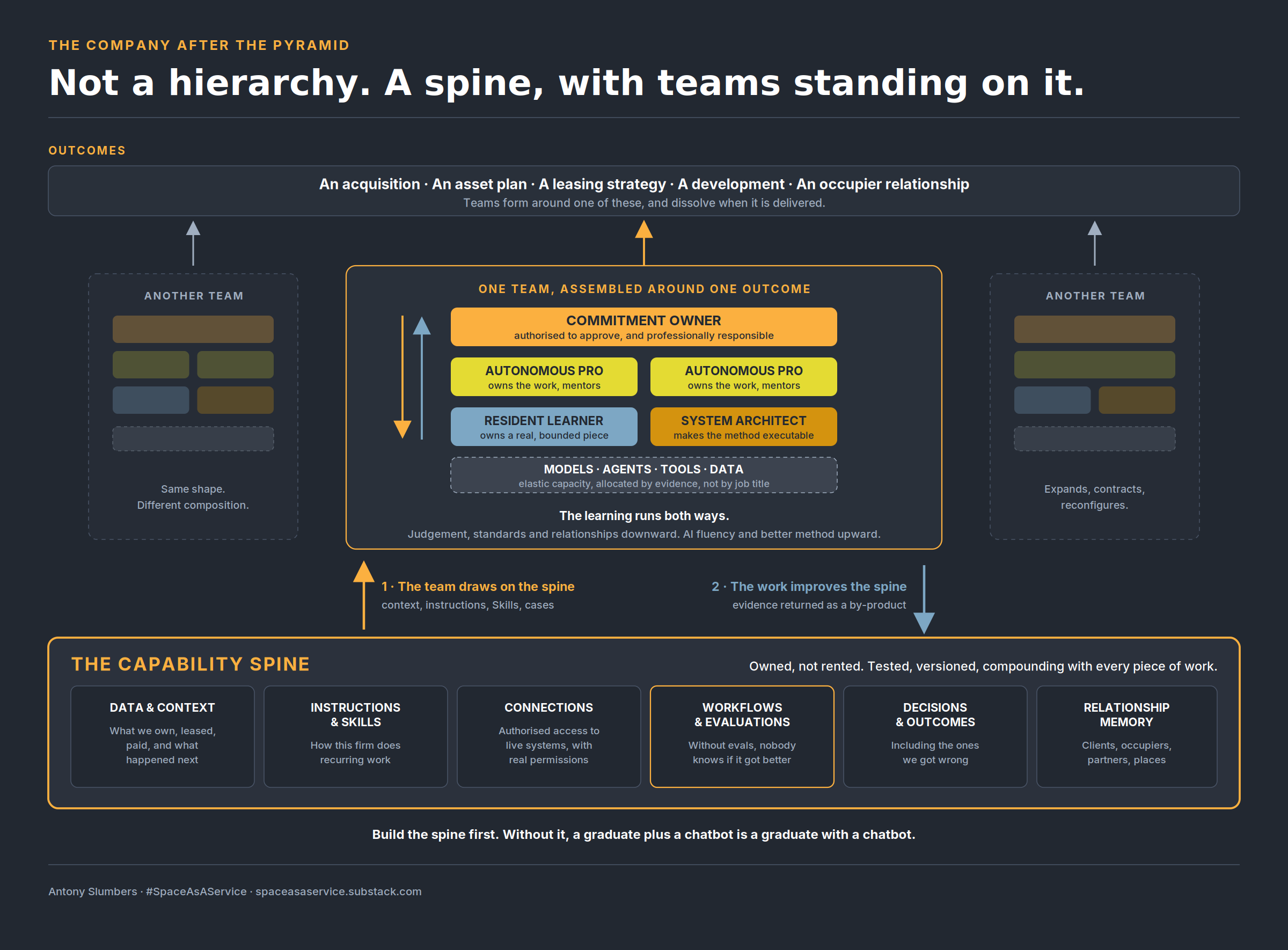
A professional firm made up solely of experienced people and AI is a cul-de-sac. Its successor is a network of small human+machine teams standing on a shared capability spine, in which the learning runs in both directions.
Last week I ended with a question: what does a commercial real estate company designed to learn this way actually look like? I first tried to answer this in December 2025, with a proposed ‘Human+Machine Organisational Architecture’. The structure of that framework still stands. Some of what I attached to it does not, particularly the numbers I put on productivity and on the compression of professional development, which were hypotheses dressed in more precision than the evidence supported. I withdraw those. Two other parts of the argument now need much more weight: the shared institutional intelligence a company builds for itself, and the route in for young people.
EXECUTIVE SUMMARY
The professional pyramid used junior production work to fund the development of future experts. AI is destroying the economics of that work, and some firms have responded by dispensing with juniors altogether. That works for a firm able to buy experienced people from elsewhere. It fails as the general model for a profession, and it may fail faster than its architects expect.
The company after the pyramid will be built on a capability spine foundation. The data, context, instructions, Skills, workflows, evaluations, decision cases and relationship memory that make a company more than the sum of the models it rents. As frontier models become commodities, every firm will have the same intelligence available and none of it will be an advantage. What a company puts around the model is the advantage. This is not an advanced move for the technically ambitious. It is the new baseline, in the way a computer on the desk stopped being a strategy around 1995. And if your method lives inside somebody else’s product, it is their asset, not yours.
The structure will be small teams standing on that spine. Accountable leaders, autonomous professionals, resident learners on a deliberate development path, and a crossover System Architect who turns how we work into something a machine can execute reliably. Five people commanding capabilities that used to need fifty.
The learning runs in both directions. The right graduate arrives fluent in tools most senior people use tentatively, so the junior is an input to the firm’s capability and not only a draw on it. Without a spine, a graduate plus a chatbot leaves nothing behind. With one, everything they improve lands somewhere permanent.
The bargain is two outputs. Every consequential piece of work delivers value for the client or asset today, AND leaves the company more capable tomorrow. A company exists to create value for customers and investors. Capability is a co-product of that, and we need both.
Start with the spine. Write down what you have, build one recurring workflow properly, and count how many of your core processes run on instructions you wrote yourselves. Everything else in this piece develops from that.
ONE ANSWER HAS ALREADY APPEARED
In May I wrote about Pierson Ferdinand, the fast-growing US law firm built around hundreds of partners, AI and no US associates.
It is a wonderfully clean answer to the broken pyramid. Keep the experienced people. Give them excellent AI. Remove the expensive junior tier. Recruit laterally whenever more capability is required. It launched in January 2024 with around 130 partners, is now past 280, and it is no longer a distant American curiosity: it operates in London as Pierson Ferdinand UK LLP, regulated by the SRA. It is also fully distributed with no offices, which produces a small irony for readers of this newsletter. The flagship AI-native professional firm makes a large part of its saving by not renting our product!
For Pierson Ferdinand, this may remain an excellent business. For the professions as a whole, it is a cul-de-sac. A firm can buy rather than build talent only while other firms continue to build it. Everybody is fishing the lateral market and nobody is stocking the lake. If law firms, investment managers, architects, surveyors and accountants all remove their entry-level roles, the lake empties, and in the meantime large numbers of capable young people lose their route into productive professional work.
Questions, of course, remain about the timescale. The lateral market will not run dry next year. A generation of experienced professionals already exists and international talent pools are deep, so a firm harvesting that supply could do well for a decade, longer than most planning horizons. If the case for building people rests only on the collective interest of the profession, a finance director will reasonably ignore it.
Longer than most planning horizons is the operative phrase. Very few C-suites are greatly exercised about what happens a decade out, because bonuses are paid on this year and the next, and the person who harvests now will have banked it before the bill lands. Shareholders might want to think hard about whether those incentives still make sense. Employees would do well to understand their bosses’ time horizons and plan accordingly.
But the decade is a guess, not a forecast. How confident are you in it, really? If this takes fifteen years, the harvesting firm is right, and its leaders will be out and cashed in long before anything hurts. If it takes three to five, which is not unthinkable based on the last three, then a firm that spent that time buying capability instead of building it might turn out to be roadkill. I do not know which it will be. Neither do you. What I do know is that only one of those two bets is recoverable if you get it wrong.
So hiring juniors has to pay at the level of the individual firm. It does, for reasons I underrated when I first sketched this architecture. First, though, let’s look at the thing the whole design stands on.
THE CAPABILITY SPINE IS THE COMPANY
Everything else in this piece rests on this.
As frontier models become commodities, and they are becoming commodities fast, no company’s advantage will come from having access to the best model. Everyone will have access to the best model. Advantage will come from everything a firm puts around it. That collection of things is what I am calling the capability spine, and it contains:
Trusted data and institutional context. What we own, what we leased, what we paid, what happened next. Everything related to whatever area of CRE you operate in. Cleaned, connected and available to a machine rather than sitting in fourteen systems and a filing cabinet.
Precise instructions and reusable Skills encoding how this firm does recurring work. Not a prompt somebody typed once. The written-down, tested, versioned method by which our company appraises a site, abstracts a lease, screens an acquisition or answers an occupier. Or whatever we do.
Authorised connections to live systems, with permissions reflecting who may do what.
Tested workflows, agents and evaluations. Above all evaluations. Capability is jagged and the boundary between human and machine work moves constantly, so a task a junior does today may go to an agent tomorrow and come back the month after. Evaluations are how a firm knows where that line currently sits, rather than guessing.
The history of decisions and outcomes, including the ones we got wrong, kept in a form a machine can learn from.
Relationship memory covering clients, occupiers, partners and places.
Generic prompts and public data are available to everyone. Context capturing how a particular company evaluates an asset, serves an occupier, prices risk and learns from the consequences is much harder to reproduce. This is why I think the spine is the foundational rock. Whatever strengths a company decides it needs over the next decade, in valuation, in operations, in development, in customer service, it will build them on this or it will not build them at all.
The spine also compounds, which almost nothing else in a professional firm does. A team draws on it to do the work. The work produces evidence that improves it. The next team starts from a better position. Ten years of that is a genuine moat, and one of the few a mid-sized CRE company can realistically dig. It is also, as a consequence rather than a purpose, the thing that makes hiring a junior worth doing again. I will come back to that.
None of this is a novel idea outside our industry. Anyone building seriously with AI has been calling some version of it context engineering for a couple of years now, and among people who do this for a living it is close to common knowledge. In commercial real estate it is not common knowledge at all. Which is precisely why there is still an advantage sitting in it, and why that advantage has a shelf life.
The obvious objection is that most CRE firms cannot do this. Many could not tell you what an evaluation is, have never written an instruction they would describe as tested, and would respond to the word Skills with a blank look. All true, and it changes nothing. No successful commercial real estate company of the next decade will be without a capability spine. This is not an advanced manoeuvre for the technically ambitious. It is the new baseline, in the way that a computer on the desk stopped being a strategy somewhere around 1995 and became the price of entry. You do not get to opt out of a baseline. You only get to be late to it.
There is a second reason to own this rather than rent it, and I made the argument at length in The Toll and the Amputation. The dangerous form of AI dependence is the supplier whose system quietly learns the judgement that distinguishes your firm, in a form you never possessed and cannot take with you. The spine is the positive version of that argument: the place where the judgement accrues to you instead. Every instruction you do not write is an instruction somebody else writes for you, and keeps.
There is a catch, and it falls unevenly across our industry. Much of the material that would make an adviser’s spine valuable belongs to somebody else. Engagement letters, data processing terms and professional obligations decide how much client and occupier data a firm may retain, and whether it may be used to serve the next client. Sort that out at the contract stage, not during a due diligence exercise on your own firm. It is also why this model is cleanest for principals: an owner building a spine from its own portfolio has no such conversation to have.
Treating any of this as IT infrastructure would be a profound mistake. Building, testing and pruning the spine needs to be core business activity, funded and governed like one, with someone senior accountable for it.
Building one out properly is a subject in itself, and there is a section at the end of this piece on where to begin. What concerns us here is what it does to the shape of the company standing on it.
SMALL TEAMS, VERY LARGE CAPABILITIES
The post-pyramid company will be a network of small teams organised around outcomes: an acquisition, an asset plan, a development, a leasing strategy, a building, a portfolio. A typical team might contain:
a Commitment Owner, authorised to approve consequential decisions and professionally responsible for them
one or more Autonomous Professionals, owning substantial parts of the work and mentoring others
a Resident Learner, contributing to the live outcome while progressing through a deliberate development programme
access to a System Architect, improving the workflows, context and AI capabilities the team uses
a changing collection of models, agents, tools and data supplying elastic analytical capacity
The team expands, contracts and reconfigures around the problem, then dissolves when the outcome is delivered. People still belong to a firm and a professional community, but much of working life happens in these teams. Without the spine underneath them, each one is a talented group renting intelligence from the same suppliers as everyone else. With it, five people command capabilities that used to need fifty.
The fourth item on that list deserves more than a line, because the System Architect is the only genuinely new role in the whole design. Half domain expert, half knowledge engineer, this is the person who turns how we do things into something a machine can execute reliably, then keeps testing whether it still works. It does not mean hiring a floor of technologists. Most firms need one strong crossover person to begin with, and a good number already have that person on the payroll without appreciating it. The analyst who automated the rent-roll reconciliation nobody asked them to automate. The building manager who is quietly better with a model than the head of technology. Go and find them, before somebody who understands what they are worth finds them first.
THE LEARNING RUNS BOTH WAYS
This is the part I would most like you to take away, and the part I missed entirely the first time I sketched this.
The pyramid taught in one direction. Knowledge flowed downhill from partner to associate to analyst, because the partner had seen more deals and the analyst had seen none. That gradient was the whole basis of apprenticeship, and it is why the seniors-plus-AI firm looks so rational: if juniors only ever receive, and the receiving is expensive, stop hiring them.
That gradient has partially reversed.
A capable graduate now arrives fluent in tools that most senior people in commercial real estate use tentatively, if at all. Fluent in the sense of knowing what a model is good and bad at, when to argue with it, how to structure a problem so it produces something worth having, and how to tell workslop from work. That fluency is scarce in exactly the population holding the decision rights.
So the Resident Learner is an input to the firm’s capability, not only a draw on it. They stress-test the workflows a System Architect builds. They find where the shared context is wrong. They show a twenty-five-year veteran a way of interrogating a lease portfolio the veteran would not have thought to ask for. In return they get what no model gives them: judgement, relationships, a sense of which questions matter, and a Commitment Owner who has been wrong enough times to know why the standards exist.
That is also the answer to an objection I would put to myself. Why hire a learner when the same money buys another agent pointed at the same neglected work? Because the agent does not improve the seniors around it, cannot be accountable to a customer, and does not appreciate in value. The learner does all three.
And none of it works without the spine. A graduate plus a chatbot is a graduate with a chatbot: quick, occasionally impressive, leaving nothing behind. A graduate plus a spine is someone whose every improvement lands somewhere permanent, gets executed by the next team, and raises the floor for everybody. The spine is not built for the juniors. It is built because an AI-fluent company cannot function without one. But it is what turns a junior from a cost you tolerate into an asset that compounds, and firms without one will keep concluding, quite logically, that juniors are not worth hiring.
But two important conditions apply.
The first is who you hire. What is worth paying for is a combination of four things:
- strong human skills
- real critical thinking
- problem-solving ability
- data fluency.
Or, at minimum, the demonstrated ability to acquire them quickly, since the frontier moves every few months and today’s fluency is next year’s baseline. Candidates now have a patient world-class tutor available at conversational cost, so the ones who have taught themselves are visible, and so are the ones who have not bothered. Design the interview to tell them apart. A degree classification will not.
The second is on us. A senior professional who will not learn anything from someone twenty-five years younger closes the loop before it starts. That is a cultural problem long before it is a technological one, and in our industry it is a substantial one.
One more group, and it is not the juniors who have it hardest. It is the middle. If your value has been production capacity plus a portion of judgement, both halves are under pressure at the same time, and no amount of seniority-in-waiting will protect either. I have said repeatedly that the middle of the road is the worst place to stand, and it is truer now than when I first wrote it. The way out is to go full stack: real CRE domain depth and real AI capability, in the same head. That combination is rare, entirely learnable, and where the leverage in this industry now sits.
THE RESIDENT LEARNER OWNS PART OF THE OUTCOME
Renaming the graduate analyst a ‘Resident Learner’ achieves precisely nothing if they spend their days checking AI output and watching senior people make decisions.
A Resident Learner must own a defined, commercially valuable part of the outcome.
In an investment business that might be a submarket thesis, a particular risk or a defined part of the asset plan; in an operating business, a group of occupiers or a small improvement budget. Bounded ownership means owning the analysis, the recommendation, the follow-through and the capture of what was learned. Consequential commitments still pass through a senior, but the learner’s work changes what the team does, and the boundary widens as evidence of capability grows.
On material judgements they must form a view before the model offers one, then use AI to attack it. Do that for every routine task and you have built theatre. Do it where framing and calibration matter and you are building a professional.
They must also be in front of clients early. Relationship skill may end up mattering more than Excel skill, and under the old model serious client exposure began somewhere around Associate Director. That was defensible when the scarce commodity was technical production. If the scarce commodity is becoming trust and judgement in the room, starting the clock a decade late is an expensive habit.
Much of the risk in this is handled by the shape of the team rather than by rules. In the pyramid, a junior’s work travelled up three levels to someone remote from it, and review was a gate at the end. Here the Commitment Owner sits inside the work and watches it form, so supervision is continuous, and the boundary widens on evidence seen first-hand by the person carrying the responsibility.
What the team cannot solve is credentials and contracts. Red Book valuations need a qualified valuer’s signature, regulated advice needs permissions, PI insurers have views about who does what, and engagement letters make representations about the seniority of the team. So draw the boundary in the language the risk register already uses: what a learner may own outright, what needs review before it leaves the building, what needs a named signature regardless of quality. Tell your insurer before you start, not after.
And one thing the old structure did well by accident, this one has to do on purpose. Formal review gates left a paper trail. Continuous supervision produces better work and, left alone, no record of when authority was exercised. The instrumented workflow that captures learning for the spine is also what records who approved what. Use it for both.
THE TWO-OUTPUT RULE
A company exists to create value for customers and investors. Capability development is not a rival objective, it is the co-product. Lose the commercial outcome and you have built an academy. Lose the capability outcome and you are consuming human capital without replenishing it.
The traditional firm asked every project for one output: the work the client commissioned. The learning company asks consequential work for two. The external outcome, and the capability-spine update: the evidence and learning returned to the shared context, instructions, Skills, workflows, evaluations and decision cases.
At which point a reasonable reader thinks: knowledge management. We tried that, and there is a shared drive full of lessons-learned documents nobody has opened since 2019. When I put an early version of this to my own virtual board it was attacked precisely there. The board was right about the old design and wrong about the new one, for two reasons.
The artefact has changed. A lessons-learned document has to be found, opened and read by someone who does not know it exists. An evaluation, a Skill, an updated context file or a revised workflow gets executed by the next team whether or not anyone reads it. The learning applies by default rather than on discovery.
And capture should be an architectural property of the system rather than a task appended to a project. If work happens inside instrumented workflows, the decision, the inputs, the model version, the alternatives considered and the expected outcome are recorded as a by-product of doing the work at all. AI systems are already moving this way: persistent memory that writes itself is becoming a feature rather than a discipline. What is left for a human is small, the annotation saying why and the judgement about what generalises. Ask people to write up their experience and you’ll be lucky to get much coherence. Ask them to add two lines to what the system already captured and you might get the truth.
And you have to pay for it. Teaching, challenging, externalising expertise and extending decision rights are part of a senior’s commercial contribution, so they belong in the compensation formula rather than an appraisal form. Incentives, not cost, are the binding constraint.
You get what you pay for.
WHY THIS PAYS
The old model generated margin by selling large quantities of relatively inexpensive human time, much of which funded learning indirectly, although clients were rarely told this was part of the bargain. AI weakens that model and creates the means to build another. The return has four sources, and they are the reason to design the company this way rather than simply shrink it.
Greater coverage. CRE leaves enormous amounts of valuable work undone because the economics never supported it. Smaller assets get superficial attention. Occupiers are contacted at the lease event and rarely in between. Alternative plans go unexplored because exploring them costs a fortnight nobody has. A learner with the tools and the spine behind them makes a meaningful slice of that affordable, and unlike an agent, can be accountable to a customer at the end of it.
Better service. More responsiveness, explanation, scenario work and human contact, without returning to the old cost base. Attentive human service commands a premium where the outcome is consequential or emotionally charged, which in real estate it usually is.
New products. Portfolio intelligence an investment manager could not previously staff. Bespoke work for clients always too small to support it. More combinations of use, design, phasing and commercial model tested before capital is committed, which is where development value is won or lost.
Compounding capability, both ways. The learner improves the workflows now, raises the AI fluency of the people around them, and later becomes an autonomous professional carrying firm-specific knowledge the lateral market cannot supply.
I am not going to attach numbers to any of that. This is emergent organisational work, not a solved problem with a spreadsheet at the end, and an invented figure would be worse than saying nothing.
The economics will vary. A balance-sheet investor captures the benefit directly and has no client-data problem, which is why I expect this among owners before advisers. An adviser may need to move from selling hours towards pricing outcomes or continuing service. Smaller firms can share infrastructure, mentors and case libraries through guilds or consortia. There will be no single model. There does need to be a profitable one.
Regular readers know where this goes. The choice is how much of the capacity AI releases we harvest as margin and how much we reinvest in growth. More output alone gets us nowhere: ten times as many scenarios that nobody uses is ‘Workslop’ at industrial scale. New capacity creates value when it reaches a decision, a service, a relationship or a place. That is how you build a bigger pie.
WHERE TO START, AND IN WHAT ORDER
The order matters. Do it backwards and you’ll conclude it doesn’t work.
One. Fix the incentives first. If senior reward recognises only personal revenue, everything below will wither in the first busy week. Add capability contribution to the next compensation review as a named line, not a comment in an appraisal.
Two. Start the spine. Write down which of the six components listed above you actually have, in what state, and who owns each. Then pick one recurring piece of work small enough that one person does it in a morning, and map it out properly: what it needs to know, how this firm does it, what good and bad output look like, where the live data comes from, and how anyone can tell it worked. That assembly is what the tools call context, Skills and evaluations, and it is the smallest complete unit of a capability spine. Do one. It will take longer than you expect but will be very instructive.
Then a question rather than a count. Take your five most important recurring pieces of work and ask, for each, where the method for getting it done actually lives: in somebody’s head, inside a vendor’s product, or written down and owned by you. Most firms will find that third column empty. Which gives us a starting position.
Three. Name a System Architect. One person, from inside, with the time genuinely protected rather than notionally allocated.
Four. Only then, give a learner something real to own. Bounded, commercially valuable, with the boundary drawn in the language your risk register already uses. Do this before the first three and you get a graduate with a chatbot, which is precisely the failure this piece is about.
Five. Promote on decision rights, not years. Progress should be visible in expanding authority, and movement should depend on evidence: the quality of someone’s decisions and challenge, how they respond when wrong, the people they teach, the systems they leave better. Resolved decisions become the training cases, so a learner works with the information available at the time, defends a recommendation, then finds out what actually happened. Young people finally get to see what capability looks like and what they must demonstrate to earn more of it.
AND WHAT YOU STOP DOING
Every transformation that works is as much cessation as addition, and I have just added a great deal to the job of a senior professional. Some things have to come off the other side.
Stop reviewing what the system should be checking. If a senior’s week is spent finding errors in first drafts, that is an evaluation you have not written yet. Reviewing for judgement is the job. Reviewing for arithmetic is a workflow defect.
Stop buying tools that keep your method inside them. Every procurement decision from here is also a decision about who owns the resulting intelligence. Ask the question in the room, before signing.
Stop the graduate milk round you designed in 2015. It selects for the wrong things and it will keep doing so, efficiently, for as long as you leave it running.
Stop calling capability spending an overhead. It belongs in the operating model and the investment budget alongside technology. Left in HR, it is first against the wall the moment margins tighten.
None of that is free. Each one is somebody’s habit, somebody’s budget line, or somebody’s sense of what their job is. That is the actual work.
THE COMPANY AFTER THE PYRAMID
So what does a commercial real estate company designed to learn this way actually look like? Four things are different from a CRE company of today.
Its intelligence is owned, not rented. Today the method sits in people’s heads and inside suppliers’ products. In the new firm it is written down, tested, versioned, and it compounds. That is the capability spine, and it is the foundation everything else stands on.
Its shape is teams, not grades. Today position is a rank you hold. In the new firm it is a role you take for the duration of an outcome, in a small group that assembles, delivers and dissolves.
Its learning is a property of the system, not an accident of who you sat next to. Today what a firm knows walks out of the door at six o’clock, and again permanently at retirement. In the new firm every consequential piece of work leaves the place more capable, because the capture is built into how the work is done rather than bolted on afterwards.
Its juniors are productive in months and useful upwards from the first week. Today they are inexpensive production capacity who become valuable in a decade. In the new firm they own real work early, and they arrive with fluency the people above them do not yet have.
None of this is free. It asks senior people to teach, expose assumptions, share relationships, externalise expertise and let their own judgement be examined, including by someone with two years’ experience and better instincts about the tools. The easier option is seniors plus AI, buying in capability that other firms paid to create. Let us call that what it is: consuming a profession’s training capacity while contributing nothing to it, and describing the result as an AI strategy. It works until it doesn’t, and it stops replenishing the company long before anybody notices.
I should say what would prove me wrong. By 2031, firms that have built this properly should be visibly different on three measures:
- the proportion of client-facing decisions owned by people with under three years’ experience
- the share of revenue from work that could not have been sold profitably in 2025
- the number of core processes running on instructions the firm wrote itself rather than bought.
If those are flat across the industry in five years, the seniors-plus-AI firm won the argument and I was wrong.
If you do nothing else after reading this, start the spine. It is the one decision that makes every later decision easier, and the one asset in a professional firm that compounds.
Almost none of this is how CRE firms are built today, and for the most part not because anyone decided against it. It has simply not been on the table. It is now. And it happens by design, or it does not happen.
——————————————————————————————————————
This is part three in a series.
1. The PropTech Paradox - AI is opening a much larger market, and making the resulting value harder to capture.
Human Judgement has a Timestamp - Commercial real estate’s answer to AI is judgement and relationships. Fine. But which judgement, doing what, verified how, and as of when?
Human Judgement Has A Timestamp
Commercial real estate's answer to AI is judgement and relationships. Fine. But which judgement, doing what, verified how, and as of when?

I began with an idea for this newsletter. Working with AI, I then spent much of two days exploring two apparently more promising versions. Both turned into rabbit holes. In the end I had returned remarkably close to where I began.
Almost.
The original intuition had survived, but now I understood why. We had generated alternatives, tested different arguments, exposed weaknesses and discarded two plausible directions. The work was an extended exchange through which I discovered what the newsletter was really about.
Which, as it happens, is the subject of this newsletter.
EXECUTIVE SUMMARY
AI capabilities are jagged: a model can be exceptional at one apparently difficult task and hopeless at another that looks easy. This makes a fixed division of cognitive labour between people and machines unreliable. The effective boundary is set by the whole apparatus we build: model, harness, data, human and task. Human + AI work is a continuing process of discovering that boundary, allocating work, checking the results and changing the allocation as capabilities improve. For commercial real estate, this turns ‘human judgement’ from a permanent moat into a current operating decision. The more durable advantage belongs to organisations that can turn experience into evidence and evidence into faster learning.
TWO RABBIT HOLES
The first rabbit hole began with an excellent essay by Sangeet Paul Choudary on scarcity and strategy. If AI makes exploration dramatically cheaper, where does value move: to selecting from more possibilities, testing them against reality or framing the right question in the first place?
I thought this was the newsletter.
Several hours later it looked like a restatement of Choudary’s argument, combined with things I have written about before; constraints, moats and RIRA. Interesting. Just not interesting enough.
Rabbit hole number two was CRE’s belief in the invulnerability of human judgement. Pull the word ‘judgement’ apart and much of it turns out to be pattern recognition, evidence synthesis, prediction and accumulated exposure. All areas in which AI is advancing rapidly.
This was much better, though it still treated the boundary as a transfer of territory: AI advances, human judgement retreats.
For years I have argued that the future is less Centaur and more Cyborg: humans and machines intertwined across workflows, each changing what the other can do. The sharper question became: how much of what we assign to the human is permanently human? And how much is waiting for better models, data, tools or ways of checking the answer?
That brought me back to where I had begun: the moving boundary between us and our machines.
But with considerably more baggage.
THE JAGGED FRONTIER
AI would be much easier to understand if its capabilities advanced in a smooth line. First it masters easy tasks, then moderately difficult ones, before eventually reaching the genuinely hard stuff.
Instead the frontier is distinctly jagged.
In 2025, an advanced version of Google’s Gemini Deep Think model produced natural-language solutions to five of the six problems in the International Mathematical Olympiad within the competition time limit. The answers were officially graded at gold-medal standard.
That is an extraordinary level of mathematical reasoning.
Yet models capable of such feats can still misunderstand a straightforward instruction, miss an obvious fact in a document or confidently answer the wrong question. For a while, the internet’s favourite example was the inability of language models to count the number of r’s in ‘strawberry’. That particular example will date. The underlying absurdity persists.
The best explanation remains the ‘jagged technological frontier’, developed in research by Harvard Business School, Wharton, MIT and Boston Consulting Group. In an experiment involving 758 BCG consultants, access to GPT-4 made people faster and substantially improved the quality of their work on tasks that fell within the model’s frontier.
On a different type but equally realistic task, the results reversed. The model processed the obvious numerical evidence but missed a crucial clue in the interview material. Consultants using AI tended to trust its polished analysis and followed it towards the wrong answer. Those working without AI performed better. The research has now been published in Organization Science, and the HBS account of the findings remains one of the best introductions to AI at work.
Tasks that look equally difficult to us can sit on opposite sides of the frontier.
Worse, the frontier moves. A new model, a tool connection, access to proprietary data, a better workflow or simply a better brief can turn yesterday’s failure into today’s routine capability.
No wonder people are confused.
EXHILARATING. EXASPERATING.
The jagged frontier helps explain why people react so differently to AI.
For some, working with it is exhilarating. You can explore ideas, test alternatives, acquire capabilities you never possessed and wander productively into areas that would previously have been inaccessible. Every conversation can produce a surprise. Occasionally a very good one.
For others, exactly the same characteristics are exasperating. They ask the same question twice and receive different answers. The model is brilliant one moment and obtuse the next. It sounds equally confident whether it has understood the problem, misunderstood it or made something up.
We have spent decades learning that software should be predictable. Press this button and that happens. If it does something else, there is a bug.
AI breaks that mental model.
Our businesses already operate amid incomplete information, ambiguous signals and unknowable futures. Now we are introducing powerful tools whose own capabilities are uncertain. Before deciding whether to trust the answer, you must decide whether the AI is competent to answer that particular question.
You have to judge the judge.
Which is why working effectively with AI is becoming a genuine management skill. You need to brief it, provide context, set standards, challenge its reasoning, verify important outputs and learn where it performs well. Then a new model arrives and part of that knowledge needs recalibrating.
Some people enjoy this open-ended process. Others want the machine to work reliably and get out of their way. Both responses are perfectly understandable.
That uncertainty makes engagement essential.
We are all feeling for the stones.
CROSSING THE RIVER
‘Crossing the river by feeling the stones’ became the shorthand for China’s gradual and experimental approach to economic reform under Deng Xiaoping. You take a step, test your footing, learn from the result and then reach for the next stone.
It is a good description of working with AI.
There is no durable map showing which tasks a model can perform reliably, where it improves a competent professional, where the professional degrades a better machine answer, or where the combination produces something neither could achieve alone.
And your frontier will differ from mine. It depends on the model, the workflow, the quality of the data, the expertise of the person, the consequences of error and the method used to verify the result.
AI literacy increasingly consists of finding this out safely.
This requires calibrated delegation: knowing what to delegate, how much autonomy to allow, what good looks like, how the work will be checked and when it should return to a human.
Conventional software is configured. AI increasingly has to be briefed, supervised and reviewed. The operating skill resembles management more than traditional software use.
This goes far beyond ‘prompt engineering’. A good manager understands the capabilities of the person, provides the context needed to perform, sets boundaries, reviews what matters and adjusts as experience accumulates.
AI requires much the same discipline.
Except your new colleague may change significantly between Friday and Monday.
THE CYBORG’S MOVING BOUNDARY
The original jagged-frontier research identified two broad patterns of human + AI working.
The Centaurs divided the work. The human performed some parts and handed other parts to the machine. The Cyborgs moved backwards and forwards continuously, integrating AI into the way they thought and produced the answer.
My belief for some time has been that the future is predominantly Cyborg. As AI becomes woven into our research, analysis, communication and decision-making, it will become increasingly difficult to say where the human contribution ended and the machine contribution began.
But human + AI comes with no guarantee.
A 2024 meta-analysis in Nature Human Behaviour examined 106 experiments that compared humans, AI and human-AI combinations. On average, human + AI performed better than humans alone. Against the stronger of the human or AI working alone, however, the average combination underperformed.
On average matters.
But the date matters too.
The paper appeared in 2024, but the experiments it synthesised were published between January 2020 and June 2023. Its ‘decision’ category largely involved people choosing among predefined options. That is some distance from the open-ended, multi-stage judgement that CRE claims as its special preserve.
It also predates the modern reasoning-model era. OpenAI released o1 in September 2024, trained to spend more time and computing power working through a problem before answering. Later models were trained to decide when and how to search, run code, inspect files and combine tools.
The technical frontier has moved faster than the human-performance evidence. Whether these systems produce better collaboration remains an empirical question.
Harnesses move it again.
A harness is the surrounding system that turns a general model into something capable of performing a particular workflow: instructions, proprietary context, retrieval, tools, memory, task decomposition, checking loops, permissions and human approval points. As Anthropic puts it, when we evaluate an agent, we are evaluating the model and its harness together.
Give the same model the leases, comparable evidence, a cash-flow engine, a second pass that challenges its assumptions and a rule requiring human approval before release, and you have created a materially different system.
The relevant unit is the model + harness + data + human + task.
The meta-analysis is most useful for the variation it exposes. Human + AI sometimes produced genuine gains and sometimes made the result worse. When the human alone was stronger, the combination was more likely to help; when the AI was stronger, human intervention frequently damaged the answer. Stronger reasoning models could therefore make uncalibrated human involvement more dangerous.
The finding that creation tasks were more promising than decision tasks belongs to the systems tested at the time. The requirement to keep feeling for the stones persists.
And the academic benchmark of ‘use whichever is best’ can be rather moot in practice. Few companies have access to the best human in the world, and fewer can afford them. The economically relevant comparison is often your available people working with your available AI against the people and processes you have today.
More recent research complicates matters further. In The Cybernetic Teammate, a field experiment with 791 Procter & Gamble professionals, individuals using AI matched the performance of conventional two-person teams while working faster. AI also helped technical and commercial specialists produce more balanced answers, crossing professional boundaries that had previously required collaboration. The average-quality difference between AI-enabled teams and teams without AI was not statistically significant. What did move was the upper tail: AI-enabled teams were roughly three times as likely as the solo control to produce a top-decile solution.
This is powerful evidence for human + AI working. It is also evidence that AI can reproduce some of the benefits we previously attributed to human teamwork.
The combination that wins today is unlikely to stay fixed.
HUMAN JUDGEMENT HAS A TIMESTAMP
Commercial real estate has a ready answer to all of this: our moat is human judgement and relationships.
Perhaps. But ‘judgement’ is currently doing far too much work.
CRE bundles a great many different cognitive moves into that one flattering word:
remembering similar transactions;
selecting and adjusting comparables;
recognising patterns;
applying rules of thumb;
reconciling conflicting evidence;
predicting how a market or counterparty will behave;
generating alternatives;
assessing risk;
choosing objectives;
negotiating agreement;
taking responsibility for a decision.
These are several capabilities, and each will cross the human-AI boundary at a different time.
A more useful decomposition is:
Layer / The question being answered / Likely direction
Repeated inference / What is likely to happen? What does the evidence suggest / Increasingly AI-absorbed
Framing / What problem are we solving? Which variables and discontinuities matter / Human + AI, with a moving boundary
Preference / What should we optimise? Whose interests count? Which trade-offs are acceptable? / Institutionally human, heavily AI-mediated
Commitment / Will we allocate capital, sign the opinion and accept the consequences / Durably human because authority must sit somewhere
Some of this judgement will migrate into the model. Much of it may migrate into the harness around it. A valuer’s comparability rules, an investment committee’s mandate, downside thresholds and approval rights can become retrieval rules, tests, permissions and escalation gates.
Human contribution then moves upstream: designing and governing the decision system, deciding where autonomy ends and accepting responsibility for the commitments it makes.
The sharpest distinction is between prediction, preference and commitment. Framing shapes all three.
AI can increasingly tell us what is likely to happen, generate alternatives, test assumptions and identify evidence that contradicts a recommendation. Someone still has to determine what the organisation wants, which trade-offs it accepts and whether it is prepared to bear the consequences.
Even here, continued human involvement says little about human intellectual superiority. Institutions require named people to authorise acquisitions, sign valuations, approve safety decisions and carry fiduciary responsibility. That is a choice about where society wants authority and liability to sit.
The human may remain because someone has to hold the pen.
THE UNAUDITED ADVANTAGE
CRE’s diffuse feedback loops may have protected mediocre judgement from scrutiny.
A property is bought. Its performance takes years to emerge. The market moves, the business plan changes, the asset manager leaves and the economic cycle overwhelms the original assumptions. Success is attributed to judgement. Failure is blamed on the market.
Often nobody can demonstrate whether the original judgement was well calibrated.
‘Human judgement’ can therefore describe a decision process whose quality has never been measured because the feedback is slow and hopelessly confounded. That is an unaudited incumbent advantage. Before calling it a moat, we should audit it.
Consider three areas.
Valuation
Comparable selection, adjustment analysis, lease-event modelling, scenario weighting and consistency checking are all exposed. The valuer’s role may concentrate around choosing the appropriate basis, recognising genuine structural discontinuities, communicating uncertainty and taking professional responsibility for the opinion.
For how long each of those remains primarily human is an empirical question.
Investment committees
Much of an investment committee’s supposed secret sauce consists of interrogating assumptions, finding inconsistencies, comparing an opportunity with previous cases, constructing downside scenarios, testing the recommendation against the mandate and identifying missing diligence.
AI can already participate in each of these, although reliability varies by task and setup. The committee’s role may become narrower and more consequential: determining the institution’s appetite for an irreversible exposure and legitimising the commitment.
Leasing and relationships
Remembering histories, assessing negotiation positions, anticipating objections, preparing communications and selecting incentives all look increasingly addressable by AI.
The word ‘relationship’ needs decomposing as well:
Discovery: knowing who owns something and who makes the decision.
Privileged access and context: hearing early, being taken seriously and receiving candid information about the history, personalities, intentions and unwritten context.
Credible commitment: being trusted to honour promises, exercise discretion fairly, resolve problems and remain accountable over time.
AI and platforms attack discovery aggressively and make relationship intelligence easier to preserve and share. But knowing who matters is different from being someone they trust, call early or speak candidly to. AI can improve how you use that access through better preparation and organisational memory; it cannot manufacture another person’s willingness to disclose, reciprocate or rely on you.
Credible commitment looks more durable. Buildings, leases and developments require prolonged cooperation because no contract can specify every future contingency. In most current arrangements, people still need to trust that someone will behave reasonably when things go wrong.
Some trust may also migrate from ‘I know this person’ towards ‘I trust this system’s evidence, controls and audit trail’. The part of relationship capital sustained by market opacity is exposed. Permission, reciprocity and earned confidence are different.
My belief that #HumanIsTheNewLuxury survives this argument. Luxury value has always been separable from technical performance. A mechanical watch keeps worse time than a cheap quartz one; its value lies elsewhere. Human attention, empathy, recognition and meaning can become more valuable even as machines outperform us cognitively.
Human value and human cognitive superiority are different propositions.
RIRA HAS A TIMESTAMP
This matters directly for my RIRA framework and the CRE Automation Matrix.
Quadrant D, hard-to-verify cognition, is currently human-led with AI acting as challenger. But it must never become a protected human reservation.
Hard to verify today does not mean uniquely human forever.
Tasks can migrate as organisations improve their data, record outcomes, build simulations and shorten feedback loops. Models may also improve at judgement without the underlying task ever becoming objectively verifiable, simply by learning across more imperfect cases than any individual could encounter.
Every classification in the Automation Matrix therefore needs a date at the top.
It also needs to record the system being tested: model, harness, data, human and task. Change any one of them and the classification may change with it.
And the RIRA false-negative challenge should become tougher. For every task claimed to require human judgement, ask:
What precisely is the human contributing?
What evidence shows that humans perform it consistently well?
Which future capability, data source or verification method would change the classification?
‘I know it when I see it’ should not pass.
RIRA itself is a way of feeling for the stones. Release the inherited constraints. Imagine what becomes possible. Redesign the work around the best available combination of human and machine. Actualise it, observe what happens and feed the result into the next redesign.
The map is provisional. The learning is cumulative.
THE LEARNING ARCHITECTURE
Choudary’s three possible destinations for value are judgement, experimentation and framing. His resolution is that none provides an enduring advantage on its own. The scarce capability is the architecture connecting them.
An AI-native organisation needs to:
frame the right search space;
generate many possibilities within it;
eliminate weak options cheaply;
test promising ones against reality;
identify where irreversible commitment is justified;
record the result and improve the next round of search.
For CRE, this means capturing why decisions were made, connecting them to eventual outcomes, measuring calibration, preserving organisational memory and continually reallocating work as the frontier moves.
The harness is where this learning architecture becomes operational. Evidence becomes retrieval, accumulated experience becomes context, outcomes become evaluations, and the organisation’s thresholds and approval rights become checks within the workflow. Each round can improve the next one.
My hypothesis is that the more defensible advantage lies in the organisation’s ability to turn experience into evidence, evidence into better decisions and decisions into faster learning, while retaining legitimacy when real people and irreversible capital are affected.
That is a much more demanding proposition than ‘our people have judgement’.
It is also much more defensible.
BACK WHERE I STARTED
Which brings me back to this newsletter.
It started in one place, explored two alternatives and returned close to its origin. The process produced more than words: it turned an intuition into a position I can defend.
That is Cyborg work.
No one can give you a permanent map of the human-AI frontier. But you can build the skills and the organisation required to keep finding it.
We are all feeling for the stones.
The difference will be how quickly we learn from each step.
And that leads to next week’s question: what does a commercial real estate company designed to learn this way actually look like?
This is part four in a series.
The PropTech Paradox: AI is opening a much larger market, and making the resulting value harder to capture.
Human Judgement has a Timestamp: which judgement, doing what, verified how, and as of when?
The Company After the Pyramid: what a future CRE company needs to look like.
The Capability Spine: How to Build One: How CRE firms can build a capability spine, one workflow at a time